Today in this article we will discuss about Why You Type Well in Practice but Fail in Exam? or Why You Type Well in Practice but Fail the Actual Government Typing Test and How to Fix It? this article identifies exactly why your exam performance drops below your practice performance and gives you a complete pre-exam preparation protocol designed to close that gap, so your exam WPM matches – or even exceeds – your practice WPM.
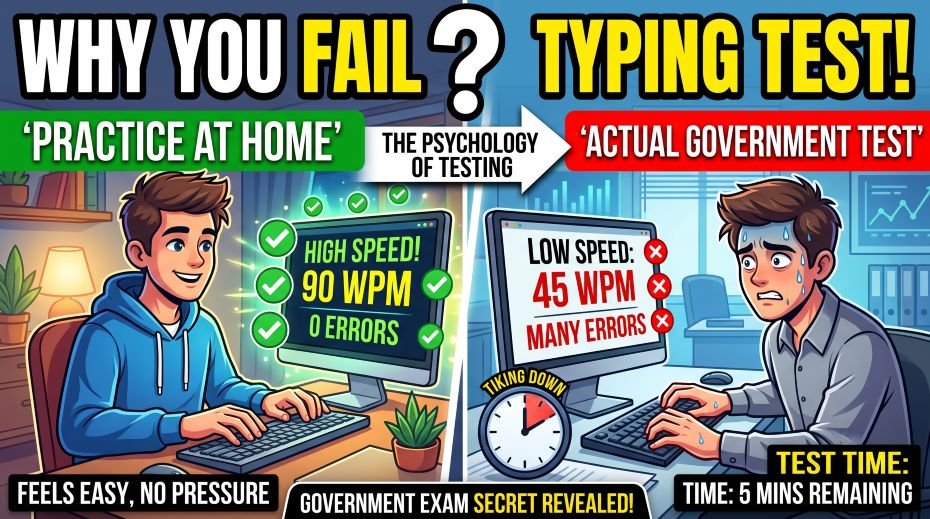
This is one of the most painful experiences in government exam preparation: you have been practicing for weeks. At home, on your own keyboard, in your own room, you consistently hit 38-42 WPM. You feel ready. Then you sit at the NIELIT or SSC exam center, the timer starts, and somehow you only manage 26-28 WPM. You failed a test your practice scores said you should pass.
This gap between practice performance and exam performance is extremely common and has specific, identifiable causes – most of them related to performance anxiety and the difference between practiced conditions and real exam conditions. The good news is that every cause of this gap can be addressed through specific preparation strategies that simulate exam conditions before the actual day.
Quick Facts: The Practice-to-Exam Performance Gap
| Question | Answer |
| Is a practice-to-exam speed drop normal? | Yes – most candidates experience some drop. The question is how large and whether it crosses the failing threshold. |
| Typical speed drop under exam pressure | 5–15% reduction is common; unprepared candidates can drop 20–30% |
| Main causes of the gap | Anxiety, unfamiliar keyboard/environment, unfamiliar passage style, one-shot pressure, distraction |
| Safe practice buffer recommended | Practice to at least 15–20% above the qualifying WPM standard |
| Can the gap be eliminated? | Largely yes – through deliberate exam-condition simulation in the weeks before the test |
If your practice WPM is only 2-3 WPM above the qualifying standard, even a normal anxiety-related drop can cause failure. The fixes below aim to both reduce the drop AND build a larger safety buffer.
Why Exam Performance Drops Below Practice Performance: 6 Real Causes
Cause 1: Genuine Exam Anxiety and Physiological Stress Response
Under real exam pressure, your body activates a stress response – increased heart rate, muscle tension, shallower breathing. This is the same physiological system involved in any high-stakes performance situation. Increased muscle tension specifically reduces fine motor precision in fingers, directly degrading typing speed and accuracy.
- Why this happens: Your brain correctly perceives a government typing test as high-stakes – a single failure can mean disqualification from months of preparation.
- The fix: Simulate real stakes in practice through competitive races (TypeRacer), public testing (have someone watch), and treating practice mock tests as if they were the real exam, with consequences you create for yourself.
Cause 2: Unfamiliar Keyboard and Physical Environment
If you practice exclusively on your own laptop keyboard at home, and the exam center uses a different desktop keyboard with different key spacing, tactile feedback, and travel distance – your finely-tuned muscle memory experiences a small but real disruption.
- The fix: In the final 2-3 weeks before your exam, practice on a standard external desktop keyboard rather than your laptop’s built-in keyboard. Visit a cyber cafe or borrow a friend’s desktop setup if needed.
- Additional tip: If possible, visit your specific exam center type (NIELIT etc.) before exam day, or ask others who have tested there about the keyboard brand/model used.
Cause 3: Unfamiliar Passage Style and Vocabulary
If your daily practice has been on casual text, literary quotes, or repeated passages – but the government exam uses formal administrative language with specific vocabulary patterns – your fingers encounter words and phrase structures they have not specifically automated.
- The fix: In the final month before your exam, shift 70% or more of your practice to government-style formal passages – administrative orders, scheme descriptions, official correspondence language.
- Where to find such passages: Use TypingMasterPro.com’s government-exam-style passage bank, or find PDFs of previous exam papers and notification text to practice typing.
Cause 4: One-Shot Pressure (No Retry Available)
In daily practice, if you make an error or have a bad run, you simply try again immediately – there is always a next attempt. In the actual exam, you typically get exactly one attempt. This ‘no second chance’ framing creates a fundamentally different psychological experience that most practice never replicates.
- The fix: In your final 2 weeks, run ‘one-shot’ mock tests – commit beforehand that you will only attempt the test once that session, record the result no matter what, and reflect on it as if it were final. Repeat this discipline 3-4 times per week.
Cause 5: Unfamiliar Software Interface and Test Format
Government typing tests use specific software interfaces (often NIELIT’s testing software or similar) that differ from Monkeytype, TypeRacer, or other practice tools. Small differences – how errors are displayed, whether backspace works differently, how the timer is shown – can disrupt rhythm in a high-stakes moment.
- The fix: If your exam notification or coaching center provides demo software or describes the interface, practice with something similar. At minimum, practice with a tool that has a visible countdown timer and similar error-highlighting behavior to reduce surprise.
Cause 6: Insufficient Speed Buffer Above the Qualifying Standard
This is the most important and most overlooked cause. If your practice WPM is only marginally above the qualifying standard (e.g., practicing at 37 WPM for a 35 WPM requirement), even a small, completely normal anxiety-related drop of 10% takes you below the passing threshold. Candidates who build a much larger buffer rarely fail even with significant performance drops.
| Practice WPM | Qualifying Standard | 10% Exam Drop | Result |
| 37 WPM | 35 WPM | ~33 WPM | FAIL – insufficient buffer |
| 40 WPM | 35 WPM | ~36 WPM | PASS – buffer absorbed the drop |
| 45 WPM | 35 WPM | ~40.5 WPM | PASS comfortably – large safety margin |
Target practicing at minimum 5-8 WPM above your qualifying standard, ideally 10+ WPM above, before considering yourself exam-ready. This buffer is your single most reliable protection against the practice-to-exam gap.
The Exam-Condition Simulation Protocol: 3 Weeks Before Your Exam
| Timeframe | Focus | Specific Actions |
| 3 weeks out | Build buffer + switch to formal passages | Shift practice to government-style passages exclusively. Push speed to 8-10 WPM above qualifying standard. |
| 2 weeks out | Equipment + one-shot discipline | Switch to desktop keyboard if normally using laptop. Begin one-shot mock tests 3-4 times weekly – no retries, record result. |
| 1 week out | Full simulation + stress inoculation | Have someone watch you test. Set a loud timer. Test at the same time of day your exam is scheduled. Visualize the exam center. |
| Exam eve | Light practice + rest | One short, calm confidence-building session (15 min, comfortable speed). Sleep 7-8 hours. No new techniques. |
| Exam morning | Arrival + composure | Arrive 30+ minutes early. Light hand stretches. Breathe slowly. Trust your buffer-built preparation. |
This protocol specifically targets each of the 6 causes identified above – equipment familiarity, passage style, one-shot pressure, and buffer building – in a structured timeline.
Breathing and Composure Technique for Exam Day
- Before the test starts: Take 3 slow breaths – inhale 4 seconds, hold 2 seconds, exhale 6 seconds. This activates the parasympathetic nervous system, reducing the physical stress response.
- If you make an error during the test: Do not let one mistake spiral. Correct it calmly if needed and continue – panicking after an error causes 3-5 additional errors in the following words.
- If you feel your speed dropping mid-test: Consciously relax your shoulders and hands for 2 seconds, then resume. Tension in shoulders directly transfers to reduced finger dexterity.
- Mental anchor phrase: Prepare a short calming phrase beforehand (‘I have practiced this many times, I am ready’) to use if anxiety spikes during the test.
ALSO READ: Why Is Your Typing Speed Not Improving?
FAQ:
How much speed drop under exam pressure is considered normal?
A drop of 5-10% from your practice average is common and expected even for well-prepared candidates. A drop of 15-20% suggests significant anxiety or unfamiliarity with exam conditions that the simulation protocol in this article specifically addresses. If you build a 10+ WPM buffer above the qualifying standard, even a 15-20% drop should still leave you passing comfortably.
Should I practice on the exact same keyboard model used at my exam center?
If you can determine the exact keyboard model (sometimes coaching centers or previous candidates share this information), practicing on an identical or very similar model in your final weeks is ideal. If this is not possible, the more important principle is practicing on a standard external desktop keyboard rather than a laptop keyboard, since most exam centers use desktop setups with full-size keyboards.
Is it better to slow down during the actual exam if I feel nervous?
Yes – if you notice your hands tensing or errors increasing due to nerves, deliberately reducing your speed by 10-15% while maintaining accuracy is usually the better strategy than pushing through at full speed with increasing errors. A controlled, slightly slower pace that stays above your qualifying threshold with high accuracy outperforms a fast, error-ridden attempt that fails on net WPM.
Conclusion: Close the Gap Before Exam Day, Not During It
The gap between your practice WPM and your exam WPM is real, well-understood, and – most importantly – addressable through deliberate preparation rather than hope. The candidates who walk into their exam center and perform at or near their practice level are not the ones who got lucky with their nerves. They are the ones who specifically trained for exam conditions in their final weeks, not just for typing speed in general.
Build your buffer 8-10 WPM above the qualifying standard. Practice on government-style passages. Switch to a desktop keyboard. Run one-shot mock tests. Simulate the pressure deliberately so the real pressure feels familiar rather than foreign. The gap between your best practice score and your exam score can shrink to almost nothing – but only if you treat exam-condition preparation as seriously as you treat speed-building.
Start your exam-condition simulation today at TypingMasterPro.com using the government-style passage mode and timed mock tests.