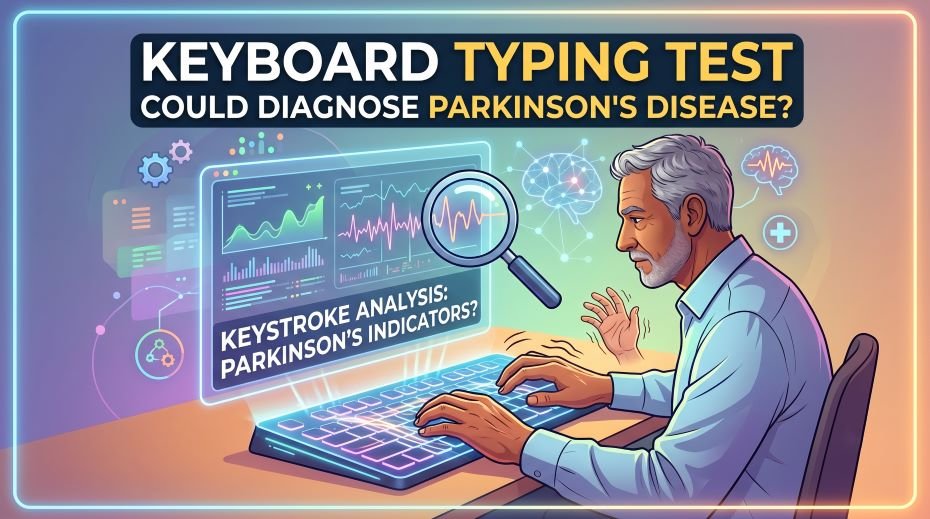
In this article we will discuss about a topic Keyboard Typing Test Could Help Diagnose Parkinson’s Disease Early so, In October 2025, Drug Discovery News reported a breakthrough with wide-ranging implications: a new diagnostic keyboard typing test could help identify Parkinson’s disease in its earliest stages – before severe motor symptoms become visible. The research, led by a team seeking a simple, accessible, non-invasive screening tool, found that the way a person types on a standard keyboard reveals measurable neurological signals associated with early-stage Parkinson’s.
This is significant for several reasons. Parkinson’s disease is notoriously difficult to diagnose early – by the time most patients receive a confirmed diagnosis, 50–80% of dopamine-producing neurons in the brain have already been lost. A simple typing test that anyone can take at home or in a clinic could transform early detection, treatment timing, and patient outcomes worldwide.
This article explains the research in full: what the typing test measures, how it detects Parkinson’s, what Adams’ diagnostic approach involves, the current state of Parkinson’s diagnosis, global and Indian context, and what this means for the future of neurological screening. We also address what this research means for regular typists and why understanding the typing-brain connection matters for everyone.
Quick Facts: Keyboard Typing Test and Parkinson’s Disease Research
| Detail | Information |
| Research Coverage | Drug Discovery News, October 7, 2025 |
| Core Innovation | A simple keyboard typing test to detect early Parkinson’s disease symptoms |
| Lead Researcher | Adams (name as cited in Drug Discovery News report) |
| Test Type | Computer-based keystroke timing and pattern analysis |
| Disease Targeted | Parkinson’s disease – early-stage detection |
| Key Signal Detected | Irregular inter-key intervals, slowed keystroke rhythm, increased errors |
| Why It Matters | Most Parkinson’s patients are diagnosed only after 50–80% neuron loss |
| Test Accessibility | Standard keyboard – no special equipment required |
| Global Parkinson’s Patients | Approximately 10 million worldwide (Parkinson’s Foundation) |
| India Parkinson’s Estimate | Approximately 5.8 – 7 million patients (one of highest globally) |
Source: Drug Discovery News, October 7, 2025. Adams’ research goal: develop a simple test to help people recognize early Parkinson’s symptoms.
What Is Parkinson’s Disease? Understanding the Condition
To understand why a typing test can detect Parkinson’s, you first need to understand what Parkinson’s disease is and how it affects movement. Parkinson’s disease is a progressive neurodegenerative disorder that primarily affects the motor system. It is caused by the loss of dopamine-producing neurons in a region of the brain called the substantia nigra.
Dopamine is a neurotransmitter that plays a critical role in smooth, coordinated movement. As dopamine-producing neurons die, the brain loses its ability to regulate movement effectively. This leads to the four cardinal symptoms of Parkinson’s disease:
- Tremor – involuntary shaking, often starting in one hand
- Rigidity – muscle stiffness and resistance to movement
- Bradykinesia – slowness of movement, difficulty initiating actions
- Postural instability – balance problems and risk of falls
The fundamental challenge with Parkinson’s diagnosis is timing. Symptoms typically only become noticeable when approximately 50–80% of dopamine neurons in the substantia nigra have already been destroyed. By that point, the window for the most effective early intervention – which includes neuroprotective therapies and lifestyle modifications – has narrowed significantly.
This is why researchers like Adams have been working to find biomarkers that can detect Parkinson’s earlier – ideally before significant neuron loss has occurred. The keyboard typing test represents one of the most promising and accessible approaches discovered so far.
Parkinson’s Disease: Key Facts and Global Impact
| Fact Category | Data |
| Global Prevalence | ~10 million people worldwide (Parkinson’s Foundation, 2025) |
| India Prevalence | ~5.8–7 million patients – one of the highest burdens globally |
| Age of Onset (Typical) | Most diagnoses after age 60; Young-onset Parkinson’s before age 50 |
| Speed of Progression | Slow – 10–20 years from first neuron loss to visible symptoms |
| Current Diagnosis Method | Clinical observation of motor symptoms – no definitive blood test or scan |
| Time to Diagnosis (Average) | 1–2 years from symptom onset to confirmed diagnosis |
| Neuron Loss at Diagnosis | 50–80% of substantia nigra dopamine neurons already lost |
| Current Treatment | No cure – symptoms managed with levodopa and other medications |
| Cost of Late Diagnosis | Reduced effectiveness of neuroprotective interventions; faster decline |
| Second Most Common Neurodeg. Disease | After Alzheimer’s – and the fastest-growing neurological disorder |
Data sources: Parkinson’s Foundation, WHO, and Indian medical literature. India’s burden is expected to double by 2040 due to aging population demographics.
How the Keyboard Typing Test Detects Parkinson’s: The Science Explained
The core insight behind Adams’ research is elegant: the fingers do not lie. Even before a patient or their doctor notices visible tremors or motor slowdowns, the fine motor control required for keyboard typing begins to deteriorate in measurable ways. A standard keyboard – when combined with the right software – can capture these subtle changes with millisecond-level precision.
Here is exactly what the diagnostic typing test measures and why each signal matters:
Key Diagnostic Signals Measured
| Signal Measured | What It Detects | Parkinson’s Indicator |
| Inter-Key Interval (IKI) | Time between consecutive keystrokes in milliseconds | Irregular IKI = loss of smooth motor sequencing |
| Key Hold Duration | How long each key is pressed before release | Prolonged hold time = bradykinesia (slowness) |
| Keystroke Rhythm Variability | Consistency of typing rhythm across a passage | High variability = disrupted motor control |
| Error Rate and Pattern | Types of errors made – transpositions, repeats, omissions | Specific error patterns linked to motor tremor |
| Typing Speed Over Time | Whether speed drops during sustained typing | Progressive slowdown = fatigability of motor system |
| Bilateral Hand Asymmetry | Difference in speed/accuracy between left and right hands | Parkinson’s often starts asymmetrically in one hand |
| Flight Time vs Dwell Time | Time between releasing one key and pressing the next | Parkinson’s patients show distinctive flight-time patterns |
These measurements require only a standard keyboard and specialized logging software – no MRI, blood tests, or clinical equipment needed. This is what makes the test potentially revolutionary for mass screening.
How the Test Is Administered
According to the Drug Discovery News report, Adams’ goal was to develop a simple test that could help someone recognize their early Parkinson’s symptoms. The test protocol is designed to be:
- Short: A typing test of 5–15 minutes duration – comparable to a standard government typing test
- Accessible: Requires only a standard computer keyboard – no specialized medical equipment
- Self-administrable: Can potentially be taken at home, at a GP’s clinic, or at a pharmacy
- Non-invasive: No needles, no radiation, no contrast agents – just typing
- Objectively scored: Software analysis removes the subjectivity of clinical motor observation
- Longitudinal: Repeated over time, it can track the progression or stability of motor symptoms
The test asks participants to type standardized passages – similar to those used in professional typing tests – while keystroke-logging software captures every key press and release with millisecond precision. The resulting data is then analyzed by an algorithm trained to identify patterns associated with early Parkinson’s motor dysfunction.
Why Early Parkinson’s Diagnosis Is Critical: The Treatment Window
The significance of Adams’ typing test research cannot be fully understood without appreciating how devastating late diagnosis of Parkinson’s is for patients. Here is a timeline of the disease progression and why earlier detection changes everything:
| Stage | What Is Happening | Diagnosis / Treatment Status |
| Years 1–5 (Pre-motor) | Neuron loss begins in substantia nigra; no visible motor symptoms | Undetectable by current standard methods; typing test may detect |
| Years 5–10 (Early motor) | Subtle hand tremor, slight slowness; easy to dismiss as aging | Most patients visit GP but often misdiagnosed initially |
| Years 10–15 (Clinical) | Clear motor symptoms; 50–60% neuron loss already occurred | Typical diagnosis stage – but already significantly late |
| Years 15–20 (Advanced) | Significant disability; 70–80% neuron loss; falls, rigidity | Advanced treatment – levodopa, DBS surgery |
| Ideal detection (Typing test) | Pre-motor or early motor stage – before major neuron loss | Neuroprotective therapy, lifestyle intervention, medication planning |
The earlier Parkinson’s is detected, the more effective neuroprotective interventions can be. Current standard diagnosis typically occurs at the ‘Clinical’ stage – when 50–70% of neurons are already lost.
Typing Test vs Other Parkinson’s Early Detection Methods
Adams’ keyboard typing test is not the only early detection approach being researched. Here is how it compares to other Parkinson’s biomarker research currently underway:
| Detection Method | Invasiveness | Cost | Accessibility | Current Status |
| Keyboard Typing Test (Adams) | None | Very Low | Very High | Research / Early validation |
| DaTscan (Brain Imaging) | Radiation | Very High | Low (hospital only) | Clinically used – gold standard |
| Alpha-synuclein Blood Test | Blood draw | Moderate | Moderate | Active research – promising |
| Smell Test (Olfactory) | None | Low | High | Supplementary tool – limited |
| Voice / Speech Analysis | None | Low | High | Research stage – AI-based |
| MRI Neuroimaging | None (but loud) | High | Low (hospital only) | Research – not yet diagnostic |
| Wearable Tremor Sensor | None | Moderate | Moderate | Research / consumer stage |
| CSF Biomarker Test | Spinal tap | High | Very Low | Research – highly invasive |
The keyboard typing test stands out for its unique combination of zero invasiveness, very low cost, and high accessibility – making it potentially viable for mass population screening in a way that imaging-based methods are not.
Parkinson’s Disease in India: Why This Research Matters Here
India faces a particularly significant Parkinson’s burden. With an estimated 5.8 to 7 million Parkinson’s patients, India has one of the highest absolute case counts in the world. Several factors make the keyboard typing test especially relevant for the Indian healthcare context:
| Indian Healthcare Factor | Why the Typing Test Could Help |
| Shortage of neurologists | India has fewer than 1,500 trained neurologists for 1.4 billion people. A GP-administrable typing test reduces specialist dependency. |
| High cost of imaging | DaTscan and MRI are expensive and unavailable in rural areas. A keyboard-based test costs almost nothing. |
| Rising aging population | India’s 60+ population will reach 340 million by 2050. Parkinson’s cases will increase proportionally. |
| Widespread smartphone/computer access | Even in semi-urban India, computer access at government offices, cyber cafes, and schools is high enough for population-level screening. |
| Late diagnosis pattern | In India, Parkinson’s patients typically present to doctors 2–4 years after symptom onset – later than global average. Early screening tool is critical. |
| Government typing test infrastructure | India’s NIELIT centers, SSC exam centers, and state recruitment test centers already have the keyboard infrastructure for large-scale testing. |
India’s existing government typing test infrastructure – used for SSC CHSL, Rajasthan LDC, RRB NTPC and other recruitment tests – could theoretically be adapted for population-level Parkinson’s screening with minimal additional investment.
also read: Science Proves Typing Speed Affects Your Brain (Cognitive)
What This Research Means for Regular Typists and Professionals
The Parkinson’s typing test research has implications beyond the clinical world. For anyone who types regularly – whether for a government job, professional work, or daily communication – this research raises important questions and offers valuable insights:
Should You Be Worried If Your Typing Is Slow?
No. Slow typing speed is almost always due to lack of training and poor technique – not neurological disease. The diagnostic typing test does not measure WPM speed alone. It measures very specific patterns in keystroke timing, variability, and asymmetry that are distinct from ordinary typing slowness caused by inexperience. A person who types at 20 WPM due to using two fingers shows completely different keystroke patterns from a Parkinson’s patient whose speed has declined due to motor dysfunction.
What Changes in Your Typing Should You Pay Attention To?
While regular typing slowness is not a concern, there are specific changes that the research identifies as potentially meaningful neurological signals. These are worth being aware of – particularly for people over 50:
| Typing Change | Likely Benign Cause | Potentially Worth Noting |
| Sudden speed decrease | Fatigue, distraction, unfamiliar keyboard | Persistent unexplained slowdown over weeks/months |
| More errors than usual | Tiredness, rushing, emotional stress | New pattern of consistent specific error types |
| One hand slower than the other | Dominant hand stronger – normal | New, progressive asymmetry appearing in previously even typist |
| Rhythm feels choppy or hesitant | Difficult passage, unfamiliar words | Persistent irregularity even on familiar text |
| Keys being held too long | Old keyboard with stiff keys | New pattern of prolonged key holds on normal keyboard |
None of these changes in isolation are diagnostic of Parkinson’s. However, if you notice multiple persistent changes in your typing pattern, especially after age 50, it is worth mentioning to a doctor.
How Maintaining Good Typing Skills Supports Long-Term Brain Health
The research connecting typing to neurological health runs in an interesting direction: while changes in typing can signal neurological problems, actively maintaining and improving typing skills may itself contribute to cognitive health. Here is what the evidence suggests:
- Regular typing is fine motor cognitive exercise: Typing engages the motor cortex, cerebellum, prefrontal cortex, and visual processing systems simultaneously. Like physical exercise for muscles, regular complex motor tasks may help maintain the neural pathways that support movement control.
- Touch typing builds procedural memory reserves: The 2026 Nature panel study found that trained typists experience less age-related cognitive decline than untrained typists. Building strong procedural motor skills creates neural resilience that may buffer against early neurodegeneration.
- Typing speed tracking can serve as a personal health monitor: If you track your typing speed regularly using tools like typingmasterpro.com, you create a personal baseline. A meaningful, unexplained decline in your established WPM over weeks or months is a measurable signal worth noting – not just for productivity, but potentially for health.
- Accuracy patterns matter more than speed: The Parkinson’s typing test focuses primarily on keystroke timing patterns, not raw speed. Developing high-accuracy, rhythmically consistent typing habits gives you a clearer personal baseline to compare against over time.
Research Timeline: Typing Tests and Neurological Detection
| Year | Research / Finding | Significance |
| 1990s | First keystroke dynamics research | Showed keyboard typing patterns are individually unique – like fingerprints |
| 2009 | Giancardo et al. – Parkinson’s typing study | First peer-reviewed study showing typing patterns change with Parkinson’s |
| 2016 | MIT Media Lab – neuroQWERTY | Algorithm detected Parkinson’s motor symptoms from standard keyboard data |
| 2019 | BMJ Open – typing test PD study | Inter-key interval variability validated as Parkinson’s biomarker |
| 2021 | Multiple replication studies | Typing-based PD detection validated across multiple populations |
| 2023 | ML-based keystroke analysis | Machine learning improved PD detection accuracy to 85–90% from typing data |
| Oct 2025 | Adams – Drug Discovery News report | Simple typing test developed for self-recognition of early Parkinson’s symptoms |
| 2026+ | Expected clinical validation phase | Large-scale clinical trials to validate typing test for routine medical use |
The field of typing-based neurological detection has been developing for over 15 years. Adams’ 2025 work represents a practical, patient-accessible application of this growing body of research.
Official and Reference Links
| Resource | Link / Details |
| Drug Discovery News | drugdiscoverynews.com |
| Parkinson’s Foundation | parkinson.org |
| WHO Neurological Disorders | who.int/news-room/fact-sheets/detail/neurological-disorders |
| Parkinson’s Disease (Wikipedia) | en.wikipedia.org/wiki/Parkinson%27s_disease |
| AIIMS Neurology (India) | aiims.edu |
| Typing Speed Tracking (Free) | typingmasterpro.com |
For medical concerns about Parkinson’s symptoms, always consult a registered neurologist. The typing test research is still in validation phases and is not yet a clinically approved diagnostic tool.
Frequently Asked Questions
Can a typing test really detect Parkinson’s disease?
Research indicates yes – with important caveats. Studies since 2009, including work at MIT and multiple peer-reviewed journals, have shown that keystroke timing patterns change measurably in early Parkinson’s disease. Adams’ 2025 research reported in Drug Discovery News represents a practical implementation of this concept. However, the test is still in research and early validation phases – it is not yet a clinically approved diagnostic tool. It should be considered a screening aid, not a replacement for neurologist evaluation.
What typing patterns suggest early Parkinson’s disease?
The key indicators are: irregular inter-key intervals (the time between keystrokes becomes inconsistent), prolonged key hold duration (keys pressed for longer than normal), progressive slowdown during sustained typing (fatigability), increased variability in keystroke rhythm, new asymmetry between left and right hand typing, and specific error patterns such as repeated keystrokes. A single typing session showing these patterns is not conclusive – persistent patterns over repeated tests are more meaningful.
Is slow typing a sign of Parkinson’s?
Not on its own. Slow typing is almost always due to lack of training, poor technique, or fatigue. The Parkinson’s typing test does not measure speed alone – it measures the timing signature and rhythm of keystrokes, which is very different from overall WPM. A person who has always typed slowly shows different patterns from someone whose speed has recently declined due to motor dysfunction. If you are concerned about a new, unexplained change in your typing, consult a doctor.
At what age should people consider Parkinson’s typing screening?
Parkinson’s disease is most common after age 60, though early-onset cases (before 50) do occur. For general awareness, the research suggests that tracking your personal typing baseline from your 40s onward could provide useful comparative data if symptoms develop later. Formal screening would most likely be recommended for people over 60 with other risk factors, or anyone experiencing new motor symptoms at any age.
How is this different from a government typing test?
A government typing test measures WPM and accuracy for employment qualification – it has a pass/fail standard based on speed. The Parkinson’s diagnostic typing test measures keystroke timing signatures with millisecond precision – patterns that are invisible to the human eye but detectable by software. The physical act of typing is similar (standard keyboard), but what is being measured is completely different: one measures productive output speed, the other measures neurological motor signals.
Can typing practice help prevent or slow Parkinson’s disease?
There is no evidence that typing practice prevents or treats Parkinson’s disease, which is driven by neurodegeneration beyond the reach of behavioral interventions alone. However, maintaining strong motor skills and cognitive engagement through regular typing may contribute to general cognitive reserve, which research suggests can delay the functional impact of neurodegeneration. The 2026 Nature panel study found that trained typists experience less age-related cognitive decline – which may have some relevance to neurodegenerative conditions, though this specific link requires further research.
Conclusion: The Keyboard Is Becoming a Medical Instrument
The research reported by Drug Discovery News in October 2025 represents a remarkable convergence of two worlds: the everyday keyboard that billions of people use for work, school, and communication, and the cutting-edge science of neurological disease detection. Adams’ typing test embodies a simple but powerful idea – that the way we interact with keyboards contains information about our brain health that we have barely begun to decode.
For the 10 million people worldwide living with Parkinson’s disease – and the many millions more who are in the pre-symptomatic phase without knowing it – earlier detection through a simple, accessible, inexpensive typing test could represent a genuine medical breakthrough. For India specifically, with its enormous Parkinson’s burden and shortage of neurologists, a keyboard-based screening tool could be transformative.
For regular typists and professionals, this research is a reminder that typing is not just a productivity skill – it is a window into neurological health. Tracking your typing speed over time at TypingMasterPro.com gives you a personal baseline. Improving your typing accuracy and rhythm through deliberate practice builds both professional capability and cognitive resilience. And staying informed about research like Adams’ work helps you understand your own brain better.
If you have noticed unexplained changes in your typing patterns – particularly after age 50 – speak with a doctor. And regardless of age, start building strong, consistent typing habits today. Your keyboard knows more about your brain than you might think.