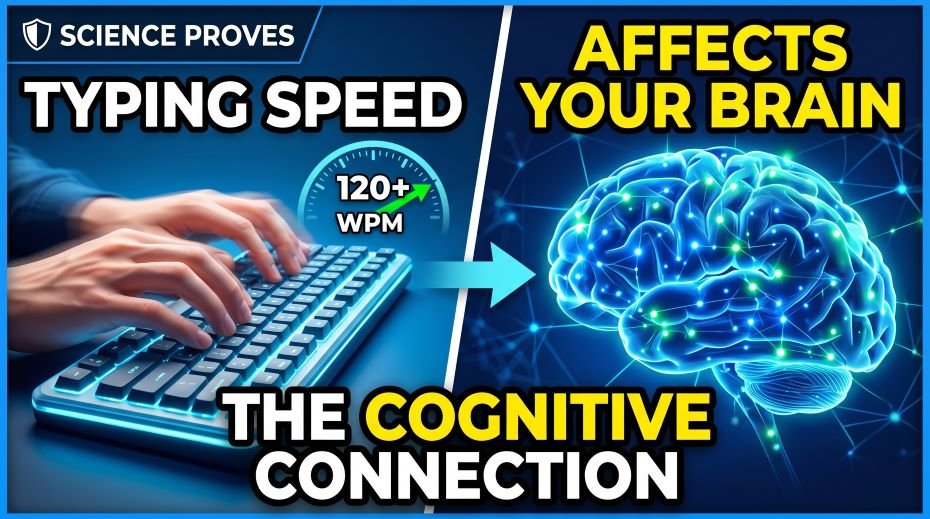
Today in this article we will discuss about a topic named Science Proves Typing Speed Affects Your Brain so, In January 2026, the journal Scientific Reports – published under the Nature portfolio – released a major study titled ‘Functional and Cognitive Correlates of Typing Speed in a Large U.S. Panel Study.’ The research examined how typing speed relates to cognitive function, memory, processing speed, and everyday functioning across thousands of American adults.
The findings have significant implications not just for researchers but for every student, professional, and government job aspirant who types for a living. Typing is no longer just a clerical skill – science is confirming what many productivity experts have long suspected: how fast and accurately you type is a meaningful indicator of broader cognitive health and efficiency.
This article breaks down what the Nature study found, explains the science behind the typing-brain connection, compares findings with earlier research, and – practically – explains what all of this means for how you should approach typing skill development.
Quick Facts: The 2026 Nature Typing Speed Study
| Study Detail | Information |
| Study Title | Functional and Cognitive Correlates of Typing Speed in a Large U.S. Panel Study |
| Published In | Scientific Reports (Nature Portfolio) |
| Publication Date | January 21, 2026 |
| Study Type | Large-scale longitudinal panel study – United States |
| Key Finding | Typing speed is significantly correlated with cognitive processing speed, working memory, and overall functional ability |
| Population Studied | Large U.S. panel – adults across age groups and education levels |
| Relevance | Typing has become central to everyday functioning – speed reflects and affects cognitive health |
| Access | nature.com/articles/scientificreports (open access) |
Source: Scientific Reports, Nature Portfolio, January 21, 2026. ‘Typing has become increasingly integral to everyday functioning.’
What the Nature Study Actually Found: Key Findings Explained
The 2026 Scientific Reports study is significant because of its scale and methodology. Rather than a small lab experiment, it used a large U.S. panel dataset – meaning thousands of real people of different ages, education levels, and occupations were studied in naturalistic conditions. Here are the core findings:
Finding 1: Typing Speed Correlates With Cognitive Processing Speed
The study found that individuals who typed faster also performed better on measures of cognitive processing speed – the rate at which the brain processes and responds to information. This is not simply because smarter people type faster. The relationship held even after controlling for education and age, suggesting that typing speed and cognitive speed share underlying neural mechanisms.
In practical terms: people who type at 60 WPM tend to process information, make decisions, and respond to stimuli faster than people who type at 30 WPM – even on tasks unrelated to typing.
Finding 2: Working Memory and Typing Speed Are Linked
Faster typists showed stronger working memory performance – the ability to hold and manipulate information in mind simultaneously. This makes intuitive sense: skilled typists can focus on composing ideas while their fingers handle the mechanical output automatically. Slow typists must split their mental resources between thinking and physically finding keys.
The study suggests this relationship may run in both directions: people with stronger working memory learn to type faster, and learning to type fast may itself strengthen working memory through the sustained attention and motor sequencing demands of the skill.
Finding 3: Typing Speed Declines With Age – But Trained Typists Age Better
Like most motor and cognitive skills, typing speed declines with age. However, the study found that individuals who had developed high typing speeds earlier in life showed significantly smaller age-related declines compared to those who had never trained systematically. This suggests that touch typing – as a trained motor skill – creates a form of cognitive reserve that partially buffers age-related decline.
Finding 4: Typing Is Now Central to Everyday Functioning
Perhaps most importantly, the study explicitly states that typing has become increasingly integral to everyday functioning. This is a scientific acknowledgment that typing is no longer a specialist clerical skill – it is a fundamental literacy for the modern world, as universal and as important as reading and arithmetic.
Summary: Core Study Findings at a Glance
| Finding | What It Means Practically | Implication for You |
| Typing speed ↔ cognitive processing speed | Faster typists process info and decisions faster overall | Improving typing may improve general mental speed |
| Typing speed ↔ working memory | Skilled typists free up mental resources for complex thinking | Touch typing reduces cognitive load during writing tasks |
| Typing speed declines with age | Everyone gets slower – but trained typists decline less | Learning proper touch typing now pays off for decades |
| Typing = everyday functional literacy | Slow typing is now a practical disability in knowledge work | 35+ WPM is no longer optional for professionals |
| Higher WPM = better functional outcomes | Faster typists complete tasks faster and more accurately | Every 10 WPM improvement has real productivity value |
Findings summarized from ‘Functional and Cognitive Correlates of Typing Speed in a Large U.S. Panel Study’, Scientific Reports, January 2026.
The Science Behind the Typing-Brain Connection
To understand why typing speed and brain function are connected, it helps to understand what the brain actually does when you type. Typing is a complex, multi-system motor and cognitive task that engages several brain regions simultaneously:
Brain Systems Involved in Typing
| Brain Region / System | Role in Typing | Cognitive Function Shared |
| Motor cortex | Controls finger movement sequences | Procedural memory, motor learning |
| Prefrontal cortex | Manages attention, planning, error correction | Executive function, working memory |
| Cerebellum | Coordinates timing and rhythm of keystrokes | Motor timing, automaticity |
| Visual cortex | Processes text on screen (reading what to type) | Visual processing speed |
| Basal ganglia | Automates learned movement patterns | Habit formation, procedural learning |
| Broca’s area | Language processing – converts thought to words | Language fluency, verbal working memory |
Typing is one of the few everyday activities that simultaneously engages motor, visual, language, and executive brain systems – making it a genuinely complex cognitive-motor task.
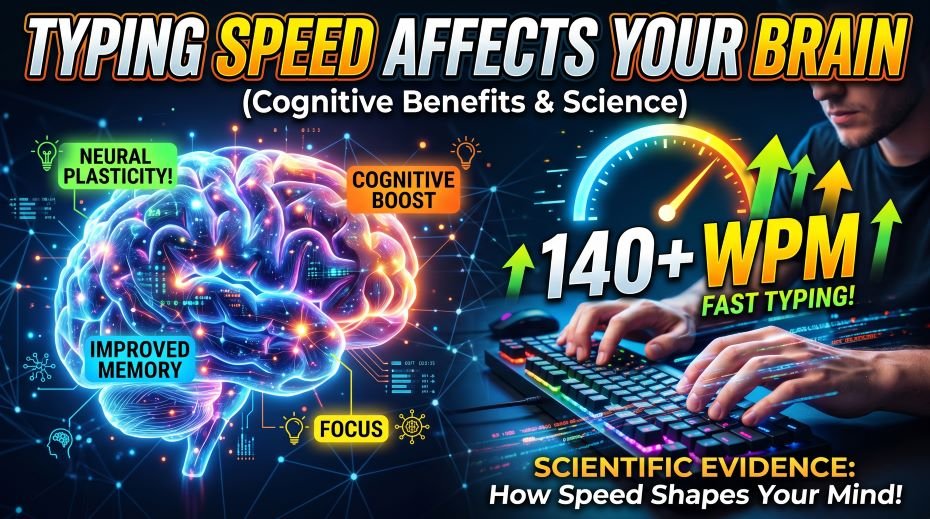
When a skilled typist types at 60+ WPM, the finger movements are almost entirely automated – handled by the basal ganglia and cerebellum with minimal conscious attention. This frees the prefrontal cortex – the seat of working memory and complex thinking – to focus entirely on the ideas being expressed. This is why experienced writers, programmers, and executives often describe a state of creative flow while typing: their fingers are on autopilot, and their mind is free.
In contrast, a slow typist using two fingers must consciously direct each keystroke, consuming significant prefrontal cortex resources. The mental bottleneck is not thought – it is output. This explains why typing slowly makes writing and thinking feel harder, not just slower.
Typing Speed Benchmarks: By Age, Profession, and Cognitive Group
The Nature study, combined with existing research on typing performance, allows us to build a clear picture of how typing speed varies across demographic and professional groups:
Average Typing Speed by Age Group
| Age Group | Average WPM | Accuracy | Notes |
| 13–18 years | 35–45 WPM | 92–95% | Digital natives – high exposure, moderate accuracy |
| 19–28 years | 40–55 WPM | 94–97% | Peak learning age – fastest improvers |
| 29–40 years | 45–60 WPM | 95–98% | Professional peak – experience + practice combined |
| 41–55 years | 40–55 WPM | 96–98% | Slight speed decline; accuracy often improves |
| 56–65 years | 32–45 WPM | 94–97% | Speed decline accelerates; still functional |
| 65+ years | 22–35 WPM | 90–95% | Significant motor slowdown; trained typists decline less |
Average WPM figures based on aggregate research data including the 2026 Nature panel study. Individual variation is high – trained typists at all ages significantly outperform these averages.
Average Typing Speed by Profession
| Profession | Avg WPM | Required WPM | Typing Medium |
| Professional Typist / Transcriptionist | 75–100 WPM | 70+ WPM | English |
| Software Developer / Programmer | 55–80 WPM | No formal min. | English + code |
| Journalist / Content Writer | 60–80 WPM | 60+ WPM preferred | English |
| Government LDC / Clerk | 35–50 WPM | 35 WPM (Eng) / 30 WPM (Hindi) | English or Hindi |
| Data Entry Operator | 45–65 WPM | 8,000 KDPH | English numeric |
| Customer Support Executive | 40–55 WPM | 40+ WPM | English |
| General Office Worker | 38–50 WPM | No formal min. | English |
| Student (College Level) | 30–45 WPM | No formal min. | English |
Professional WPM averages are based on industry surveys and research data. There is significant individual variation within each category.
Cognitive Benefits of Improving Your Typing Speed: What Research Shows
The Nature study is not the first to examine the brain-typing connection. Here is a synthesis of what multiple studies have found about the cognitive benefits of developing strong typing skills:
| Cognitive Benefit | Research Evidence | Practical Outcome |
| Reduced cognitive load during writing | Automatized typing frees prefrontal resources | Better writing quality at same mental effort |
| Improved working memory | Holding text in mind while typing trains memory | Better performance on memory-intensive tasks |
| Stronger motor sequence learning | Touch typing trains procedural memory systems | Easier learning of other motor-sequence skills |
| Faster information output | Speed directly reduces time-on-task for all typing work | 1–2 hours daily time savings for knowledge workers |
| Cognitive reserve building | Complex motor-cognitive training builds neural resilience | Smaller age-related cognitive decline (per 2026 study) |
| Reduced mental fatigue | Effortful typing depletes executive resources faster | Less fatigue during long writing or data entry sessions |
These findings are drawn from multiple peer-reviewed studies including the 2026 Nature panel study and prior research in cognitive psychology and motor learning.
Typing vs Handwriting: Which Is Better for Your Brain?
The 2026 study reignites an ongoing scientific debate: is typing or handwriting better for learning, memory, and cognitive development? Research shows the two engage the brain differently – and both have distinct advantages depending on the goal:
| Dimension | Typing | Handwriting |
| Speed of output | 3–5x faster than handwriting | Much slower – limits volume |
| Memory encoding | Weaker – speed allows verbatim transcription without processing | Stronger – slower pace forces summarization and encoding |
| Note-taking for learning | Less effective for retention (per Mueller & Oppenheimer, 2014) | More effective for retention – slower = more processing |
| Professional productivity | Essential – emails, documents, code, communication | Limited utility in modern professional settings |
| Fine motor development | Different motor pattern – bilateral finger coordination | Pen grip and hand-eye coordination |
| Brain regions engaged | Motor, visual, language, executive – simultaneously | Motor, visual, spatial – more pen-specific regions |
| Best use case | Professional output, communication, data entry | Learning, note-taking, creative ideation |
The science suggests both skills have value. For professional productivity and government job requirements, typing speed is essential. For learning and memory, handwriting has advantages. Use both deliberately.
What the Nature Study Means for Government Job Aspirants in India
For the millions of Indians preparing for government typing tests – SSC CHSL, Rajasthan LDC, LAHD-SSRB, UP LDC, and others – the 2026 Nature study carries a powerful message: developing your typing skill is not just about clearing a test. It is an investment in your cognitive capacity and professional effectiveness for decades.
- Typing preparation is brain training: When you practice touch typing daily, you are not just improving finger speed – you are training procedural memory, sustained attention, and motor sequencing. These benefits extend beyond typing.
- Reaching 35 WPM is the minimum – not the goal: The study shows that higher typing speeds correlate with better cognitive outcomes. Use the government minimum as a floor, not a ceiling. Push to 50+ WPM for maximum professional benefit.
- Starting young matters – but starting now matters more: The study shows that trained typists experience less age-related decline. Whether you are 20 or 45, starting touch typing practice today builds cognitive reserve you will benefit from for life.
- Consistent daily practice is cognitively superior to cramming: Motor skill learning (including typing) consolidates during sleep. Short daily sessions (20–30 minutes) are neurologically more effective than marathon sessions before the exam.
- Accuracy is a cognitive indicator, not just a test requirement: The study’s correlation between typing accuracy and cognitive function suggests that building high-accuracy typing habits reflects and reinforces careful, detail-oriented thinking patterns.
How to Use the Science to Improve Your Typing Speed Faster
Knowing the neuroscience of typing skill development gives you a significant advantage – you can structure your practice to align with how the brain actually learns motor skills. Here is the science-backed approach:
Principle 1: Deliberate Practice Over Volume
Research in motor learning consistently shows that deliberate, focused practice – targeting specific weaknesses – is far more effective than high-volume repetitive practice. Do not just type for 30 minutes. Identify your three slowest key transitions, create specific drills for those transitions, and practice them at a speed where you can maintain perfect accuracy.
Principle 2: Sleep Consolidates Motor Skills
Multiple studies have shown that motor skills – including typing – improve measurably after sleep, even without additional practice. This is because the brain consolidates procedural memories during slow-wave sleep. The practical implication: always practice before sleeping, not just in the morning. And never skip sleep to practice more – it is counterproductive.
Principle 3: Interleaved Practice Outperforms Blocked Practice
Blocked practice means practicing one skill repeatedly (e.g., the letter ‘B’ for 10 minutes). Interleaved practice means mixing different challenges (e.g., alternating between weak letters every 2 minutes). Research shows interleaved practice feels harder but produces significantly better long-term retention and transfer – particularly for motor skills like typing.
Principle 4: The Testing Effect – Mock Tests Build Real Skill
Research in cognitive psychology shows that testing yourself – rather than just practicing – produces stronger memory encoding and skill consolidation. For typing, this means running timed mock tests is more valuable than untimed practice. The stress of the timer activates the same neural circuits that fire on test day, building what psychologists call ‘contextual learning’ – the ability to perform under pressure.
Science-Backed 30-Day Typing Improvement Plan
| Week | Daily Time | Science-Backed Focus | Cognitive Goal |
| Week 1 | 20 min | Home row touch typing only – build automaticity for core keys through blocked repetition | Procedural memory encoding – home row becomes unconscious |
| Week 2 | 25 min | Interleaved full-keyboard drills – mix weak and strong keys every 2 minutes | Interleaved practice – stronger long-term retention of full keyboard |
| Week 3 | 30 min | Passage typing + deliberate weak-key targeting (identify via mock test errors) | Deliberate practice – targeted improvement of specific bottlenecks |
| Week 4 | 30 min | Daily timed mock tests (testing effect) + review errors immediately after each test | Testing effect + contextual learning – exam-condition performance |
Practice at typingmasterpro.com – free timed typing tests, passage practice, and WPM tracking aligned with government exam standards.
Typing Speed in India: A National Productivity and Skills Gap
The 2026 Nature study was conducted in the United States, but its findings have strong relevance to India, where keyboard-based communication has expanded dramatically over the last decade. India has the second-largest internet user base in the world, and digital governance, remote work, and online education have made keyboard proficiency a critical everyday skill for hundreds of millions of people.
Yet the average typing speed among working-age adults in India remains significantly below global averages, particularly in Hindi and regional language typing. Several factors contribute to this gap:
| Factor | Impact on Indian Typing Proficiency |
| Multi-language environment | Many users switch between English, Hindi, and regional languages – multiple keyboard layouts to learn |
| Mobile-first internet adoption | Millions learned typing on smartphones first – different muscle memory from desktop keyboards |
| Limited school-level typing education | Formal touch typing training is rare in Indian schools – most people self-teach with poor habits |
| Hindi typing complexity | Kruti Dev, Mangal, Inscript, Remington Gail – multiple competing standards create confusion |
| Government job focus | Most typing training in India is exam-focused (pass minimum WPM) rather than skill-focused (maximize WPM) |
India’s government typing test infrastructure (NIELIT centers, RSMSSB centers, SSC centers) is actually one of the most developed in the world – but the upstream training ecosystem needs strengthening.
Official and Reference Links
| Resource | Link / Details |
| Nature / Scientific Reports Study | nature.com/scientificreports |
| Scientific Reports Journal | nature.com/srep |
| Working Memory (Wikipedia) | en.wikipedia.org/wiki/Working_memory |
| Cognitive Processing Speed | en.wikipedia.org/wiki/Mental_chronometry |
| Free Typing Tests & Practice | typingmasterpro.com |
| NIELIT (Typing Test Centers) | nielit.gov.in |
The full Nature / Scientific Reports study is available open-access at nature.com. Search the exact title: ‘Functional and Cognitive Correlates of Typing Speed in a Large U.S. Panel Study’.
Key Research Milestones: Typing and Cognitive Science Timeline
| Year | Study / Milestone | Key Finding |
| 1888 | First typewriter speed competitions | Typing established as a measurable professional skill |
| 1973 | Shaffer – keystroke timing studies | Typing shown to involve complex motor timing mechanisms |
| 2003 | Logan & Crump – typing and cognition | Skilled typing operates as largely unconscious motor program |
| 2007 | Gentner – typing automaticity research | Touch typing activates different brain circuits than hunt-and-peck |
| 2014 | Mueller & Oppenheimer – laptop vs handwriting | Handwriting beats laptop typing for memory retention in learning |
| 2018 | Dhakal et al. – large-scale typing study | Average typist uses 6 fingers, not 10; speed varies widely |
| 2023 | Pinet et al. – typing and language processing | Typing and reading are more tightly coupled than previously thought |
| Jan 2026 | Nature / Scientific Reports panel study | Typing speed significantly correlated with cognitive function in large U.S. panel |
Research on typing cognition has accelerated significantly since 2010 as keyboard use became universal. The 2026 Nature study is the largest panel study on this topic to date.
Frequently Asked Questions
What did the 2026 Nature study find about typing speed?
The January 2026 Scientific Reports (Nature portfolio) study found that typing speed is significantly correlated with cognitive processing speed and working memory in a large U.S. adult panel. Faster typists tend to process information more quickly and show stronger working memory performance – and trained typists experience less age-related cognitive decline than untrained typists.
Does improving typing speed make you smarter?
The research suggests a bidirectional relationship – people with higher cognitive processing speed tend to type faster, but learning to type faster through deliberate practice also appears to strengthen working memory and reduce cognitive load during complex tasks. Improving typing speed is unlikely to raise IQ, but it does free up cognitive resources and appears to build cognitive reserve over time.
Is typing speed a sign of intelligence?
Not directly. The 2026 Nature study found correlations between typing speed and cognitive processing speed after controlling for education and age – but correlation is not causation. Many highly intelligent people type slowly due to lack of training, and fast typists are not necessarily more intelligent. What the research does show is that typing speed and cognitive speed share underlying neural mechanisms.
At what age does typing speed peak?
Research suggests typing speed peaks between the ages of 29 and 40 for most trained typists – when the combination of developed motor skill, professional experience, and cognitive capacity is at its highest. The 2026 Nature study confirms that speed declines after this peak, but individuals who developed high typing speeds earlier in life decline less steeply than those who never trained systematically.
Is handwriting or typing better for the brain?
They engage the brain differently. Handwriting is better for learning and memory retention because the slower pace forces the brain to process and summarize rather than transcribe verbatim. Typing is better for professional output, speed, and volume – and appears to build cognitive reserve through its complex motor-cognitive demands. The ideal approach is to use both deliberately: handwriting for learning, typing for professional output.
How does this research affect government typing test preparation?
The research reinforces what good preparation looks like: daily deliberate practice is neurologically superior to cramming, sleep consolidates motor skills so pre-sleep practice matters, and mock tests (testing effect) build stronger performance under pressure than untimed practice. The 30-day preparation plan on typingmasterpro.com is built around these exact principles.
Also read: What Happens If You Fail a Government Typing Test?
Conclusion: Typing Is Not Just a Skill – It Is a Cognitive Investment
The 2026 Nature / Scientific Reports study is a landmark piece of research that elevates typing from a clerical skill to a measurable indicator of cognitive health and functional capacity. The finding that typing speed correlates with processing speed and working memory – even after controlling for age and education – confirms what many researchers and productivity experts have long suspected.
For government job aspirants in India, this research carries a dual message. First, developing your typing skill to meet the minimum qualifying standard is a professional necessity. Second, pushing well beyond that minimum – toward 50, 60, or 70 WPM – is an investment in your own cognitive efficiency that will pay dividends for decades in every aspect of your professional and personal life.
Start your science-backed typing improvement journey today at TypingMasterPro.com. Take a baseline speed test, follow the 30-day deliberate practice plan, and track your weekly progress. Every 10 WPM improvement is not just a better test score – according to the science, it is a measurable enhancement in how efficiently your brain works.