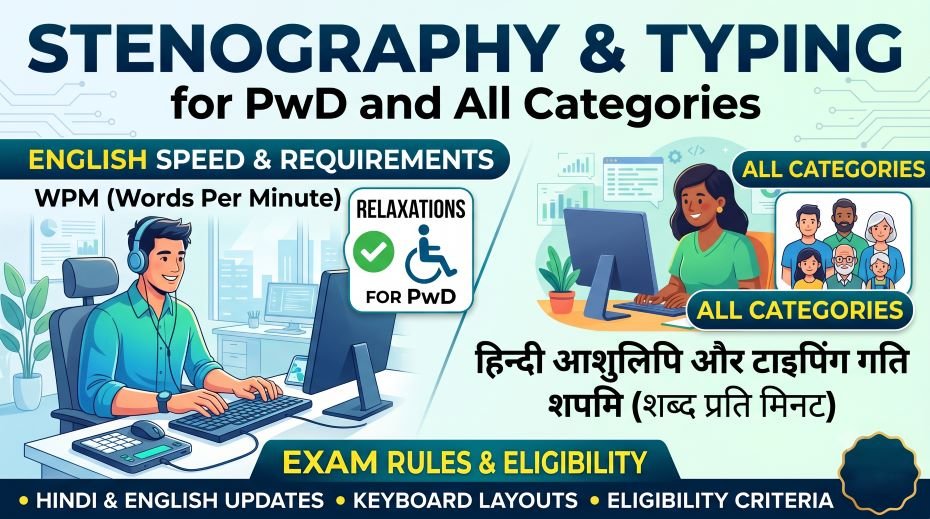
In this article we will discuss about the Complete guide to stenography and typing for PwD and all categories (reservation) in India – English and Hindi steno speed requirements, category-wise relaxations, exam patterns, scribe rules, previous year cutoffs, preparation plans and official links.
Stenography is one of the most demanding skill-based qualifications in Indian government recruitment. Unlike a simple typing test, stenography combines two separate skills – shorthand (writing speech in a coded system of symbols) and transcription typing (converting those symbols back into typed text). For government jobs, stenographers are among the highest-paid clerical-grade employees, with posts available in SSC, Railways, High Courts, State PSCs, and virtually every major government department.
For Persons with Disabilities (PwD) and candidates from reserved categories (SC/ST/OBC/EWS/Ex-Servicemen/Women), the stenography test presents both unique challenges and legally guaranteed protections. From the April 2026 Punjab and Haryana High Court ruling on typing discrimination to the RPwD Act 2016’s mandate for reasonable accommodation – the landscape of rights for all categories in steno and typing tests is evolving rapidly.
This complete guide covers everything: what stenography is and how it differs from typing, English and Hindi steno speed requirements, category-wise relaxations for all reservation groups, PwD-specific accommodation in steno tests, exam-wise details for SSC Steno, High Court Steno, Railway Steno and state PSC steno, previous year cutoffs, and a structured preparation plan for every category and background.
Quick Facts: Stenography and Typing – All Categories at a Glance
| Parameter | Key Information |
| Stenographer Grade C (SSC) | Dictation: 100 WPM English | Transcription: 40 min English / 55 min Hindi |
| Stenographer Grade D (SSC) | Dictation: 80 WPM English | Transcription: 50 min English / 65 min Hindi |
| PwD Extra Time | 75 minutes extra for VH; 60 minutes extra for OH – for transcription |
| VH Steno Scribe | Visually Handicapped candidates may use scribe for dictation AND transcription |
| SC/ST Age Relaxation | +5 years over General upper age limit |
| OBC Age Relaxation | +3 years over General upper age limit |
| PwD Age Relaxation | +10 years General / +13 OBC / +15 SC-ST over upper age limit |
| Speed Relaxation for PwD | Primarily through extra transcription time – dictation speed same for all |
| Hindi Steno Layout | Pitman Hindi Shorthand – different symbols from English Pitman |
| Governing Law (PwD) | Rights of Persons with Disabilities Act 2016 (RPwD Act) |
SSC Stenographer exam is the largest central government steno recruitment. High Courts, various state PSCs, and Railways also recruit stenographers with similar but not identical speed requirements.
Stenography vs Typing: What Is the Difference?
Before understanding category-wise relaxations, it is essential to clearly understand what stenography involves and how it differs from a regular typing test. Many candidates confuse the two – they are related but fundamentally different skills:
| Dimension | Regular Typing Test | Stenography Test |
| What you do | Read a passage on screen → type it on keyboard | Listen to dictation → write in shorthand → type out in full |
| Skills involved | Keyboard typing speed and accuracy only | Shorthand writing + typing + memory + speed under pressure |
| Test stages | One stage – typing only | Two stages – Dictation (shorthand writing) + Transcription (typing) |
| Speed measured | Words Per Minute (WPM) – typically 25–35 WPM | Dictation: 80–120 WPM | Transcription: 40–60 min total time |
| Shorthand system | Not applicable | English: Pitman Shorthand | Hindi: Pitman Hindi or Kailash Chandra |
| Time to learn | 10–16 weeks to reach govt. standard | 12–24 months to reach govt. steno standard |
| Salary / Grade Pay | LDC: Level 2 (Rs. 1,900 Grade Pay) | Grade D: Level 4 (Rs. 2,400) | Grade C: Level 5 (Rs. 2,800) |
| Post examples | LDC, JSA, Clerk, Data Entry Operator | Stenographer Grade C, Grade D, PA to Officers, Court Reporter |
Stenographers earn significantly more than LDC/typing test posts and have better promotion prospects. The investment in learning shorthand is worthwhile for career-focused candidates.
Shorthand Systems Used in Indian Government Steno Exams
India uses different shorthand systems for English and Hindi stenography. Understanding which system is required for your target exam is critical before starting preparation:
English Stenography – Pitman Shorthand
Pitman shorthand is the most widely used shorthand system in India for English stenography. Developed by Sir Isaac Pitman in 1837, it is a phonetic system that represents sounds using geometric shapes – strokes, hooks, and circles – written on a notepad. It is the standard for SSC Stenographer, High Court Stenographer, Railway Steno, and most central government steno posts.
- Speed levels: Beginners start at 40–60 WPM dictation. Government Grade D requires 80 WPM. Grade C requires 100 WPM. Expert court reporters achieve 160–200 WPM.
- Learning time: 60 WPM takes 4–6 months. 80 WPM takes 8–12 months. 100 WPM takes 12–18 months of dedicated daily practice.
- Outlines required: Candidates must memorize thousands of shorthand outlines for common English words and phrases.
Hindi Stenography – Pitman Hindi and Kailash Chandra
Hindi stenography uses two primary systems: Pitman Hindi (a phonetically adapted version of Pitman for Hindi sounds) and the Kailash Chandra system (developed specifically for Hindi). SSC Steno exams accept both systems for Hindi dictation.
- Pitman Hindi: Adapted from English Pitman – similar geometric symbols modified for Devanagari phonetics. More widely taught.
- Kailash Chandra: Developed specifically for Hindi. More commonly preferred by experienced Hindi steno practitioners.
- Speed levels: Hindi steno is generally attempted at slightly lower speeds – 80 WPM for Grade D, 100 WPM for Grade C, same as English.
- Transcription: Unlike typing tests where you type from a screen, Hindi steno transcription requires typing from your own handwritten shorthand notes – using Kruti Dev or Mangal font.
Exam-Wise Stenography Speed Requirements: Complete Reference 2026
SSC Stenographer Grade C and D – Speed Requirements
| Post | Dictation Speed | Dictation Duration | Transcription (English) | Transcription (Hindi) | Pay Level |
| Steno Grade C | 100 WPM | 10 minutes | 40 minutes | 55 minutes | Level 6 |
| Steno Grade D | 80 WPM | 10 minutes | 50 minutes | 65 minutes | Level 4 |
| Steno Grade D (PwD – VH) | 80 WPM | 10 min + extra | 50 + 75 min | 65 + 75 min | Level 4 |
| Steno Grade D (PwD – OH) | 80 WPM | 10 min + extra | 50 + 60 min | 65 + 60 min | Level 4 |
| Steno Grade C (PwD – VH) | 100 WPM | 10 min + extra | 40 + 75 min | 55 + 75 min | Level 6 |
Extra time for PwD in transcription: VH candidates get 75 additional minutes; OH candidates get 60 additional minutes. Dictation speed requirement is NOT reduced – only transcription time is extended.
Other Major Steno Exams – Speed and Requirements
| Exam / Post | Dictation Speed | Transcription Time | Language | Conducting Body |
| SSC Steno Grade C | 100 WPM | 40 min (Eng) / 55 min (Hindi) | English / Hindi | Staff Selection Commission |
| SSC Steno Grade D | 80 WPM | 50 min (Eng) / 65 min (Hindi) | English / Hindi | Staff Selection Commission |
| High Court Stenographer | 100–120 WPM | Varies by court | English (mainly) | Respective High Court |
| Railway Steno (RRB) | 80 WPM | 50 min (Eng) / 65 min (Hindi) | English / Hindi | Railway Recruitment Board |
| Rajasthan Steno (RSMSSB) | 80 WPM Hindi | As per notification | Hindi | RSMSSB |
| UP Steno (UPSSSC) | 80 WPM Hindi | As per notification | Hindi | UPSSSC |
| Delhi Steno (DSSSB) | 80–100 WPM | 50–55 min | English / Hindi | DSSSB |
| IB ACIO Steno | 100 WPM | 40 min | English | Intelligence Bureau |
| CSIR / Scientific Depts. | 100 WPM | 40 min (Eng) | English | Various central depts. |
High Court steno exams are generally the most competitive and demanding – 100–120 WPM dictation with strict accuracy. They also offer the highest salary and job security in the steno category.
SSC Stenographer 2026: Complete Exam Pattern and Stages
The SSC Stenographer exam is the most popular and widely attempted steno recruitment in India. Here is the complete exam structure:
SSC Stenographer Exam Structure – All Tiers
| Tier | Stage | Mode | Marks | Duration | Purpose |
| 1 | Computer Based Test (CBT) | Online – CBT | 200 Marks | 2 Hours | Screening – shortlist for Tier 2 |
| 2 | Skill Test (Stenography) | Offline – paper notepad | Qualifying | 10 min dictation | Pass/Fail – 80/100 WPM required |
| 3 | Transcription (Typing) | Computer – keyboard | Qualifying | 50/65 min (D); 40/55 min (C) | Type out shorthand notes on computer |
| 4 | Document Verification | In-person | – | 1 Day | Verify all original certificates |
Final selection is based purely on Tier 1 (CBT) merit – Skill Test (Tier 2 + Tier 3) is qualifying only. All PwD accommodations apply in both the CBT and the Skill Test stages.
SSC Stenographer Tier 1 – Marks Distribution
| # | Subject | Questions | Marks | Duration |
| 1 | General Intelligence & Reasoning | 50 | 50 | Combined 2 Hours |
| 2 | General Awareness | 50 | 50 | Combined 2 Hours |
| 3 | English Language and Comprehension | 100 | 100 | Combined 2 Hours |
| Total | – | 200 | 200 | 2 Hours |
Negative marking: -0.25 per wrong answer in all sections. English section (100 marks) is the most heavily weighted – strong English skills are critical for SSC Steno success.
Category-Wise Relaxations in Stenography Tests: Complete Reference
SC / ST Candidates – Steno Relaxations
| Relaxation Type | SC | ST |
| Upper Age Limit | +5 years over General | +5 years over General |
| Application Fee | Nil – fully waived | Nil – fully waived |
| Dictation Speed (Shorthand) | Same as General – 80/100 WPM | Same as General – 80/100 WPM |
| Transcription Time | Same as General – no extra time | Same as General – no extra time |
| CBT Written Exam Cutoff | Lower – category merit list | Lower – category merit list |
| Post Reservation | 15% of steno vacancies | 7.5% of steno vacancies |
| Skill Test – any difference? | No – same skill test for all | No – same skill test for all |
SC/ST get lower CBT cutoffs and age/fee relaxation – but the steno skill test (dictation speed and transcription time) is IDENTICAL for all categories. SC/ST candidates must achieve the same 80/100 WPM as General category.
OBC (NCL) Candidates – Steno Relaxations
| Relaxation Type | OBC NCL Entitlement |
| Upper Age Limit | +3 years over General upper limit |
| Application Fee | Reduced (Rs. 100 instead of Rs. 100 – nominal fee; waived for women in SSC) |
| Steno Dictation Speed | Same as General – 80/100 WPM – NO reduction |
| Transcription Time | Same as General – no extra time |
| Written Exam Cutoff | Lower than General – category-wise merit |
| Post Reservation | 27% of steno vacancies for OBC NCL |
| NCL Certificate | Current/preceding financial year Non-Creamy Layer certificate mandatory |
OBC NCL candidates benefit from post reservation and lower CBT cutoffs – but must achieve identical steno skill test standards as General category. The steno skill test has no category-based speed differentiation.
PwD / Handicapped Candidates – Steno Relaxations (Most Comprehensive)
Persons with Disabilities receive the most significant and legally mandated relaxations in stenography tests. These are governed by the Rights of Persons with Disabilities Act 2016 and SSC’s own circulars:
| Relaxation Type | VH (Visually Handicapped) | OH (Orthopedically Handicapped) |
| Upper Age Limit | +10 yrs General / +13 OBC / +15 SC-ST | +10 yrs General / +13 OBC / +15 SC-ST |
| Application Fee | Nil – fully waived | Nil – fully waived |
| CBT Extra Time | 20 extra minutes per hour + scribe option | 20 extra minutes per hour |
| CBT Scribe | Yes – scribe permitted for written exam | Yes – for candidates who cannot write |
| Dictation Speed | Same – 80/100 WPM (no speed reduction) | Same – 80/100 WPM (no speed reduction) |
| Dictation Stage Scribe | Yes – scribe writes shorthand for VH | Case by case – severe OH only |
| Transcription Extra Time | +75 minutes for Grade D; +75 min Grade C | +60 minutes for Grade D; +60 min Grade C |
| Transcription – screen reader | Yes – screen reader software permitted | Not typically needed |
| Post Reservation | 4% of vacancies across all steno posts | 4% of vacancies across all steno posts |
CRITICAL: For VH candidates, the scribe at the dictation stage writes the shorthand on behalf of the candidate. This requires the scribe to know shorthand – a highly unusual requirement that must be arranged with the recruitment body well in advance.
PwD Extra Transcription Time: Exact Calculation
| Post | Standard Time (Eng) | Standard Time (Hindi) | VH Total Time | OH Total Time |
| Steno Grade D | 50 minutes | 65 minutes | 50 + 75 = 125 min | 50 + 60 = 110 min |
| Steno Grade C | 40 minutes | 55 minutes | 40 + 75 = 115 min | 40 + 60 = 100 min |
| Grade D Hindi (VH) | – | 65 minutes | 65 + 75 = 140 min | 65 + 60 = 125 min |
| Grade C Hindi (VH) | – | 55 minutes | 55 + 75 = 130 min | 55 + 60 = 115 min |
The extra transcription time for VH candidates (75 minutes) is the largest PwD accommodation in any government skill test in India – reflecting the genuine additional time needed to type from screen-reader-assisted shorthand notes.
Women Candidates – Steno Relaxations
| Relaxation Type | SSC Steno (Central) | State Steno Exams |
| Application Fee | Nil – all women exempt from SSC exam fees | Varies – many state exams also waive for women |
| Upper Age Limit | Same as General (no SSC-specific women age relaxation) | Rajasthan/UP: +5 yrs extra | varies by state |
| Dictation Speed | Same as General – 80/100 WPM | Same – no speed reduction in most states |
| Transcription Time | Same as General | Same as General |
| Post Reservation | 33% horizontal reservation in most steno posts | Varies – Rajasthan 30-33% women reservation |
| Widow/Divorced Women | Age relaxation up to 35/40/45 yrs (Gen/OBC/SC-ST) | Many states: 45–50 yrs + fee waiver |
Women’s 33% horizontal reservation in steno posts means 33% of each category’s vacancies (General, OBC, SC, ST) must be filled by women. This effectively increases women’s chances significantly in steno recruitment.
also read: How Long Does It Take to Learn Typing for Government Exam?
Ex-Servicemen (ESM) – Steno Relaxations
| Relaxation Type | Ex-Servicemen Entitlement |
| Upper Age Limit | Period of military service + 3 years (General ESM); SC/ST ESM: service + 3 + 5 years |
| Application Fee | Nil – fully waived in SSC and most state exams |
| Steno Speed Requirement | Same as General – no speed reduction in most exams |
| Post Reservation | 10% of Group C vacancies; 14.5% of Group D vacancies (Central Govt.) |
| Steno Exemption | Some defence department steno posts have modified rules – check specific notification |
EWS Candidates – Steno Relaxations
| Relaxation Type | EWS Entitlement |
| Post Reservation | 10% of steno vacancies reserved for EWS |
| Application Fee | General fee applies – no waiver for EWS in SSC Steno |
| Age Relaxation | No separate age relaxation – same as General upper limit |
| Steno Speed | Same as General – no speed or time relaxation |
| EWS Certificate | Income and Asset certificate from SDM/Tehsildar – valid for current financial year |
EWS provides 10% reservation in steno posts – a significant benefit. However, no steno speed relaxation or extra transcription time is provided. EWS candidates must meet the same skill test standards as General category.
Master Table: All Category Relaxations in Steno Exams
| Category | Age Relax. | Fee Waiver | Steno Speed Relax. | Extra Trans. Time | Scribe | Post Reservation |
| General | Baseline | Rs. 100 (Men) | None | None | None | – |
| General Women | Baseline | Nil ✓ | None | None | None | 33% horizontal ✓ |
| SC | +5 yrs ✓ | Nil ✓ | None | None | None | 15% ✓ |
| ST | +5 yrs ✓ | Nil ✓ | None | None | None | 7.5% ✓ |
| OBC NCL | +3 yrs ✓ | Partial~ | None | None | None | 27% ✓ |
| EWS | None | None | None | None | None | 10% ✓ |
| PwD (VH) | +10 yrs ✓ | Nil ✓ | None* | +75 min ✓ | Yes ✓ | 4% ✓ |
| PwD (OH) | +10 yrs ✓ | Nil ✓ | None* | +60 min ✓ | Case~ | 4% ✓ |
| Ex-Servicemen | Svc+3 yrs ✓ | Nil ✓ | None | None | None | 10% Grp C ✓ |
✓ = Available | None = Not provided | ~ = Partial/varies | *PwD dictation speed is same as General – extra time only applies to transcription stage. All figures are for SSC Stenographer – state exams may differ.
SSC Stenographer Previous Year Vacancies
| Year | Exam Cycle | Total Posts | Grade C | Grade D | PwD Posts | Status |
| 2024–25 | SSC Steno 2024 | ~2,000+ | ~500 | ~1,500 | ~80+ | Active |
| 2023–24 | SSC Steno 2023 | ~1,207 | ~312 | ~895 | ~48 | Completed |
| 2022–23 | SSC Steno 2022 | ~1,524 | ~361 | ~1,163 | ~61 | Completed |
| 2021–22 | SSC Steno 2021 | ~1,482 | ~342 | ~1,140 | ~59 | Completed |
| 2020–21 | SSC Steno 2020 | ~1,774 | ~432 | ~1,342 | ~71 | Completed |
PwD posts (4% of total) are distributed across VH, HH, OH, and multiple disability categories. Check the current notification for category-wise PwD post breakdown.
SSC Stenographer Previous Year Cutoff Marks (CBT – Out of 200)
| Year | Post | General | OBC | SC | ST | EWS | PwD |
| 2023 | Grade C | 152–158 | 144–150 | 130–136 | 118–124 | 145–151 | 110–120 |
| 2023 | Grade D | 143–149 | 135–141 | 121–127 | 109–115 | 136–142 | 100–110 |
| 2022 | Grade C | 149–155 | 141–147 | 127–133 | 115–121 | 142–148 | 108–118 |
| 2022 | Grade D | 140–146 | 132–138 | 118–124 | 106–112 | 133–139 | 98–108 |
| 2021 | Grade C | 145–151 | 137–143 | 123–129 | 111–117 | 138–144 | 105–115 |
| 2021 | Grade D | 136–142 | 128–134 | 114–120 | 102–108 | 129–135 | 94–104 |
PwD cutoffs are the lowest across all categories – reflecting both reservation priority and the additional challenges PwD candidates face. Cutoffs are estimated from available SSC result data and may vary slightly. Official cutoffs are published on ssc.nic.in.
Important Dates: SSC Stenographer 2026 Timeline
| Event | Date / Status |
| SSC Steno 2026 Notification | Check ssc.nic.in – typically released July–September |
| Online Application Period | As per notification – usually 30 days window |
| CBT (Tier 1) Exam Date | As per SSC annual calendar – typically Nov–Jan |
| CBT Result Declaration | ~45–60 days after CBT |
| Skill Test (Steno) Admit Card | ~10 days before Skill Test |
| Skill Test – Dictation Stage | After CBT result – as per schedule |
| Skill Test – Transcription Stage | Same day as or immediately after dictation |
| Skill Test Result | ~30 days after Skill Test |
| Document Verification | After Skill Test result |
| Final Merit List | After DV – typically 60–90 days post DV |
SSC releases an annual exam calendar in December/January. Monitor ssc.nic.in and enable notifications for exact 2026 dates.
Preparation Plan: Stenography for All Categories – Timeline and Schedule
English Steno – Time to Reach 80 WPM (Grade D Standard)
| Starting Point | Daily Practice | Time to 80 WPM Dictation | Time to 100 WPM (Grade C) |
| Complete beginner (no shorthand) | 45 min shorthand + 30 min typing | 10–14 months | 16–22 months |
| Know basics (30–40 WPM) | 45 min shorthand + 30 min typing | 6–9 months | 12–16 months |
| Intermediate (50–60 WPM) | 45 min shorthand + 30 min typing | 3–5 months | 7–10 months |
| Advanced (65–75 WPM) | 40 min shorthand + 20 min typing | 1–3 months | 4–6 months |
Shorthand learning is the primary bottleneck – not typing. Most candidates reach 35 WPM typing quickly but struggle to achieve 80 WPM dictation accuracy. Prioritize shorthand practice above all else.
12-Month Steno Preparation Schedule (Complete Beginner → Grade D 80 WPM)
| Month | Shorthand Target | Shorthand Practice | Typing Practice |
| Month 1 | Learn alphabet + basic strokes | 45 min/day – alphabet, vowels, consonants | 20 min/day – touch typing basics |
| Month 2 | Common words 20 WPM | 45 min/day – word outlines, phrases | 20 min/day – build to 25 WPM typing |
| Month 3 | Sentences at 30 WPM | 45 min/day – sentence dictation practice | 25 min/day – typing from steno notes |
| Month 4 | 40 WPM consistent | 45 min/day – speed building | 25 min/day – transcription from notes |
| Month 5–6 | 50–60 WPM | 45 min/day – sustained dictation practice | 30 min/day – full transcription practice |
| Month 7–8 | 65–70 WPM | 45 min/day – speed push + accuracy | 30 min/day – timed transcription tests |
| Month 9–10 | 75 WPM | 45 min/day – exam-style dictation passages | 30 min/day – full mock transcription |
| Month 11–12 | 80 WPM (Grade D) | 45 min/day – mock test simulations | 25 min/day – consolidation and maintenance |
Steno preparation is a marathon, not a sprint. Candidates who try to rush past outlines or skip foundation months consistently fail the speed test later. Build each speed level solidly before moving to the next.
PwD Candidate – Special Steno Preparation Notes
- VH candidates must arrange a steno-skilled scribe: The dictation stage requires a scribe who knows shorthand – this is extremely rare and must be coordinated with the recruitment body (SSC) well in advance. Contact SSC directly at least 30 days before the skill test.
- Use screen reader from Day 1: VH candidates doing transcription use screen readers. Practice transcription with NVDA or JAWS from the very beginning – switching screen readers close to the exam disrupts muscle memory.
- OH candidates – ergonomic keyboard essential: For candidates with limited hand/arm mobility, practice on a keyboard that matches the physical setup you will use on exam day. Ergonomic keyboards or keyguards may be required.
- Use all available extra time: VH candidates have 75 extra minutes for transcription. Practice consistently with this extended duration – completing transcription in standard time and then using extra time to review and correct.
- Document everything in advance: Contact SSC/recruitment body at least 45 days before the skill test to confirm your accommodation (scribe, extra time, screen reader). Get everything in writing.
Official Links: Steno Exams and PwD Resources
| Resource | Link / Details |
| SSC Official Website | ssc.nic.in |
| SSC Stenographer Notification | Available under ‘Closed Examinations / Latest Notifications’ on ssc.nic.in |
| RPwD Act 2016 | disabilityaffairs.gov.in |
| CCPD (PwD Grievances) | ccpd.nic.in |
| RRB (Railway Steno) | indianrailways.gov.in |
| UPSSSC (UP Steno) | upsssc.gov.in |
| RSMSSB (Rajasthan Steno) | rsmssb.rajasthan.gov.in |
| NVDA Screen Reader (VH) | nvaccess.org |
| Typing Practice (Free) | typingmasterpro.com |
For PwD accommodation in SSC Steno, contact SSC directly through their helpdesk: helpdesk-ssc@nic.in | 011-24360107. Early contact is essential – accommodation cannot be arranged at the last minute.
Frequently Asked Questions
What is the steno speed required for SSC Stenographer Grade D and C?
SSC Stenographer Grade D requires 80 WPM dictation speed in English or Hindi, with transcription time of 50 minutes (English) or 65 minutes (Hindi). Grade C requires 100 WPM dictation with 40 minutes (English) or 55 minutes (Hindi) transcription time. PwD candidates (VH) get an additional 75 minutes for transcription; OH candidates get 60 extra minutes.
Do SC/ST candidates get lower steno speed requirement?
No. The steno skill test speed requirement is identical for all categories – General, SC, ST, OBC, and EWS must all achieve 80 WPM (Grade D) or 100 WPM (Grade C) in dictation. SC/ST relaxations apply only to the upper age limit (+5 years), application fee (waived), and written exam cutoff (lower). The dictation speed and transcription time are not reduced for any reservation category except PwD (who get extra transcription time – not speed reduction).
How does a visually handicapped candidate appear for the steno dictation test?
A VH candidate appearing in the SSC Stenographer skill test requires a specially arranged scribe – someone who can write shorthand on behalf of the candidate during the dictation stage. This is unusual and must be coordinated with SSC in advance. During transcription, the VH candidate types from the scribe’s shorthand notes using a screen reader (NVDA/JAWS) to verify accuracy, with 75 extra minutes available. Contact SSC at helpdesk-ssc@nic.in well before the skill test date.
Which is better for a PwD candidate – Hindi steno or English steno?
For most PwD candidates, English steno tends to be more accessible because English Pitman shorthand has more learning resources, coaching material, and speed-building tools available. However, if your target is state government steno posts (Rajasthan, UP, MP, Bihar), Hindi steno is necessary. For SSC Stenographer, both English and Hindi are available – choose whichever language you are stronger in and have better coaching access for.
Can a housewife or mature woman learn shorthand for steno exam?
Yes – absolutely. Shorthand, like typing, is a trainable skill that responds to dedicated practice at any age. Many women in their 30s and 40s have successfully cleared steno exams after returning to formal preparation. The realistic timeline for a mature learner starting from scratch is 14–18 months to reach 80 WPM dictation speed with dedicated daily practice of 60–75 minutes. The key is consistent, daily shorthand practice – not intensive but irregular sessions.
What happens if a PwD candidate’s accommodation is denied at the steno skill test?
If accommodation (extra time, scribe, screen reader) is denied at the skill test center, the candidate should immediately: (1) Request written confirmation of the denial from the invigilator. (2) File a complaint with SSC headquarters within 7 days citing RPwD Act 2016 Section 21 and the Punjab & Haryana HC April 2026 ruling. (3) Approach CCPD at ccpd.nic.in. (4) File a writ petition in the relevant High Court – courts have consistently upheld PwD accommodation rights in skill tests.
Conclusion: Every Category Has a Path – Know Yours and Prepare Accordingly
Stenography is one of the most rewarding skills in India’s government job landscape – well-paid, career-progressive, and available across central and state governments. For every category – PwD, SC/ST, OBC, Women, Ex-Servicemen – the legal framework provides protections and reservations that make this path accessible.
The key message from this guide is: know the difference between what changes and what doesn’t. Category relaxations change the written exam cutoff, the age limit, the fee, and for PwD – the transcription time. What does NOT change for any reservation category is the dictation speed requirement. Every aspirant – regardless of category – must achieve 80 WPM (Grade D) or 100 WPM (Grade C) in shorthand dictation.
For PwD candidates: the additional 75 minutes of transcription time is a significant advantage – use it fully by practicing longer transcription sessions from the very beginning. For all other categories: focus your energy on shorthand speed building and typing accuracy, knowing that your category provides reservation in posts and protection in the written exam – not a shortcut in the skill test.
Begin your typing practice today at TypingMasterPro.com. Build the transcription speed that your steno notes will demand. And start shorthand practice now – the earlier you begin; the sooner you will hear those 80 WPM dictations and know you are ready.