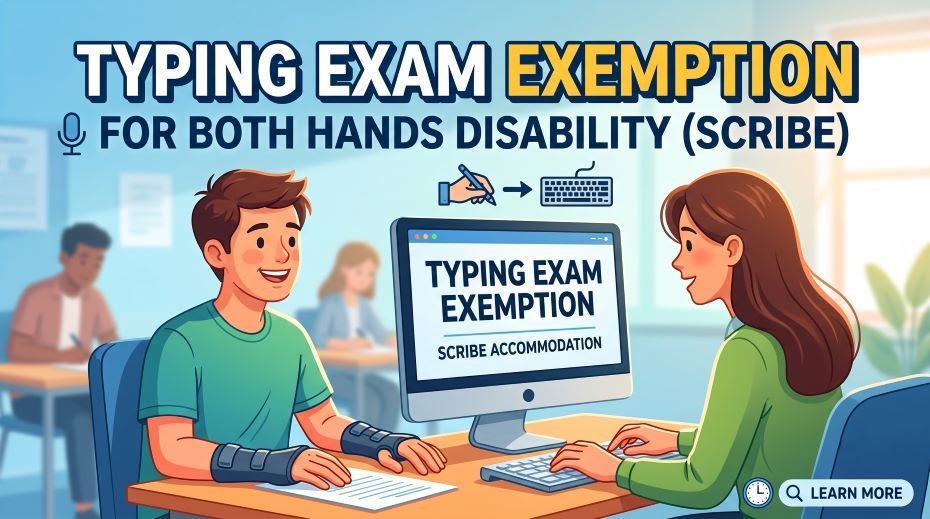
In this article we have shared info about the Typing Exam Exemption for Both Hands Disability (Scribe), Can Candidates Without Both Hands Appear for Government Typing Exams? Exemption, Scribe and Facility Guide or Can a candidate with both hands affected still appear for a government typing exam? Learn the official exemption process, scribe facility rules, and what the law actually says.
This is one of the most important and most misunderstood questions among physically challenged aspirants: if a candidate does not have functional use of either hand, can they still qualify for a government job that requires a typing test? The honest answer is yes, in most cases – but not by typing with an alternative body part as an officially recognised method. Instead, the system provides two distinct legal routes: a formal exemption from the typing test itself, or a certified scribe who types on the candidate’s behalf. This guide explains exactly how both routes work, what the disability category system recognises, and what recent court rulings have said about candidates in this exact situation.
How SSC and Similar Bodies Classify This Disability
Government recruiting bodies use a standard disability classification list under the broader framework of the Rights of Persons with Disabilities Act, 2016. Within this list, a candidate with no functional use of either hand generally falls under the category commonly labelled “BA – Both Arms Affected,” distinct from “OA – One Arm Affected” or various leg-related categories. This exact classification is what determines which facilities and exemptions a candidate is eligible for, so getting your disability certificate correctly categorised at the very first step matters more than almost anything else in the process.
The Two Official Routes: Exemption vs Scribe
For candidates who cannot physically operate a keyboard, the system does not expect them to invent an alternative typing method on their own. Instead, two structured options typically exist, and which one applies depends on the specific post applied for.
| Route | How It Works | When It Applies |
| Full exemption from typing test | Candidate is exempted entirely from the skill test and selected based on written exam performance alone | Posts where typing is not the core job function, and a valid permanent-disability certificate is submitted in time |
| Scribe-assisted typing test | A certified scribe types the passage exactly as dictated by the candidate | Posts where the skill test is mandatory and cannot be waived, such as dedicated Data Entry Operator positions |
One important distinction: for posts specifically created for data entry work, such as Data Entry Operator, the skill test is generally treated as mandatory for every candidate, and no exemption is normally granted even with a valid disability certificate. In that specific case, the scribe route becomes the only practical path forward.
How to Apply for a Typing Test Exemption
The exemption route requires precise paperwork submitted well before the exam date, not on the day itself.
- Obtain a certificate in the exact prescribed format (commonly a specific Annexure number stated in the notification) from a Civil Surgeon at a Government Health Care Institution.
- Ensure the certificate explicitly states that the disability makes the candidate permanently unfit to operate a keyboard for typing purposes.
- Submit the exemption request through the official channel and email address stated in the notification, well before the given deadline – this window is often short and strictly enforced.
- Carry the original certificate, along with a photocopy, to document verification even after submitting it earlier, since most bodies re-verify documents in person.
- Track your exemption confirmation status through the official portal rather than assuming approval; a missed step here can result in you being marked absent for the skill test instead of exempted.
How the Scribe Facility Works
When the skill test cannot be waived, the scribe system is designed to let the candidate demonstrate comprehension and dictation ability while someone else physically types. Modern implementations increasingly require the scribe to be registered and identity-verified through Aadhaar-based authentication on the official portal, rather than being an informally arranged helper.
- Choose and register your scribe through the official portal, providing their details as required, well before the admission certificate becomes active.
- Confirm the scribe’s identity verification (typically a one-time password sent to their registered mobile number) is completed before exam day.
- If a self-arranged scribe is not properly authenticated in time, many recruiting bodies will provide a scribe of their own instead – plan around this possibility rather than relying entirely on a personally chosen scribe.
- Practice dictating passages clearly and at a steady pace with a practice partner beforehand, since dictation speed and clarity directly affect scribe accuracy.
What About Typing With Feet or Other Adaptive Methods?
Some individuals with no functional hand use do learn adaptive techniques for daily computer use, including foot-operated input devices, in personal or assistive settings. However, it’s important to be realistic: standard government typing exams are not currently structured around recognising foot-typing or similar adaptive methods as an official substitute for hand typing within the exam hall itself. The two paths that are formally recognised and reliably available remain exemption and scribe assistance.
- If you have developed strong adaptive typing ability through assistive devices, it can still be valuable for the job itself once selected, even if it isn’t the accommodation route used during the exam.
- Any request for an unconventional exam accommodation should be raised in writing, with supporting medical and technical documentation, directly with the recruiting body well in advance – informal requests made at the centre on exam day are unlikely to be accepted.
- Do not assume an accommodation exists simply because it seems logical; always confirm it in writing from the official source before relying on it.
What the Courts Have Said
Legal precedent has increasingly supported candidates with significant hand or arm disabilities. In one notable case, a Delhi High Court ruling addressed a candidate with a locomotor disability affecting one arm who was denied an exemption from a computer typing test for a clerical post. The court held that requiring a full typing test from a candidate whose disability was recognised as suitable for that very post was neither fair nor legally sound, and directed that the candidate’s eligibility be judged on their written examination performance instead. Rulings like this reinforce that exemption requests are not a favour being asked for, but a right grounded in how the post itself has been classified for suitability.
Do’s and Don’ts for Both-Hands-Affected Candidates
| Situation | Do | Don’t |
| Choosing your route | Confirm early whether your target post allows exemption or strictly requires the skill test | Don’t assume all posts follow the same exemption rule – DEO-type posts usually don’t |
| Certificate format | Use the exact Annexure format and wording specified in that year’s notification | Don’t submit a generic disability certificate not matching the required format |
| Deadlines | Submit exemption or scribe registration requests well within the stated window | Don’t wait until the admit card stage to start this paperwork |
| Scribe selection | Choose someone who can type accurately and stay calm under a strict time limit | Don’t pick a scribe purely for convenience without confirming they can perform under exam conditions |
| Unofficial accommodations | Request any unconventional method in writing, in advance, from the recruiting body | Don’t attempt an unapproved method at the exam centre expecting it to be accepted |
| Rejection at verification | Ask for the specific reason in writing and use the official appeal or grievance channel | Don’t accept an informal rejection at the counter as final without requesting it in writing |
Quick Fact Table
| Point | Detail |
| Disability category | Commonly classified as “BA – Both Arms Affected” in official SSC-type disability lists |
| Exemption certificate authority | Civil Surgeon of a Government Health Care Institution, in the prescribed Annexure format |
| Posts where exemption usually isn’t available | Dedicated Data Entry Operator and similar typing-core posts |
| Scribe identity verification | Increasingly done via Aadhaar-based OTP authentication on the official portal |
| Legal backing | Court rulings have supported exemption where the post itself is classified suitable for the candidate’s disability category |
Step-by-Step Checklist
- Identify your correct disability category and get it clearly stated on your certificate.
- Check your target post’s notification for whether typing test exemption is available for your category.
- If exemption applies, gather the correct Annexure-format certificate from a Civil Surgeon well before the deadline.
- If the skill test is mandatory for your post, register and verify your scribe early through the official portal.
- Keep both digital and original physical copies of every certificate and confirmation.
- Practice dictation with a partner if you’re using the scribe route and confirm all details in writing if you’re using the exemption route.
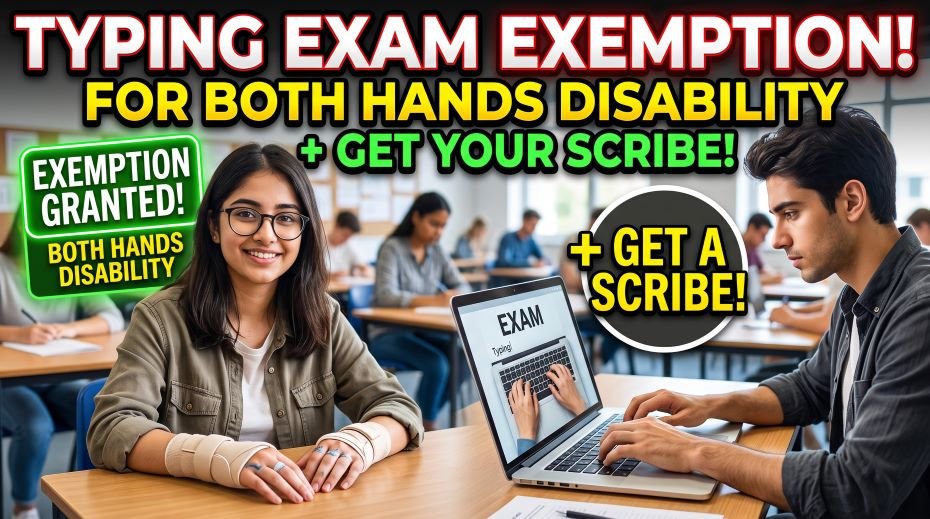
Table: Issues, Causes, Solutions & Where to Complain
For candidates with disabilities affecting both hands, typing an exam passage on a keyboard may not be physically possible – and government exam bodies do recognize this through a formal exemption process, not just extra time. However, this exemption comes with strict conditions, specific certificate formats, and post-wise exceptions that many aspirants overlook. Below is a breakdown of common issues around claiming this exemption, along with where to raise concerns, plus real examples from candidates who’ve gone through the process.
| Issue / Cause | Problem Faced | Solution / Tip | Where to Complain |
|---|---|---|---|
| Exemption wrongly assumed to be automatic | Candidate skips typing test without proper certificate, gets disqualified | Exemption must be formally claimed with a valid medical certificate – it is never automatic | Not applicable (self-preparation) |
| Wrong certificate format submitted | Application/claim rejected during document verification | Use the exact Annexure specified in that year’s notification (format varies by exam cycle – verify current one before applying) | Exam Conducting Body’s Grievance Portal |
| Certificate not from a competent authority | Exemption claim not entertained | Certificate must be from a Civil Surgeon or competent Government Medical Authority, confirming permanent inability to type | Not applicable (get certificate reissued from valid authority) |
| Exemption claimed for a DEST-mandatory post | Claim rejected since exemption doesn’t apply to that post | Check the notification carefully – exemption from typing test does not apply to posts requiring Computer Proficiency or where DEST is mandatory (with limited exceptions like Tax Assistant, CBDT) | Exam Conducting Body’s official notification |
| Original certificate not carried on exam/verification day | Facility denied even after prior approval | Always carry the original certificate, not just a photocopy, to Document Verification/Skill Test | Center Invigilator / Document Verification Officer |
| Confusion between “exemption” and “extra time” | Candidate applies for the wrong facility | Understand the difference: exemption skips the typing test entirely (specific eligibility); extra time (compensatory time) is for candidates who do take the test | Exam Conducting Body’s PwBD Cell |
| Scribe requested but not properly declared during application | Scribe not arranged on exam day | Declare scribe details at the time of application, or within the window given after applications close | Exam Conducting Body’s Grievance Portal |
| Own scribe brought without prior Aadhaar authentication | Scribe not allowed to assist | Follow current rules – many exam bodies now provide scribes only through the Commission itself | Center Superintendent |
| Post-specific exemption rules unclear to candidate | Uncertainty about eligibility before applying | Read the specific para on PwBD/DEST exemption in that exam’s official notification carefully before applying | Exam Conducting Body’s official website |
Table: Real-Life Examples
| Candidate Situation | What Happened | Outcome / Lesson |
|---|---|---|
| Candidate with both hands affected assumed exemption was automatic | Skipped the typing test without submitting any certificate | Claim was rejected; learned exemption must be formally applied for with proper documentation |
| Aspirant submitted an old exemption certificate format from a previous year’s notification | Certificate rejected during document verification | Now checks the exact Annexure number required in the current year’s notification |
| Candidate applied for a Tax Assistant (CBDT) post with valid exemption certificate | Exemption was granted since this specific post allows it | Learned that exemption availability differs by post, not just by disability |
| Candidate with both-hand disability applied for a post requiring Computer Proficiency | Exemption request denied despite valid certificate | Understood that certain posts don’t allow DEST exemption regardless of disability |
| Aspirant forgot to carry original certificate to document verification | Facility temporarily denied, resolved after producing original later | Now keeps original medical certificates in a dedicated folder for every exam |
| Candidate declared a personal scribe without prior Aadhaar verification | Scribe was not permitted to assist during the exam | Switched to using the Commission-provided scribe as per updated rules |
Note: Exemption formats, eligible posts, and Annexure numbers change with each notification cycle – always cross-check the latest official notification for your specific exam before relying on this table.
ALSO READ: One-Hand Typing in Government Exams (Pwd Typing Aspirants)
FAQ:
Is there any post where even both-hands-affected candidates cannot get any accommodation?
Some highly specialised posts explicitly requiring independent physical typing, most notably dedicated Data Entry Operator roles, are generally treated as exceptions where the skill test itself cannot be waived – though the scribe route may still apply. Always confirm this post-by-post in the official notification.
Can I request both exemption and scribe facility together?
Typically, these are treated as alternate routes rather than combined ones – exemption applies where the test is waived entirely, while the scribe facility applies where the test still needs to be attempted. Check your specific notification, since the exact mechanics can differ.
What happens if my exemption request is rejected?
Ask for the rejection reason in writing and use the recruiting body’s official grievance or appeal channel. Courts have supported candidates in similar situations before, so a rejection is not necessarily the final word if your documentation and post classification genuinely support your case.
Not having functional use of either hand does not close the door on a government career – it simply means the path runs through the correct paperwork and the right facility rather than assuming any single fixed process. Know your disability category, confirm your specific post’s exemption or scribe policy directly from the official notification, and submit every document well ahead of the deadline. The legal and procedural groundwork exists precisely so that a physical difference does not become an unfair barrier to a job you are otherwise fully qualified for.