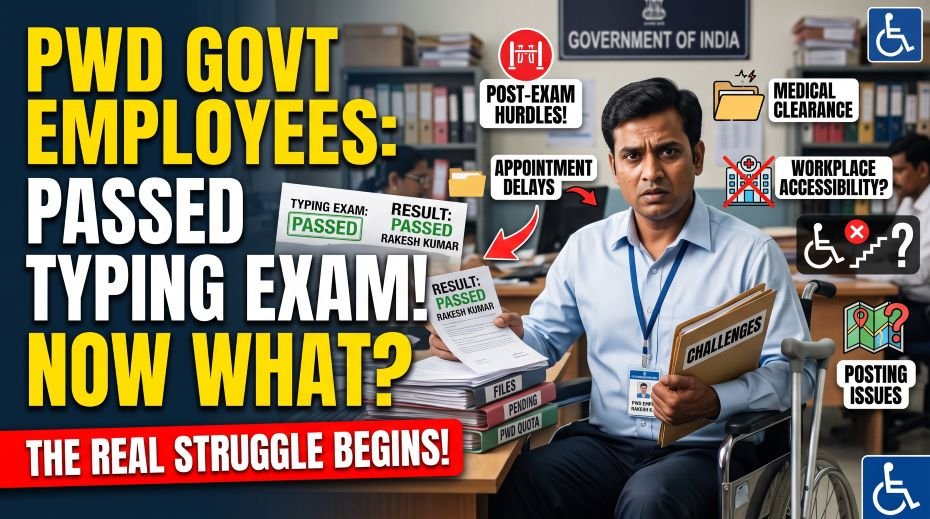
In this article we have shared info about the PwD Govt Employees Challenges After Typing Exam, PwD promotion reservation, what happens after a PwD aspirant clears the government typing exam? Real challenges around accessibility, transfers, promotion and daily routine, with solutions so, Clearing the government typing exam is a genuine milestone, but for a physically challenged candidate, it is closer to the start of a new set of challenges than the end of one. Joining day brings its own set of questions: is the building actually accessible, will colleagues understand your needs without being asked repeatedly, and how do career milestones like promotion, transfer, and departmental exams work once you’re inside the system rather than applying to enter it? This guide covers the full journey after selection – the real problems PwD employees commonly face, the solutions that work, and the legal facilities you are entitled to but may not know about.
Joining Day: What to Expect and Prepare For
- Carry your disability certificate, appointment letter, and medical documents together – document verification often repeats at the joining stage even after the exam.
- Request an office-level orientation covering physical layout, washroom locations, and emergency exits before your first working day if possible.
- Introduce your specific access needs to your immediate supervisor early and in writing, rather than assuming they’ll be inferred over time.
- Confirm your seating and desk setup can be adjusted for your condition; most offices are willing to accommodate this if asked directly.
Workplace Accessibility: What You’re Entitled To
Government buildings are expected to meet defined accessibility standards under national accessibility guidelines connected to the Rights of Persons with Disabilities Act, 2016, including ramps, accessible washrooms, and clear pathways. In practice, older buildings often lag behind these standards, so knowing what to formally request matters.
- Ramp access and railings at all entry points, not just the main gate.
- At least one accessible washroom on or near your working floor.
- Lift access or ground-floor seating where lifts are unavailable or unreliable.
- Adjustable furniture or equipment where your role requires prolonged desk work.
- If your specific building falls short, raise it in writing to your office’s grievance or welfare officer – most departments track and report accessibility gaps upward.
Common Workplace Challenges and Practical Solutions
| Challenge | Why It Happens | Practical Solution |
| Inaccessible building layout | Older government buildings predate current accessibility norms | Request specific modifications in writing; escalate through the grievance officer if ignored |
| Colleagues unsure how to help | Limited disability awareness in general workplace culture | Communicate your needs directly and clearly rather than expecting assumptions |
| Fatigue from commute plus work hours | Combined physical strain of travel and a full workday | Discuss flexible reporting time or partial remote arrangements where the role allows it |
| Being left out of informal decisions | Unconscious exclusion rather than deliberate unkindness in most cases | Proactively stay engaged in team communication channels and meetings |
| Slow processing of facility requests | Bureaucratic delay rather than refusal | Follow up in writing with reference numbers and keep a dated file of every request |
Handling Colleague and Supervisor Behaviour
Attitudes at a new workplace vary widely – some colleagues will be genuinely supportive, others simply uninformed, and a few may be dismissive. A steady, professional approach tends to work best over time.
- Set expectations early and matter-of-factly; most awkwardness fades once colleagues understand what does and doesn’t require their assistance.
- Document any pattern of unfair treatment or exclusion, rather than only reacting to isolated incidents.
- Use official channels (HR, welfare officer, or an internal grievance committee) for repeated issues instead of letting them accumulate silently.
- Build a small support network with any other PwD colleagues in your office or department; shared experience often surfaces practical fixes faster than raising things alone.
Building a Sustainable Daily Routine
- Structure your morning with extra buffer time for commute and building navigation, rather than cutting it close to reporting time.
- Plan short recovery breaks through the day if your condition causes fatigue, rather than pushing through discomfort silently.
- Keep a consistent seating and equipment setup so you’re not re-adjusting daily.
- Separate work stress from physical fatigue in your own tracking – treating them as the same thing often leads to underestimating how much rest you actually need.
Transport and Vehicle Facilities
Reaching the office reliably is often a bigger daily challenge than the work itself. A few facilities are commonly available, though they can vary by department and state.
- Many government departments allow a conveyance or transport allowance specifically for employees with mobility-related disabilities – confirm your department’s specific policy with HR.
- Reserved or accessible parking close to the building entrance is commonly available on request.
- Some state transport bodies offer travel concessions for certified PwD individuals – these are usually separate from any workplace allowance and need to be claimed directly with the transport authority.
- If you use a modified personal vehicle, check whether your department offers any allowance or reimbursement support tied to vehicle modification.
Departmental Exams and Further Career Growth
Government careers usually involve periodic departmental exams for confirmation, higher grades, or specific postings. PwD employees remain eligible for all of these on the same basis as other employees, along with the same categories of compensatory time and scribe facility used during recruitment exams where applicable.
- Confirm compensatory time and scribe eligibility separately for each departmental exam – recruitment-stage accommodations don’t automatically carry forward without a fresh request.
- Keep your disability certificate renewed and valid, since expired documentation can delay accommodation approval for internal exams too.
- Ask your HR or establishment section directly about exam-specific accommodation procedures rather than assuming they mirror the original recruitment process exactly.
Promotion: Know Your Legal Rights
One of the most significant and still under-known protections is reservation in promotion for employees with benchmark disabilities. Indian courts have repeatedly upheld this right in recent years, confirming that disability-based reservation is not limited to the point of initial recruitment.
- The Supreme Court has held that reservation benefits apply to promotion, not only initial appointment, rejecting arguments that reservation should end once a candidate is hired.
- This protection applies whether an employee was recruited under the PwD quota or developed a qualifying disability after joining service.
- If you believe you were unfairly bypassed for a promotion despite meeting eligibility criteria, request written reasons and consult your department’s grievance mechanism or a legal aid cell before escalating further.
- Keep a personal record of your appraisal ratings, exam results, and eligibility milestones, since promotion disputes are resolved far more smoothly with clear documentation.
Transfer and Posting: What You Can Request
Government policy generally allows physically challenged employees to request posting preference near their native place, recognising the added difficulty of relocating and rebuilding accessibility arrangements repeatedly. This reflects the broader principle of reasonable accommodation that Indian courts have increasingly emphasised in employment matters involving disability.
- Submit a written request for posting near your native place through proper channel, citing your disability certificate and the relevant departmental guideline.
- For Group C and D-equivalent posts recruited on a regional basis, this preference is generally easier to secure than for all-India transferable Group A or B roles.
- If a transfer would clearly worsen your access to medical care or daily support systems, state this explicitly and in writing as part of your representation.
- Keep copies of every transfer-related request and response for future reference, especially if you need to escalate the matter.
Seniority and Ranking: Common Points of Confusion
- Being recruited under a PwD reserved category does not affect your seniority position relative to colleagues recruited in the same batch – seniority is generally determined by merit order and date of joining, not by recruitment category.
- If your promotion is delayed due to reserved-category vacancy processing, this should not silently affect your seniority ranking; verify this explicitly with your establishment section.
- Raise any seniority-list discrepancy in writing as soon as you notice it, since delayed objections are harder to resolve administratively.
Quick Fact Table
| Fact | Detail |
| Government job reservation for PwD | 4% of vacancies reserved for persons with benchmark disabilities under current law |
| Benchmark disability threshold | Certified disability of 40% or more, verified by an authorised government medical authority |
| Reservation in promotion | Upheld by the Supreme Court as applicable to promotion, not just initial recruitment |
| Transfer preference | Central Government policy supports posting PwD employees near their native place, especially in regionally recruited posts |
| Recognised disability categories | 21 categories recognised under current disability rights law, expanded from 7 under the earlier law |
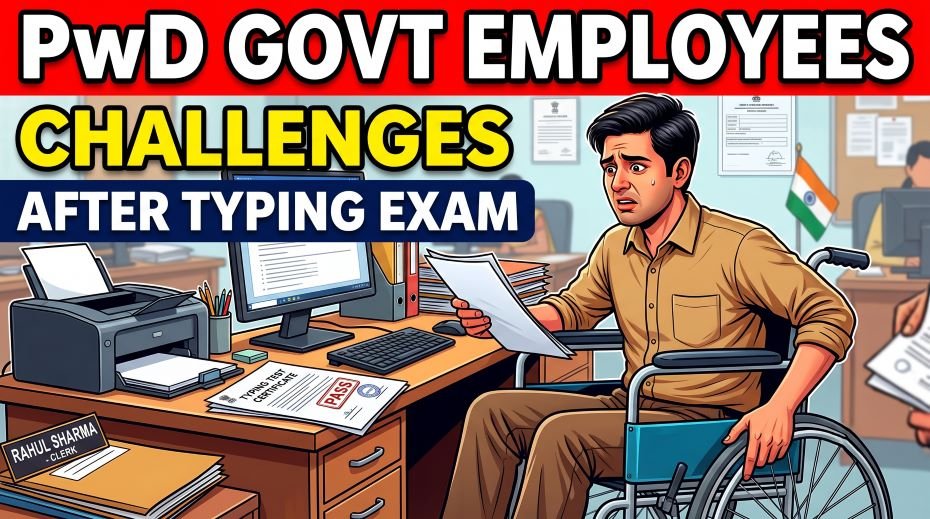
Do’s and Don’ts for PwD Employees Post-Selection
| Situation | Do | Don’t |
| Accessibility gaps | Report them in writing to the grievance or welfare officer | Don’t quietly work around a barrier that should formally be fixed |
| Colleague friction | Address it directly and calmly, escalate through HR if repeated | Don’t let repeated issues go unrecorded and unreported |
| Promotion cycles | Track your eligibility and request written reasons for any denial | Don’t assume a missed promotion was automatically fair without checking |
| Transfer requests | Apply formally with your disability certificate and departmental guideline reference | Don’t rely on a verbal request alone for something this important |
| Departmental exam facilities | Reconfirm accommodations for every new exam | Don’t assume old exam accommodations automatically carry over |
Table: Issues, Causes, Solutions & Where to Complain
Clearing the typing exam is often just the beginning – many PwD candidates who join government service face a fresh set of challenges around workplace accessibility, reasonable accommodation, and career growth. Fortunately, Indian law (the RPwD Act, 2016) puts clear obligations on government establishments and gives employees defined channels to raise concerns. Below is a breakdown of common post-selection challenges, practical solutions, and where to file a complaint, along with real examples from PwD government employees.
| Issue / Cause | Problem Faced | Solution / Tip | Where to Complain |
|---|---|---|---|
| No accessible workstation/equipment provided | Difficulty performing daily job tasks efficiently | Request reasonable accommodation in writing (assistive devices, modified equipment) – employers must provide this at no cost | Departmental Grievance Redressal Officer (mandatory under Section 23, RPwD Act) |
| Promotion denied citing disability | Career stagnation despite eligibility | Cite Section 20 of RPwD Act, which prohibits denying promotion on grounds of disability | Grievance Redressal Officer / District-Level Committee on Disability |
| Reduction in rank after acquiring disability in service | Demotion despite continued capability to perform duties | RPwD Act explicitly bars reduction in rank due to disability acquired during service | Grievance Redressal Officer of the department |
| No Liaison Officer appointed at workplace | No clear point of contact for disability-related issues | Request department to appoint a Liaison Officer as mandated under RPwD Rules | Departmental Head / Grievance Redressal Officer |
| Inaccessible office building or facilities | Difficulty in daily commute within office premises | Request barrier-free access as per accessibility standards under the Act | Grievance Redressal Officer / Chief Commissioner for Persons with Disabilities (CCPD) |
| Complaint not resolved within reasonable time | Ongoing hardship with no accountability | Grievance must be inquired into within 2 weeks of registration by law | District-Level Committee on Disability (if unsatisfied with GRO action) |
| Discriminatory treatment by colleagues/supervisors | Hostile work environment | Document incidents in writing and file formal complaint | Grievance Redressal Officer, then Chief Commissioner for Persons with Disabilities if unresolved |
| Leave denied during treatment/recovery | Financial and job security stress | Refer to applicable government leave rules for employees unfit to return to duty | Departmental HR / Grievance Redressal Officer |
| Digital tools/portals at workplace not accessible | Difficulty completing routine digital tasks (forms, reports, e-office) | Request IT support to provide accessible formats/technology as mandated under the Act | Departmental IT Support / Grievance Redressal Officer |
Table: Real-Life Examples
| Employee Situation | What Happened | Outcome / Lesson |
|---|---|---|
| PwD employee joined a department with no assistive equipment provided | Struggled with daily tasks for months without raising a formal request | Filed a written accommodation request; department was legally bound to provide it |
| Employee acquired a disability during service and was assigned a lower-responsibility role | Faced reduction in rank without cause | Escalated complaint citing RPwD Act protections; role was reinstated |
| Employee’s promotion was repeatedly delayed with no clear reason given | Suspected discrimination based on disability | Approached the Grievance Redressal Officer with documented promotion history; case was reviewed |
| PwD employee found the internal e-office portal incompatible with screen readers | Could not complete routine digital work independently | Raised the issue with IT support; accessible version was rolled out for the department |
| Employee’s complaint to the Grievance Redressal Officer went unanswered for over a month | No action taken despite the 2-week statutory timeline | Escalated to the District-Level Committee on Disability, which prompted a response |
| New employee didn’t know who to approach for workplace accessibility issues | Confusion and delay in getting support | Learned that departments are required to appoint a Liaison Officer as the point of contact |
Note: Specific rules, timelines, and escalation paths can vary by department and state – always verify current provisions with your department’s HR or the Department of Empowerment of Persons with Disabilities (DEPwD).
ALSO READ: Typing Exam Exemption for Both Hands Disability (Scribe)
FAQ:
Does reservation in recruitment guarantee reservation in promotion too?
Not automatically by default in every organisation, but courts have consistently ruled that the right to reservation legally extends to promotion as well. If your department is not applying this, it is worth raising formally rather than assuming it doesn’t apply to you.
Can I request a transfer purely for accessibility reasons?
Yes. Difficulty accessing suitable medical care, family support, or a more accessible building are all valid grounds to formally cite in a transfer request, alongside the general native-place preference many departments already recognise.
What if my office building genuinely cannot be made accessible?
Raise this formally rather than accepting it as unchangeable. Departments are expected to work toward accessibility compliance over time, and documented requests contribute to that process even if a fix isn’t immediate.
Passing the exam proves your capability; what happens afterward is about knowing – and actively using – the rights and facilities already built into the system for you. Ask for accommodations in writing, keep your own documentation trail, and treat promotion, transfer, and accessibility requests as entitlements you’re following a process for, not favours you’re hoping to receive. The framework exists precisely so a physical difference doesn’t quietly become a lifelong career ceiling.