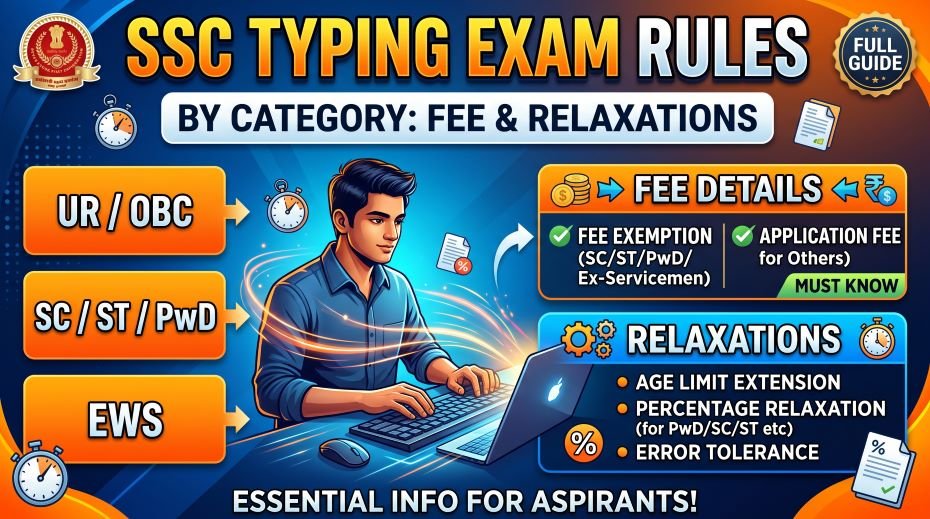
Today we have shared info about the SSC Typing Exam Rules by Category, Complete category-wise guide to government typing exam rules for Hindi and English, application fee, age relaxation, and exemptions for SC, ST, OBC, EWS, UR and PwD.
Every category listed on a government exam form – SC, ST, OBC, EWS, UR, OH, HH, VH, and Other – comes with its own set of rules around typing speed standards, application fees, age relaxation, and exemptions. Mixing these up is one of the most common and costly mistakes candidates make, sometimes resulting in a rejected form or a missed facility they were fully entitled to. This guide breaks down exactly what applies to each category for Hindi and English typing tests, so you can fill your form correctly the first time and claim every benefit you’re eligible for.
Category Table at a Glance
Government exam forms typically list the following category columns. Understanding what each one stands for is the first step before filling anything in.
| Code | Full Form | Nature of Benefit |
| SC | Scheduled Caste | Fee exemption, age relaxation, reserved vacancies |
| ST | Scheduled Tribe | Fee exemption, age relaxation, reserved vacancies |
| OBC | Other Backward Classes (Non-Creamy Layer) | Fee exemption for OBC in most exams, age relaxation, reserved vacancies |
| EWS | Economically Weaker Section | Reserved vacancies; generally no age relaxation |
| UR | Unreserved / General | Standard fee, standard age limit, no reservation |
| OH | Orthopedically Handicapped | Compensatory time, possible exemption, fee waiver |
| HH | Hearing Handicapped | Compensatory time, fee waiver, category-specific facilities |
| VH | Visually Handicapped | Scribe/passage dictator, compensatory time, fee waiver |
| Other | Ex-Servicemen and other special categories | Fee exemption, service-linked age relaxation |
Typing Rules for English and Hindi
Most government typing tests measure performance in words per minute alongside key depressions per hour, with English and Hindi held to slightly different standards.
| Language | Typical Speed Requirement | Approx. Key Depressions/Hour |
| English | 35 words per minute | 10,500 |
| Hindi | 30 words per minute | 9,000 |
Beyond raw speed, each category has a separate permissible error percentage, which affects whether a candidate qualifies even after meeting the speed benchmark.
| Category | Maximum Permissible Error |
| UR / EWS (General) | Around 20% (varies slightly by exam) |
| OBC | Around 25% |
| SC / ST | Around 30% |
These percentages are commonly seen benchmarks across SSC-type typing tests but can vary by exam and year, so always cross-check the exact figure in your specific notification before assuming it applies unchanged.
Application Fee by Category
| Category | Typical Application Fee |
| UR (male) | ₹100 (varies by exam) |
| OBC (male) | ₹100 (varies by exam) |
| EWS (male) | ₹100 (varies by exam) |
| SC | Fully exempt |
| ST | Fully exempt |
| OH / HH / VH (PwBD) | Fully exempt |
| All women candidates | Fully exempt, regardless of category |
| Ex-Servicemen | Fully exempt |
Fee exemption for PwBD candidates generally requires a valid disability certificate showing 40% or more benchmark disability, uploaded during the application and verified again later.
Age Relaxation by Category
| Category | Typical Age Relaxation |
| UR / EWS | None (standard age limit applies) |
| OBC | 3 years |
| SC / ST | 5 years |
| OH / HH / VH (General) | 10 years |
| OH / HH / VH + OBC | 13 years |
| OH / HH / VH + SC/ST | 15 years |
| Ex-Servicemen | Actual military service period plus 3 years |
Relaxations for PwBD candidates in a reserved caste category are usually cumulative rather than a simple ‘pick the higher one’ – meaning an SC candidate who is also PwBD can typically claim the combined relaxation. Always confirm this stacking rule in your specific exam’s notification, since exact wording differs.
Facilities Specific to OH, HH, and VH Categories
- OH (Orthopedically Handicapped): Compensatory time in the typing test, potential exemption from the test itself with a valid permanent-disability certificate for eligible posts, and accessible seating.
- HH (Hearing Handicapped): Compensatory time and fee exemption; typing test structure is generally unaffected since the test does not depend on hearing ability, though instructions may need to be provided in writing.
- VH (Visually Handicapped): Scribe or passage dictator facility, compensatory time, and screen reader software support (such as JAWS) at many exam centres, subject to advance request.
- All three categories require the original disability certificate to be produced at the exam centre, not just uploaded during application, to actually receive these facilities.
Do’s and Don’ts by Category
| Category | Do | Don’t |
| SC/ST | Upload a valid, current caste certificate in the correct format | Don’t submit an expired or improperly worded certificate |
| OBC | Confirm your certificate explicitly states Non-Creamy Layer status | Don’t assume a general OBC certificate without the NCL clause will be accepted |
| EWS | Use an income certificate within the required validity window | Don’t confuse EWS with OBC benefits – EWS usually has no age relaxation |
| OH/HH/VH | Carry the original disability certificate to every stage, including document verification | Don’t rely only on the uploaded soft copy at the exam centre |
| Ex-Servicemen | Carry your discharge certificate or equivalent proof | Don’t assume the benefit if already re-employed in a Group C/D civil post, since this can affect eligibility |
| All categories | Re-verify every figure in the year’s official notification before applying | Don’t rely on last year’s numbers without checking for updates |
Quick Fact Table
| Fact | Detail |
| English typing standard | Commonly 35 WPM / ~10,500 key depressions per hour |
| Hindi typing standard | Commonly 30 WPM / ~9,000 key depressions per hour |
| PwBD compensatory time | Widely seen as 20 minutes per hour of exam duration, subject to exam-specific rules |
| Fee exemption categories | SC, ST, PwBD, Ex-Servicemen, and all women candidates in most SSC-type exams |
| Maximum stackable age relaxation | Up to 15 years for a candidate who is both SC/ST and PwBD, subject to notification-specific rules |
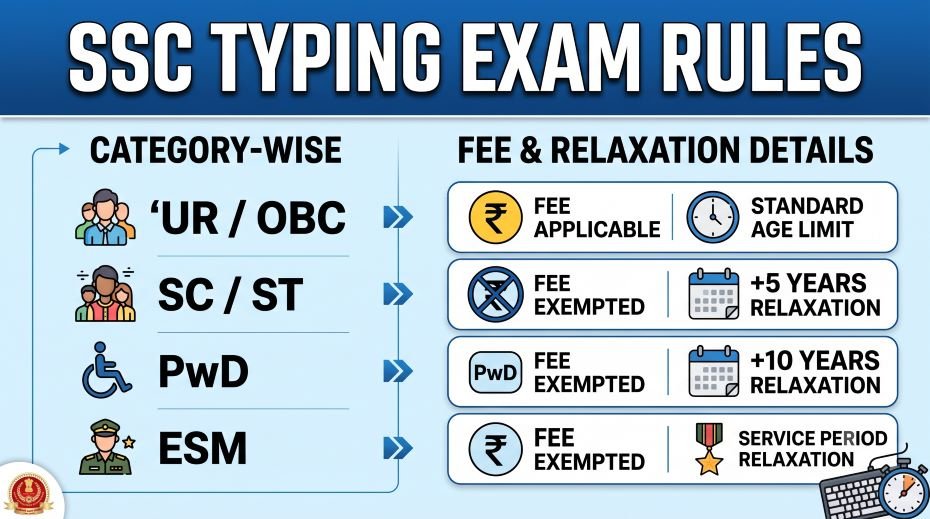
Table: Issues, Causes, Solutions & Where to Complain
SSC exams offer different application fees, age relaxations, and reservation benefits depending on category (SC, ST, OBC, EWS, PwBD, Ex-Servicemen), but many candidates lose out simply because of documentation errors or unfamiliarity with the rules. Getting the category-wise details right – and knowing where to raise an issue if something goes wrong – can make the difference between a smooth application and a rejected one. Below is a breakdown of common fee/relaxation issues, solutions, and where to complain, along with real examples from candidates.
| Issue / Cause | Problem Faced | Solution / Tip | Where to Complain |
|---|---|---|---|
| Wrong category selected at application stage | Fee charged incorrectly or relaxation not applied | Category generally cannot be changed after submission (some exams allow it only in the correction window) – always double-check before submitting | Exam Conducting Body’s Grievance Portal (during correction window, if available) |
| Fee exemption not applied despite eligible category | Fee charged even to Female/SC/ST/PwD/Ex-Servicemen candidates who should be exempted | Verify exemption applies during payment step; retain payment receipt as proof if wrongly charged | SSC Grievance Portal / Regional SSC Office |
| Age relaxation certificate missing or wrong format | Relaxation claim rejected, candidate deemed overage | Submit the relevant category certificate (caste/PwBD/ESM discharge certificate, etc.) in the prescribed format before the deadline | SSC Grievance Portal (during application/correction window) |
| Confusion between General category and EWS relaxation eligibility | Wrong category claimed, leading to rejection at verification | EWS has its own certificate and income/asset criteria – distinct from OBC/SC/ST; verify eligibility criteria before applying | Not applicable (verify before applying) |
| PwBD relaxation claimed without 40% disability certification | Relaxation claim rejected | Ensure disability certificate confirms benchmark disability of 40% or more, from a competent authority | Exam Conducting Body’s PwBD Cell |
| Ex-Servicemen relaxation miscalculated | Candidate wrongly deemed ineligible on age grounds | ESM age relaxation = actual age minus military service rendered, plus 3 years – calculate carefully using official formula | Regional SSC Office / Grievance Portal |
| Unverified rumors about “one-time age relaxation” schemes | Candidates apply based on relaxation not yet officially notified | Rely only on relaxation provisions confirmed in the official notification/gazette – treat news announcements as provisional until notified | Not applicable (verify via official notification only) |
| Widow/divorced/separated woman relaxation not considered | Eligible relaxation missed due to lack of awareness | Submit valid supporting documents (divorce decree, judicial separation order, etc.) during application/verification | SSC Grievance Portal |
| Category certificate rejected during Document Verification | Selection at risk despite qualifying in exam | Ensure certificate is issued by the competent authority in the exact prescribed Annexure format | Document Verification Officer / SSC Regional Office |
Table: Real-Life Examples
| Candidate Situation | What Happened | Outcome / Lesson |
|---|---|---|
| OBC candidate assumed fee exemption applied automatically | Was charged the full ₹100 application fee | Learned that OBC candidates (male) are not fee-exempt, unlike SC/ST/PwD/Ex-Servicemen/female candidates |
| SC candidate submitted an expired caste certificate | Certificate rejected at Document Verification | Reissued a current certificate in the correct Annexure format before the next attempt |
| PwBD candidate with 35% disability applied for age relaxation | Relaxation claim rejected for not meeting the 40% benchmark threshold | Learned the 40% benchmark disability requirement applies strictly for PwBD relaxation |
| Ex-Serviceman miscalculated his relaxed age using a generic formula | Application showed as overage during verification | Recalculated using the exact ESM formula (age minus service plus 3 years) and reapplied correctly next cycle |
| Candidate heard about a “one-time 5-year SSC age relaxation” on social media and delayed applying | Missed the actual application deadline since the scheme was never officially notified | Learned to rely only on the official SSC notification, not news claims, before making exam decisions |
| Widow candidate was unaware of applicable age relaxation | Almost missed applying due to standard age limit assumption | Found the relevant relaxation clause in the notification and applied successfully with proper documents |
Note: Fee structures, relaxation years, and eligibility conditions can differ slightly across SSC exams (CGL, CHSL, MTS, etc.) and change with each notification – always confirm current figures from the specific year’s official SSC notification.
ALSO READ: PwD Govt Employees Challenges After Typing Exam
FAQ:
Can I claim benefits under two categories at once, like OBC and PwD?
Generally yes – many exams allow PwBD candidates to additionally claim their caste-based category benefits, giving a cumulative age relaxation. However, you must choose your primary reservation category carefully during the application, since it usually cannot be changed later.
Does the EWS category get the same benefits as OBC?
No. EWS candidates typically get reserved vacancies and fee exemption in some exams, but generally do not receive the age relaxation that OBC candidates get. Treat these as separate benefit structures rather than equivalent ones.
Is the typing speed requirement different for reserved categories?
The speed requirement (words per minute) is usually the same across categories; what typically differs is the permissible error percentage, which is more lenient for OBC and SC/ST candidates compared to the unreserved category.
Filling a government typing exam form correctly starts with knowing exactly which category benefits apply to you and which don’t – mixing up OBC with EWS, or assuming a caste-based relaxation automatically stacks with a disability relaxation, are avoidable mistakes with real consequences. Keep your certificates current, confirm every fee and relaxation figure against the current year’s official notification, and claim every benefit you are genuinely entitled to.