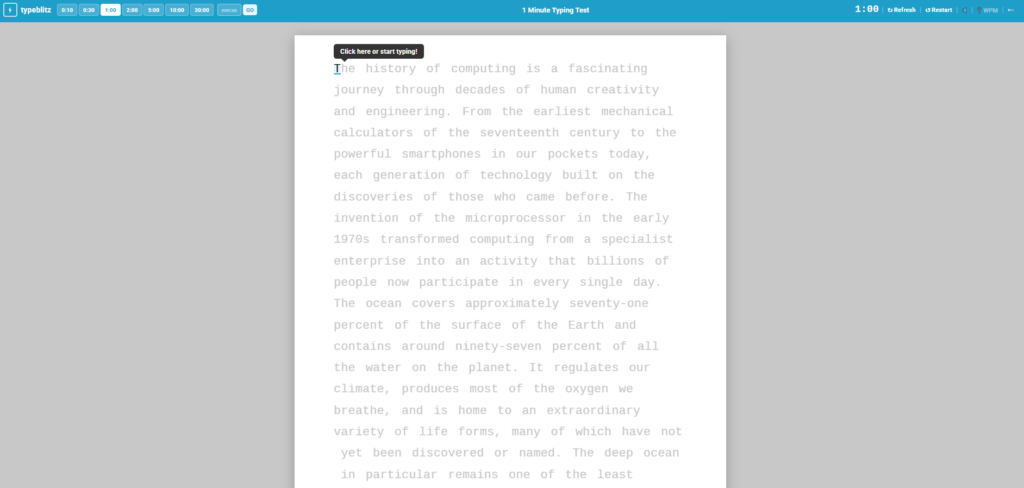
TypeBlitz (Typeblitz Type Faster Smarter (Typing Test Free Online)) is a free online typing test built for users who want fast, focused WPM practice without complications. The name reflects the tool’s core purpose: short, sharp typing sessions that sharpen your speed and accuracy in bursts rather than long drawn-out drills. Whether you have two minutes between tasks or fifteen minutes set aside for deliberate practice, TypeBlitz fits into your schedule without friction. Use it directly from this page on TypingMasterPro with no login, no installation, and no cost.
Note: Click on Link 1 to learn more about iframes, so you can understand how this typing tool currently works. A live page will open where you can try out this typing tool.
Link 1 – (https://typingmasterpro.com/typeblitz-type-faster-smarter/) click here and start typing.
Link 2 – (https://typingmasterpro.com/) Homepage
TypeBlitz is a browser-based typing speed test that measures your WPM and accuracy in a clean, fast-loading environment. It is designed around the idea that the best typing practice happens in short, intense sessions where you are fully focused for a limited time rather than grinding through extended drills that lose your attention halfway through.
The tool uses a timed test format with a focused word set. As you type, each keystroke is evaluated in real time. Correct entries advance you through the word list. Errors are highlighted immediately so you can decide whether to correct them or push through. Your final WPM and accuracy appear the moment the timer ends.
TypeBlitz features at a glance:
Running a test on TypeBlitz takes under two minutes from page load to result:
TypeBlitz is designed to load fast and start fast. The intention is that the low barrier to entry makes it easier to build the daily practice habit that actually produces long-term speed improvement. A test you can start in ten seconds is a test you are more likely to take every day.
There is a well-documented principle in skill development that short, focused practice sessions repeated consistently over time produce better results than long, infrequent sessions. This is especially true for physical skills like typing, where the goal is to build muscle memory in your fingers rather than accumulate knowledge in your mind.
When you practice at or slightly above your current ability level, your fingers are challenged to move in ways that are not yet fully automatic. This is where muscle memory is built. Practising at a comfortable pace below your maximum speed reinforces what you already know but does not push the ceiling higher. TypeBlitz’s format encourages you to type fast enough to stay challenged throughout the session.
Typing speed is stored in the same type of procedural memory as riding a bike or playing an instrument. This kind of memory consolidates during sleep and builds through repetition over days rather than hours. Practicing for fifteen minutes every day for a week produces more lasting improvement than a single two-hour session, because the daily sessions give your brain seven separate consolidation cycles instead of one.
Because TypeBlitz loads quickly and tests are short, it reduces the mental friction that prevents people from practicing consistently. The biggest obstacle to building a daily typing habit is usually not motivation but inertia. A tool that is ready to use in ten seconds removes that obstacle more effectively than one that requires navigating settings or logging in before you can begin.
Your WPM (words per minute) is your net typing speed, calculated from the number of correctly typed characters divided by five, then divided by the test duration in minutes. This standard formula treats every five characters including spaces as one word, keeping the calculation consistent across tests with different word lengths. WPM is the number most employers, exam boards, and professional typing standards use to specify speed requirements.
Your accuracy percentage shows what proportion of your total keystrokes were correct. Accuracy below 95% means errors are meaningfully reducing your effective typing speed in real tasks. Every uncorrected error in a real document requires a return visit, costing you more time than it took to make the mistake in the first place. Chasing WPM at the cost of accuracy is a counterproductive strategy for most users.
A single test result tells you your speed on that particular session with those particular words. A more meaningful picture comes from averaging your last five to ten results. If that average is rising week over week, your practice is working. If it is flat or declining, something in your approach needs to change — most commonly, you need more targeted weak-key practice rather than simply repeating more tests.
| WPM Score | Level | Context | What to Work on Next |
| Under 30 | Beginner | Learning touch typing | Home row position, no keyboard glancing |
| 30 to 45 | Basic | Casual everyday typist | Daily 15-min sessions, accuracy first |
| 45 to 60 | Intermediate | Office or admin professional | Punctuation, number keys, consistency |
| 60 to 80 | Proficient | Professional typist or writer | Advanced word sets, sustained pace |
| 80 to 100 | Advanced | Developer, journalist | Accuracy at high speed, rare words |
| 100+ | Expert | Competitive or specialist typist | Maintain speed, reduce error rate |
For government exam candidates in India: SSC CGL and CHSL require a minimum of 35 WPM in English, CPCT requires 30 WPM with 85% accuracy, and bank clerk posts typically require 40 WPM. A consistent practice score of 50 to 55 WPM on TypeBlitz gives you a reliable buffer for actual exam conditions.
TypeBlitz is particularly well suited for people who want to maintain or improve their typing speed but cannot commit to long daily practice sessions. A two-minute TypeBlitz test at the start of the workday takes less time than making a cup of tea and gives you a daily benchmark plus a warm-up for the typing work ahead.
For students preparing for competitive exams, the challenge is often consistency rather than effort. TypeBlitz’s fast-start format makes it easier to take a test every day as part of a study routine rather than treating it as a separate activity that requires setup time.
Typists stuck in the 45 to 60 WPM range often benefit from short, intense sessions that push them slightly above their comfort pace. TypeBlitz’s format encourages this kind of edge practice. Pair it with Key Rush on TypingMasterPro to identify which specific keys are holding your speed back at this level.
Not every practice session needs to be a structured training routine. Sometimes you just want to know how fast you are typing today. TypeBlitz is ideal for this use case. Two minutes, one result, done.
TypeBlitz works best alongside other tools that address different aspects of typing improvement. Here is how to integrate it into a practical daily routine:
| Tool | Session Style | Text Type | Pressure Level | Best Use |
| TypeBlitz | Short timed bursts | Word lists | Moderate | Daily habit and quick benchmarks |
| Monkey Typing | Timed with themes | Word lists | Moderate | Daily WPM tracking with variety |
| Key Racer | Competitive race | Passages | High | Pressure practice and exam prep |
| 10 Fast Fingers | Timed with leaderboard | Common words | Moderate | Global comparison and ranking |
| Key Rush | Open-ended adaptive | Pseudo-words | Low | Targeted weak key improvement |
| TypeWhiz | Timed standard test | Word lists | Moderate | Quick clean WPM check |
Yes. TypeBlitz on TypingMasterPro is completely free with no account, no subscription, and no premium tier. All features are available at no cost.
TypeBlitz is designed around short test durations suited to quick focused sessions. The standard test is typically 60 seconds or less, giving you a complete WPM and accuracy result in under two minutes from page load.
TypeBlitz works in mobile browsers. For accurate WPM measurement that reflects real typing ability, a physical keyboard gives better results than a touchscreen keyboard. Touchscreen input adds latency and limits maximum speed in ways that a physical keyboard does not.
Variation of 5 to 10 WPM between individual tests is completely normal. Factors include finger warmth, the specific words shown in that test, time of day, and focus level. Average your last five tests for a more reliable measure of your current speed.
WPM is the number of correctly typed characters divided by five, then divided by the test duration in minutes. Five characters is the standard definition of one word, making the calculation consistent regardless of whether the words in the test were short or long.
For professional use and competitive exams, 95% accuracy or above is the standard to aim for. For CPCT specifically, the stated minimum is 85%, but practising at 95% gives you a comfortable margin on exam day.
A WPM plateau usually means the remaining gains are in specific keys or habits rather than general practice volume. Switch to Key Rush on TypingMasterPro for a week to identify your slow keys, address them with targeted practice, then return to TypeBlitz tests. Most users see a noticeable improvement after this cycle.
Use the TypeBlitz tool in the iframe above to take your first test. It takes less than two minutes and gives you an immediate picture of your current typing speed. Come back every day for a short session and track your results week over week. Consistent daily short sessions are the most reliable route to a higher WPM and better accuracy.
Explore the full range of typing tools on TypingMasterPro to build a balanced practice routine. Use Monkey Typing Test for theme-based daily benchmarking, Key Racer for competitive pressure practice, Key Rush for targeted weak-key training, and 10 Fast Fingers for global leaderboard comparison. All tools are free and available without login.