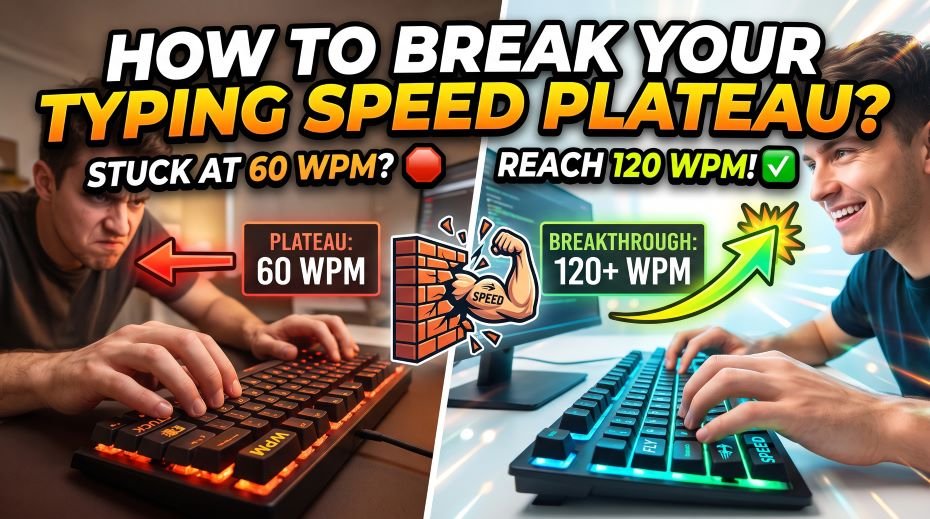
This article explains exactly why typing plateaus happen, How to Break Typing Speed Plateau? what is happening in your brain during a plateau, the 8 most common plateau types with their specific fixes, a diagnostic tool to identify which plateau you are in, and a structured 3-week breakthrough plan. Stuck at 25, 30, or 40 WPM for weeks despite daily practice? This is a typing plateau, and it has specific, fixable causes. Here is why it happens and exactly what to do to break through it. By the end, you will know not just what to do – but precisely why it will work.
You have been practicing every day. You started at 20 WPM, improved to 28 WPM, and then – nothing. For two weeks, three weeks, a month – your speed refuses to move. Every practice session shows the same number. You are doing everything right, you think. So why is nothing changing?
Welcome to the typing speed plateau – one of the most frustrating and misunderstood phases in skill development. It happens to almost every typist at some point, and it is not a sign of failure, lack of talent, or wasted effort. It is actually a predictable, well-understood phenomenon in motor learning science – and it has specific, identifiable causes and proven fixes.
Quick Facts: The Typing Speed Plateau
| Question | Answer |
| What is a typing plateau? | A period where WPM stops improving despite continued practice – normal in all motor skill learning |
| How common is it? | 100% of typists hit at least one plateau – usually at 25–30 WPM and again at 50–60 WPM |
| Most common plateau points | 25–30 WPM (beginner plateau) | 40–45 WPM (intermediate) | 55–65 WPM (advanced) |
| How long does a plateau last? | Without targeted intervention: weeks to months. With the right fix: 1–3 weeks to break through |
| Is the plateau my fault? | Not always – often caused by incorrect practice method, not lack of effort |
| Most common cause | Practicing the same way repeatedly – building no new skill, only reinforcing existing limits |
| Biggest mistake when plateaued | Practicing MORE of the same thing. Volume does not fix a plateau – method change does. |
| Can everyone break a plateau? | Yes – every plateau has a specific cause and a specific fix. No plateau is permanent. |
The typing plateau is not a ceiling – it is a floor. It means your current practice method has taken you as far as it can. To go higher, you need a different approach, not more of the same.
The Science Behind Why Typing Plateaus Happen
To understand plateaus, you need to understand how your brain builds typing skill. Typing is a procedural memory skill – stored in the same neural systems as riding a bicycle or playing piano. Unlike declarative memory (facts you know), procedural memory is built through repetition of specific movement patterns until they become automatic.
When you first learn typing, every keystroke requires conscious attention – your working memory is fully engaged finding each key. As you practice, keystroke patterns are gradually transferred from conscious control to automatic motor programs stored in the basal ganglia and cerebellum. This transfer produces the rapid early improvement most people experience in the first 4–8 weeks.
The plateau arrives when this transfer is essentially complete for your current practice patterns – but not yet complete for more challenging patterns needed at higher speeds. Your motor system has automated everything it currently knows. To improve further, it must encounter and automate new, harder patterns. But if your practice never exposes it to those harder patterns – because you keep practicing the same way – no new automation occurs. WPM stays flat.
The Three Stages of Typing Skill and Where Plateaus Hit
| Stage | WPM Range | What Brain Is Doing | Where Plateau Hits |
| Cognitive | 0–20 WPM | Conscious key-by-key control. Slow, effortful, deliberate. | Early plateau at 15–20 WPM when all easy keys are learned but hard keys still trip you |
| Associative | 20–50 WPM | Patterns automating. Errors decreasing. Common words feel automatic. | Main plateau at 25–35 WPM – the most common and most frustrating plateau |
| Autonomous | 50+ WPM | Fully automatic. Thinking about words/sentences, not keys. | Advanced plateau at 55–65 WPM – requires very targeted bigram drilling to break |
Most government exam aspirants encounter the Associative plateau (25–35 WPM). This is also the most fixable – because the cause is almost always one of the 8 specific issues identified below.
Self-Diagnosis: Which Plateau Are You In?
There are 8 distinct types of typing plateaus, each with a different cause and a different fix. Answer these questions to identify yours:
| # | Question | If YES – Your Plateau Type | Jump To |
| 1 | Do you still look at the keyboard sometimes? | Visual Dependency Plateau | Fix #1 below |
| 2 | Do you practice the same words / passages every day? | Familiarity Plateau | Fix #2 below |
| 3 | Are there 3–6 specific keys that always slow you? | Bottleneck Key Plateau | Fix #3 below |
| 4 | Do you slow down dramatically at punctuation or numbers? | Character Range Plateau | Fix #4 below |
| 5 | Are you always practicing at the same comfortable speed? | Comfort Zone Plateau | Fix #5 below |
| 6 | Do you type quickly but with many errors and corrections? | Accuracy Debt Plateau | Fix #6 below |
| 7 | Is your speed fine for 2–3 min but drops in longer tests? | Endurance Plateau | Fix #7 below |
| 8 | Have you been practicing less than 20 min/day recently? | Volume Deficit Plateau | Fix #8 below |
You may identify with more than one plateau type – this is common. Address them in the order they appear in the list above. Fix #1 first (if applicable), then Fix #3, etc.
8 Plateau Types and Their Exact Fixes – How To Break Typing Speed Plateau?
Plateau Type 1: Visual Dependency Plateau (Most Common – 25–35 WPM)
This is the most widespread plateau at any WPM level. You are still glancing at the keyboard – even occasionally – and this visual dependency is creating a speed ceiling by breaking rhythm and limiting automation.
- Symptom: WPM stuck between 25–35. Speed improves during easy, familiar passages but drops on unfamiliar text. Occasional glances when uncertain.
- Root cause: Motor memory is incomplete – visual confirmation is still supplementing it for 5–15% of keystrokes.
- The fix: Physical keyboard cover for 2 weeks (see Article #1 in this series). Until the visual dependency is completely eliminated, no amount of additional practice will break this plateau.
- Timeline to breakthrough: 2–3 weeks after eliminating keyboard glancing completely.
- How to confirm this is your plateau: Run a 5-minute test in a dark room where the keyboard is hard to see. If your WPM drops compared to normal – visual dependency is your plateau cause.
Plateau Type 2: Familiarity Plateau (Practicing Same Content)
Your brain has learned the specific passages you practice – not the general skill of typing. You have memorized patterns rather than built transferable motor skill. This is one of the most common and least recognized plateau causes.
- Symptom: WPM is noticeably higher on familiar practice texts than on new passages. You feel ‘ready’ during practice but struggle in actual tests with unfamiliar text.
- Root cause: Practicing the same 10–20 passages repeatedly builds memory for those specific word sequences – not general typing automaticity. Government exam passages are always new text.
- The fix: Switch to random text practice immediately. Use Monkeytype’s ‘random words’ or ‘1000 most common words’ mode. Use TypeRacer where you cannot predict the next passage. Never practice the same passage twice in one week.
- Timeline to breakthrough: 1–2 weeks of varied-text practice typically restores upward WPM movement.
- Prevention: Rotate through at least 10 different passage sources per week. Government exam prep passages, literary quotes, news articles, Wikipedia text – variety is the antidote.
| Practice Type | Plateau Risk | Recommendation |
| Same 5 passages repeated daily | Very High – builds passage memory | Stop immediately – switch to random text |
| 10+ different passages per week | Low | Good practice – maintain variety |
| TypeRacer (random quotes) | Very Low – never repeats | Excellent – use daily |
| Monkeytype random words | Very Low | Excellent for general fluency |
| Government-style formal passages | Medium if same ones repeated | Rotate through large passage bank |
Plateau Type 3: Bottleneck Key Plateau (The Slowest Key Controls All)
Your overall typing speed is being dragged down by a small number of keys – typically 3–6 – that are significantly slower than the rest of your keyboard. Because every key in every word matters, your slowest keys act as bottlenecks that cap your average WPM.
- Symptom: Your speed is inconsistent – fast on some words, suddenly slow on others. Certain letters or combinations cause a noticeable hesitation.
- Root cause: Uneven skill distribution across the keyboard. Common with self-taught typists who used some keys far more than others, leaving certain keys under-drilled.
- How to identify your bottleneck keys: Use Keybr.com – it automatically identifies your slowest key pairs (bigrams) with millisecond precision. Or: run a 5-minute test and note every word where you felt your fingers hesitate.
- The fix: Spend 5 minutes per session on ONLY your slowest 3 keys. Build targeted word lists using those keys heavily. Drill until those specific keys feel as automatic as your fastest keys.
- Timeline to breakthrough: 10–14 days of targeted bottleneck drilling typically restores WPM growth.
| Common Bottleneck Keys | Why They Are Slow | Targeted Drill Words |
| B and Y | Index fingers must cross the home row – awkward movement | baby, beyond, habit, buyback, beauty, hybrid |
| P | Right pinky stretch upward – least practiced finger | paper, people, possible, pepper, purple, apply |
| Q and Z | Extreme corners – rare letters, least practiced | quiz, quick, queen, zone, zero, puzzle, freeze |
| Numbers row | All fingers must stretch significantly upward | Dates, phone numbers, addresses, prices |
| Shift + letter | Coordination between two hands – right Shift + left letter | Capital sentences, proper nouns, acronyms |
Plateau Type 4: Character Range Plateau (Punctuation and Numbers)
Your letter typing is good – but punctuation marks, numbers, capital letters, and special characters drag your average WPM down dramatically whenever they appear. Government exam passages consistently include these characters.
- Symptom: High WPM on word-only tests (Monkeytype ‘no punctuation’ mode) but significantly lower WPM on passages with commas, periods, capitals, and numbers.
- Root cause: Most beginner practice focuses on letter keys only. Punctuation and numbers are practiced far less and remain conscious, slow, hesitant keystrokes.
- The fix: Add a dedicated 5-minute ‘punctuation and numbers drill’ to every session. Use Monkeytype with punctuation and numbers enabled. Practice typing email addresses, dates, addresses, phone numbers – all rich in special characters.
- For Hindi Kruti Dev typists: The equivalent problem is matras, half-characters, and the number row in Devanagari. Drill the 10 most common matras as isolated exercises before adding them to passages.
- Timeline to breakthrough: 2–3 weeks of daily punctuation drilling typically adds 3–8 WPM to government-passage test scores.
Plateau Type 5: Comfort Zone Plateau (Always Practicing at Comfortable Speed)
This is the most counterintuitive plateau cause. You are practicing at a speed that feels good – you make few errors, you feel in control, you finish each session feeling competent. But this comfortable speed is exactly the problem.
- Symptom: Practice sessions feel smooth and easy. WPM is consistent. But the number never goes up. You feel like you are doing well – because you are, at your current level.
- Root cause: Motor skill improvement only happens at the edge of current capability – the research term is ‘desirable difficulty’. Practicing within your comfort zone builds fluency at the current level but does not push the ceiling higher.
- The fix: The ‘110% Speed Drill’. Set your practice to 110% of your current comfortable WPM. At this speed, you will make errors – that is the point. The error-making at higher speed is what forces new neural pathway formation.
- How to do 110% drills: Run a TypeRacer race against bots set to your WPM + 10. On Monkeytype, enable ‘always wrong’ sounds to signal every error – then deliberately push speed until you hear those sounds. Uncomfortable = improving.
- The balance: 70% of practice at comfortable speed (for accuracy reinforcement) + 30% at 110% speed (for ceiling-raising). Never do 100% of practice at either extreme.
| Practice Mode | Effect on Plateau | When to Use |
| 100% comfortable speed | Reinforces current level – NO ceiling raise | Never exclusively – mix with challenge speed |
| 110% challenge speed | Forces new pathway formation – raises ceiling | 30% of each session |
| 90% accuracy-focus speed | Builds clean patterns – reduces error debt | 20% of each session |
| Optimal mix (70/20/10) | Comfort/challenge/accuracy – balanced growth | Best overall approach for plateau-breaking |
Plateau Type 6: Accuracy Debt Plateau (Fast but Sloppy)
You have been chasing WPM without maintaining accuracy. Over time, your fingers have learned to type quickly but incorrectly – building ‘accuracy debt’ that now caps your net WPM even though your gross speed is higher than your score suggests.
- Symptom: Gross WPM looks decent (35–40) but net WPM after error deductions is much lower (25–28). You make many of the same errors repeatedly. Backspace is your most-used key.
- Root cause: Speed-first practice builds fast-but-wrong motor patterns. Once these wrong patterns are automated, they are hard to override – because wrong automation is still automation.
- The fix – ‘Accuracy Reset’: For 2 full weeks, reduce your typing speed to 70% of current WPM and enforce 98%+ accuracy. Every error should feel unacceptable. Practice at this slow-but-perfect pace until the correct patterns are re-automated.
- After the reset: Slowly increase speed – 3 WPM per week – maintaining 96%+ accuracy at each step before moving up. Never sacrifice accuracy to gain speed again.
- Net WPM calculation reminder: Government tests measure NET WPM – gross WPM minus error penalties. An error-prone 40 WPM typist may score lower than an accurate 32 WPM typist in the same test.
| Gross WPM | Error Rate | Net WPM (approx.) | Verdict |
| 40 WPM | 10% errors | ~33 WPM | Fails SSC CHSL 35 WPM standard despite 40 gross |
| 38 WPM | 4% errors | ~36 WPM | Passes SSC CHSL 35 WPM standard |
| 35 WPM | 1% errors | ~34.5 WPM | Just below – needs 1 more WPM or fewer errors |
| 33 WPM | 0.5% errors | ~32.8 WPM | Fails – but most improvable with accuracy work |
If your error rate exceeds 5%, fixing accuracy will improve your government exam score more than any amount of additional practice at your current sloppy speed.
Plateau Type 7: Endurance Plateau (Fast Short-Term, Slow Long-Term)
Your 1-minute WPM is significantly higher than your 10-minute WPM. You can type fast in bursts but your speed degrades substantially during longer tests – exactly the format used in government typing exams.
- Symptom: TypeRacer shows 45 WPM but 10-minute government-style tests show 30–33 WPM. Speed clearly drops in the second half of a long test. Hands or fingers feel fatigued.
- Root cause: Practice has focused on short sessions. The specific neural and physical conditioning for sustained high-speed typing over 10 minutes has not been built.
- The fix – Endurance Building Protocol: Progressively extend your continuous typing sessions. Week 1: practice 5-minute continuous tests. Week 2: 7-minute sessions. Week 3: full 10-minute sessions. Week 4: 12-minute sessions (deliberate over-preparation).
- Typelit.io for endurance: Typelit.io has you type full books – long-form continuous typing that builds endurance better than any short-burst practice tool.
- Physical conditioning: If fingers genuinely feel tired, take 30-second breaks every 5 minutes and do finger stretches. Improve your typing posture – slouching accelerates physical fatigue.
- Timeline to breakthrough: 3–4 weeks of progressively longer sessions typically equalizes short-test and long-test WPM.
Plateau Type 8: Volume Deficit Plateau (Not Enough Practice Time)
Sometimes the plateau diagnosis is simple: you are not practicing enough – or you were, but life got busy and your daily practice time dropped without you fully realizing it.
- Symptom: WPM was improving before, then stopped. No other obvious technical cause. Practice has become irregular or shorter than before.
- Root cause: Motor skill maintenance requires minimum threshold input. Below approximately 15–20 minutes of daily practice, motor memory degradation keeps pace with new learning – producing no net improvement.
- The fix: Recommit to minimum 25–30 minutes daily. Track your practice sessions in a notebook. The habit of tracking creates accountability. Be specific: same time each day, same location.
- Sleep matters: Motor memory consolidation happens during sleep. If you are sleep-deprived, your practice efficiency drops dramatically. Consistent sleep + consistent practice = consistent improvement.
- Quality over quantity: 25 minutes of focused deliberate practice is more valuable than 60 minutes of distracted, casual typing. Put your phone away. Close other tabs. Time-box your session.
Plateau Diagnostic Summary: Quick Reference
| Plateau Type | WPM Range | Key Symptom | Primary Fix |
| Visual Dependency | 25–40 WPM | Glancing at keyboard even sometimes | Physical cover method for 2 weeks – no peeking |
| Familiarity | Any WPM | Better on familiar text than new passages | Switch to random text practice immediately |
| Bottleneck Key | Any WPM | Noticeable hesitation on specific keys | Identify 3 slowest keys via Keybr; drill daily |
| Character Range | 30–55 WPM | Numbers/punctuation cause sharp slowdown | 5-min daily punctuation and number drills |
| Comfort Zone | Any WPM | Practice feels too easy, no challenge | 110% speed drills – 30% of each session |
| Accuracy Debt | 30–50 WPM | High gross WPM but low net; many errors | 2-week accuracy reset at 70% speed, 98% accuracy |
| Endurance | 35–60 WPM | Short tests fast; 10-min tests much slower | Progressive long-session training (5→10→12 min) |
| Volume Deficit | Any WPM | Practice has become irregular or shorter | Recommit to 25–30 min daily; track in notebook |
Use this table as your quick reference. Match your main symptom to the plateau type and apply the corresponding fix. If you match more than one, fix them in the order listed – Visual Dependency first, then Familiarity, then Bottleneck Key, etc.

3-Week Plateau Breakthrough Plan: Day-by-Day Schedule
Here is a structured 3-week plan that combines the most effective plateau-breaking techniques. It is designed for the most common scenario: the 25–40 WPM plateau that government exam aspirants hit. Adapt based on your specific plateau type identified above.
Week 1 – Diagnosis and Foundation Reset
| Day | Time | Activity | Goal |
| Day 1 | 30 min | Baseline test (10 min) on new text. Use Keybr to identify 3 slowest keys. Record all data. | Know exactly where you are and why |
| Day 2 | 30 min | Cover method + home row drills only (if visual dependency). Or: switch to TypeRacer random text (if familiarity plateau). | Attack root cause directly |
| Day 3 | 30 min | Bottleneck key drills (5 min on each of 3 slowest keys) + general passage typing at 90% accuracy focus.. | Target weakest links |
| Day 4 | 30 min | Punctuation and numbers drill (10 min) + mixed passage practice on varied texts. | Expand character range |
| Day 5 | 30 min | 110% speed drill (10 min) + accuracy-focus drill at 70% speed (10 min) + short mock test (10 min). | Push ceiling + clean patterns |
| Day 6 | 30 min | Repeat Day 3 activities. Focus on weakest key identified Monday – has it improved? | Reinforce specific improvement |
| Day 7 | 15 min | Rest day – light practice only. One 10-min test to record Week 1 ending WPM. | Recovery + measurement |
Week 2 – Targeted Attack on Plateau Cause
| Day | Time | Activity | Focus |
| Day 8 | 35 min | Full session on plateau-specific fix (see Week 1 diagnosis). Bottleneck drilling + varied text. | Deep plateau fix work |
| Day 9 | 35 min | Interleaved practice: 5 min bottleneck drill → 5 min random passage → 5 min 110% speed → repeat. | Interleaving for retention |
| Day 10 | 35 min | Long-form endurance session: type continuous passage for 12 minutes. Note where speed drops. | Build endurance baseline |
| Day 11 | 35 min | Competition practice: 10 TypeRacer races. Note average WPM. Attempt to beat personal best. | Pressure simulation |
| Day 12 | 35 min | Return to bottleneck keys – are they faster? Adjust drill if improvement seen. Add 4th slowest key. | Adaptive targeting |
| Day 13 | 35 min | Government-style passage practice (10 min formal passage × 2). Note punctuation problem spots. | Exam simulation |
| Day 14 | 20 min | Rest + measurement: full 10-min government-style test. Compare to Day 1 and Day 7. | Measure Week 2 progress |
Week 3 – Consolidation and Ceiling Push
| Day | Time | Activity | Focus |
| Day 15 | 35 min | 110% speed drill (15 min) – push hard. Accept many errors. Speed, not accuracy, is the goal here. | Ceiling push – maximum stress |
| Day 16 | 35 min | 98% accuracy at 90% speed (15 min). Repair accuracy after yesterday’s push. | Quality consolidation |
| Day 17 | 35 min | Full exam simulation: 10-min government-style test × 2. Rest 5 min between. | Real exam conditions |
| Day 18 | 35 min | Varied text day: TypeRacer (5 races) + Monkeytype random words (10 min) + news article passage (10 min). | Transfer of skill to new contexts |
| Day 19 | 35 min | Weak points revisit: what is still slow? Target those specifically for last push. | Final gap-filling |
| Day 20 | 35 min | Mixed optimal session: 10 min bottleneck drill + 10 min exam passage + 10 min TypeRacer races. | Best-of-all practice |
| Day 21 | 20 min | Final measurement: 10-min government-style test. Compare to Day 1. Celebrate the improvement. | Record 3-week gain |
Most candidates see 5–15 WPM improvement over 3 weeks of this focused plateau-breaking program. The improvement is most dramatic in candidates with the Bottleneck Key or Familiarity plateau types.
What Plateau Breakthrough Actually Looks Like: Realistic Expectations
One of the most important things to understand about breaking a typing plateau is that improvement is rarely linear. Here is what the real pattern looks like:
| Period | WPM Pattern | What Is Happening | What to Do |
| Days 1–5 | May DROP 2–5 WPM | New practice method disrupts old patterns. Normal. | Trust the process. Do not revert to old habits. |
| Days 6–10 | Stabilizes at old WPM | New patterns establishing. Old patterns not yet replaced. | Continue targeted drills. Variety of texts. |
| Days 11–14 | First +1 to +3 WPM | New motor pathways beginning to activate. | This is the turning point. Redouble effort now. |
| Days 15–18 | +3 to +8 WPM gain | Breakthrough phase – rapid improvement as new patterns consolidate. | Maintain method. Don’t switch to new approach mid-breakthrough. |
| Days 19–21 | +5 to +12 WPM total | New baseline established. Old plateau broken. | Measure and celebrate. Plan next stage of development. |
The WPM dip in Days 1–5 is the most common reason people give up on plateau-breaking. They interpret the drop as proof the new method is not working – and revert. In reality, the dip is proof it IS working – old patterns are being disrupted.
also read: Why You Type Well in Practice but Fail in Exam? Speed Drop
Typing Plateaus in Hindi Kruti Dev: Special Considerations
Hindi Kruti Dev typing has its own distinct plateau patterns that differ from English QWERTY plateaus. Here are the most common Hindi-specific plateaus and their targeted fixes:
| Hindi Plateau Type | Symptom | Specific Fix |
| Matra (vowel sign) hesitation | Speed drops on every word with a matra (आ, इ, ई, उ, ऊ, etc.) | Drill each matra separately for 2 min daily. ‘की मात्रा’, ‘का मात्रा’ – 100 repetitions each until automatic. |
| Half-character (आधे अक्षर) plateau | Hesitation on every half-character: क्, ख्, ग्, etc. | Make a list of 20 most common half-character words. Drill daily with keyboard cover. |
| Kruti Dev layout unfamiliarity | Still looking at keyboard for many Hindi characters | Print Kruti Dev chart at eye level. Zone-by-zone learning: home row week 1, top row week 2, etc. |
| Compound character (conjuncts) plateau | Slows dramatically on संयुक्त अक्षर (ksha, gya, tra, etc.) | Dedicated conjunct drilling: list 15 most common conjuncts and drill in isolation. |
| Hindi number row plateau | Speed drops severely when Hindi numerals appear in passage | 5-min daily Devanagari number row drill. Practice typing phone numbers and dates in Hindi. |
Hindi Kruti Dev plateaus often last longer than English plateaus because the character set is more complex and learning resources are fewer. Be patient and drill each character category in isolation before combining them in passages.
Best Tools for Breaking Your Typing Plateau
| Tool | Best For | Link |
| Keybr.com | Identifying and drilling bottleneck keys | keybr.com |
| Monkeytype | Random text, blind mode, punctuation mode, speed tracking | monkeytype.com |
| TypeRacer | Varied text, competitive pressure, 110% speed practice | typeracer.com |
| Typelit.io | Endurance building – long-form continuous typing | typelit.io |
| TypingMasterPro.com | Government-style 10-min tests – exam simulation | typingmasterpro.com |
FAQ:
How long does a typing plateau last?
Without any change in practice method, a typing plateau can last indefinitely – some self-taught typists stay at the same WPM for years because they keep doing exactly what stopped working. With targeted intervention (identifying the specific plateau type and applying the corresponding fix), most plateaus break within 2–3 weeks. The 3-week plan in this article is designed specifically to break the most common 25–40 WPM plateau that government exam aspirants face.
I have been practicing for 3 months and am still at 28 WPM. What is wrong?
Three months of practice with no improvement is a classic plateau situation – almost certainly caused by one of the 8 plateau types identified in this article. The most likely causes for a 3-month 28 WPM plateau are: (1) Visual dependency – still glancing at the keyboard, (2) Familiarity – practicing the same passages repeatedly, or (3) Comfort zone – practicing at the same speed without ever pushing harder. Use the self-diagnosis table above to identify your specific type, then apply the targeted fix.
Is it normal for WPM to drop when I try to break a plateau?
Yes – completely normal and actually expected. When you change your practice method to break a plateau, you are disrupting established (but limited) motor patterns and building new ones. The disruption phase always involves a temporary WPM drop. This drop typically lasts 3–7 days and is followed by a recovery and then improvement beyond your previous plateau level. The candidates who break through are the ones who accept the temporary drop; the ones who stay plateaued are those who revert at the first sign of that drop.
Can I break a typing plateau if my exam is in 4 weeks?
Yes – 4 weeks is sufficient to break most common plateaus if you focus immediately. Prioritize these in order: (1) Fix keyboard glancing if present – this alone can add 5–10 WPM quickly, (2) Switch to random varied text if you have been repeating the same passages, (3) Drill your 3 slowest keys specifically. Avoid the accuracy reset method (Fix #6) if your exam is within 4 weeks – it temporarily drops speed. Focus on ceiling-raising techniques (110% speed drills) and bottleneck drilling instead.
What is the most effective single thing I can do to break a typing plateau?
It depends on which plateau type you are in – which is why self-diagnosis matters. However, if forced to choose one universal intervention: switch to practicing on completely new, varied text (TypeRacer or Monkeytype random words) for 2 weeks. This single change fixes the Familiarity plateau (extremely common) and also forces engagement with bottleneck keys that familiar passages may not trigger. If this does not produce improvement within 2 weeks, use Keybr to identify your slowest key pairs and drill them specifically.
Conclusion: A Plateau Is Not a Dead End – It Is a Direction Sign
A typing plateau is not a sign that you have reached your limit. It is a sign that the specific method you have been using has taken you as far as it can – and that a different approach is needed to go further. Every plateau has a cause. Every cause has a fix. And every fix works within a predictable timeframe if applied consistently.
The candidates who never break their plateau are not less talented or less capable. They are simply doing the same thing that stopped working – more of the same approach that created the plateau in the first place. The solution is never more volume. It is better targeting.
Use the self-diagnosis table in this article to identify your specific plateau type. Apply the corresponding fix for 3 weeks with the daily schedule provided. Track your WPM every Sunday. And remember: the fact that you have been stuck at the same speed for weeks is not evidence that you cannot improve. It is evidence that your current method has done its job – and it is time for a new one.
Start your plateau-breaking practice today at TypingMasterPro.com. Run a baseline 10-minute test, note your WPM, identify your plateau type from the table above, and begin the 3-week program. The number you see in Week 3 will prove that the plateau was never a ceiling – just a floor you had not yet learned to rise above.