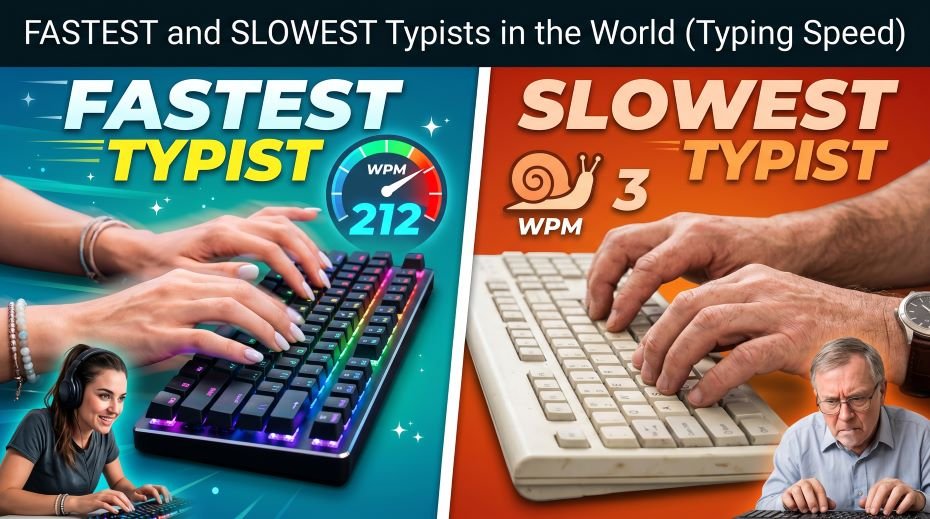
In this article we will discuss about the unique topic – Fastest and Slowest Typists in the World (Typing Speed), Who is the fastest typist in the world? What is the slowest typing speed ever recorded? Complete guide to all-time typing speed records – Guinness records, online records, historical typewriter champions, mobile records, Hindi typing records and what they teach us.
The world record for the fastest typing speed on a mechanical keyboard stands at an astonishing 216 words per minute – sustained over a full minute. The fastest single-burst speed ever recorded in a competitive online setting exceeds 300 WPM. At the other end of the spectrum, the concept of a ‘slowest typist’ record is more complex – and far more human – than you might expect.
Typing speed records span over 130 years of history, from the first typewriter speed contests in the 1880s to today’s global online competitions on platforms like TypeRacer and Monkeytype. They involve mechanical typewriters, electric typewriters, standard keyboards, specialized Dvorak keyboards, and even mobile phone touchscreens. Each era produced its own champions and its own definition of ‘fast’.
This article is the most complete guide to typing speed records ever assembled. We cover every major world record holder, their speed, their method, the historical context, Guinness Book records, online platform records, country-wise and language-wise records, mobile typing records, and yes – the fascinating and surprisingly touching story of the world’s slowest typists. We also show what these records mean for everyday typists preparing for government jobs or simply trying to get faster.
Quick Facts: Typing Speed World Records at a Glance
| Record Category | Record Holder / Speed |
| Fastest sustained keyboard typing (1 min) | Barbara Blackburn – 212 WPM sustained (Dvorak layout, 2005 Guinness record) |
| Highest single-minute speed (online) | Theoretically validated speeds of 300+ WPM in competitive online tests |
| Fastest mechanical typewriter record | Stella Pajunas – 216 WPM on IBM electric typewriter (1946) |
| Fastest male keyboard typist | Sean Wrona – 256 WPM peak; ~170 WPM sustained (TypeRacer elite) |
| Fastest mobile phone typing record | Marcel Fernandes Filho – 25.98 seconds to type standard phrase (2017 Guinness) |
| Fastest 10-finger touch typing | Anthony Goldsmith – 170+ WPM in competitive touch typing |
| Average global typing speed | ~40 WPM for general adult population |
| Average professional typist speed | ~75–80 WPM |
| Government job typing standard (India) | 35 WPM English / 30 WPM Hindi – SSC CHSL, LAHD-SSRB |
| Slowest ‘deliberate’ typing record | No official Guinness record – slowest meaningful typing estimated at 1–2 WPM |
All records are subject to verification conditions. Guinness World Records and TypeRacer have different verification standards. Online speed test records are not always independently verified to Guinness standards.
A Brief History of Typing Speed Records: From 1888 to 2026
Typing speed competitions have a longer history than most people realize. The very first recorded typing speed contest was held in 1888 – just 15 years after Christopher Latham Sholes patented the first practical typewriter in 1873. Since then, the record has been broken dozens of times across different eras, technologies, and keyboard layouts.
| Year | Record Holder | Speed (WPM) | Equipment / Context | Era |
| 1888 | Frank McGurrin | ~95 WPM | Remington typewriter – first ever recorded contest | Typewriter |
| 1906 | Charles E. Smith | ~125 WPM | Mechanical typewriter – US Championship | Typewriter |
| 1923 | Albert Tangora | 147 WPM | Underwood mechanical typewriter – World Championship | Typewriter |
| 1946 | Stella Pajunas | 216 WPM | IBM electric typewriter – still a remarkable benchmark | Electric |
| 1959 | Myra Herr | 149 WPM | Mechanical typewriter – World Championship | Typewriter |
| 1985 | Barbara Blackburn (early) | 150 WPM | Dvorak keyboard – beginning of keyboard era records | Keyboard |
| 2005 | Barbara Blackburn | 212 WPM sustained | Dvorak layout – Guinness World Record certified | Keyboard |
| 2010s | Sean Wrona | 256 WPM (peak) | QWERTY keyboard – Ultimate Typing Championship | Online |
| 2017 | Marcel Fernandes Filho | 25.98 sec phrase | Mobile phone – Guinness mobile typing record | Mobile |
| 2020s | Various (TypeRacer elite) | 250–300+ WPM (burst) | Online competitive typing – not Guinness certified | Online |
WPM records across different eras are not directly comparable – typewriter mechanisms, electric typewriters, and modern keyboards have very different actuation forces and key travel. The 1946 Stella Pajunas record of 216 WPM on an IBM electric typewriter is considered one of the most impressive feats in typing history.
Barbara Blackburn: The World’s Most Famous Fastest Typist
Barbara Blackburn holds the most widely recognized Guinness World Record for keyboard typing speed. Her story is fascinating not just for the speed she achieved, but for how she achieved it – and the unconventional path she took to get there.
| Detail | Barbara Blackburn – Complete Profile |
| Nationality | American (Salem, Oregon) |
| Peak Speed | 216 WPM peak / 212 WPM sustained over 50 minutes |
| Guinness Record | World’s Fastest Typist – certified by Guinness World Records, 2005 |
| Keyboard Layout | Dvorak Simplified Keyboard – NOT the standard QWERTY layout |
| Interesting backstory | Failed her high school typing test – was told she would never be a good typist. Later became the fastest in the world. |
| When she switched to Dvorak | After being told she was not a good typist – she switched from QWERTY to Dvorak and discovered her natural speed |
| Dvorak vs QWERTY advantage | Dvorak places the most common letters on the home row – reduces finger movement by ~60% vs QWERTY |
| Career | Administrative professional – typing was a core job skill throughout her working life |
| Legacy | Proof that early failure does not predict ultimate ability – and that the right technique changes everything |
Barbara Blackburn’s story carries a powerful lesson for every government job aspirant told they are ‘too slow’ to pass a typing test: the right method and consistent practice can transform any typist.
Top 10 Fastest Typists in World History: Complete Profiles
| # | Name | Country | Peak WPM | Era / Equipment | Notable Achievement |
| 1 | Barbara Blackburn | USA | 216 WPM peak 212 WPM sustained | Modern keyboard Dvorak layout | Guinness World Record holder – fastest sustained speed |
| 2 | Stella Pajunas | USA | 216 WPM | IBM electric typewriter 1946 | First to break 200 WPM on electric typewriter |
| 3 | Sean Wrona | USA | 256 WPM peak ~170 WPM avg | QWERTY keyboard Online competitive | Ultimate Typing Championship winner; TypeRacer legend |
| 4 | Albert Tangora | USA | 147 WPM | Underwood typewriter 1923 | World champion for 15+ years in typewriter era |
| 5 | Cortez Peters | USA | 225 WPM | IBM Selectric 1960s–70s | 8x World Champion – most decorated typewriter-era typist |
| 6 | Anthony Goldsmith | UK | 170+ WPM | QWERTY keyboard 2000s | European fastest typist; competitive scene leader |
| 7 | Guilherme Sandrini | Brazil | 160+ WPM avg | QWERTY keyboard TypeRacer | Top-ranked TypeRacer player globally; consistent speed |
| 8 | Nate Rice (poem1) | USA | 240+ WPM burst | QWERTY keyboard Online competitive | Known on Monkeytype for exceptional peak burst speeds |
| 9 | Frank McGurrin | USA | ~95 WPM | Remington typewriter 1888 | Won the very first typing speed contest ever held; touch typing pioneer |
| 10 | Marjory Leggett | UK | ~175 WPM | Electric typewriter 1960s | European champion; fastest female typist of her era |
WPM figures for historical records (pre-1980) may not be directly comparable to modern keyboard WPM due to different typewriter mechanisms and counting methods. Historical records used ‘net words per minute’ calculated differently from modern net WPM formulas.
Official Guinness World Records in Typing: Complete List
The Guinness World Records maintains the most widely recognized official typing speed records. Their verification process requires independent witnesses, standardized passages, and certified equipment – making Guinness records the gold standard in typing achievement recognition.
All Official Guinness Typing World Records
| Record Category | Record Holder | Speed / Time | Year | Equipment |
| Fastest keyboard typist (sustained) | Barbara Blackburn (USA) | 212 WPM / 50 min | 2005 | Dvorak keyboard |
| Fastest typewriter typist | Stella Pajunas (USA) | 216 WPM / 1 min | 1946 | IBM Electric |
| Fastest mobile phone typing (SMS) | Marcel Fernandes Filho (Brazil) | 25.98 seconds | 2017 | Samsung Galaxy S8 |
| Fastest mobile typing (phrase) – female | Melissa Thompson (UK) | 25.94 seconds | 2010 | LG Cookie mobile |
| Longest typing marathon | Abhijeet Kini (India) | 124 hours non-stop | 2014 | Standard keyboard |
| Fastest typing – blindfolded | Mohammed Hassan (Pakistan) | 103 WPM blindfolded | 2011 | Standard keyboard |
| Fastest typing – toes only | Prabhakar Reddy (India) | 103 WPM with toes | 2011 | Standard keyboard |
| Fastest typing – nose only | Mohammed Khurshid Hussain (India) | 103 WPM with nose | 2008 | Standard keyboard |
| Most keys typed in 1 minute (single finger) | Multiple claimants | Record disputed | Ongoing | Single finger |
India has notable representation in Guinness typing records – three records involving Indian citizens (longest marathon, toes typing, nose typing). The nose typing record by Mohammed Khurshid Hussain is particularly extraordinary.
Online Typing Platform Records: TypeRacer, Monkeytype and Beyond
Online typing platforms have created a new category of speed records – not independently verified to Guinness standards, but tracked consistently across millions of users. These represent the current frontier of competitive keyboard typing:
TypeRacer All-Time Records
| Category | Username / Player | Speed | Notes |
| Highest recorded race WPM | Various elite users | 290–320 WPM (claimed) | Not all independently verified |
| Most consistent high average | Sean Wrona | ~170 WPM average | Across thousands of races |
| Fastest legitimate verified race | Multiple elite typists | 250–260 WPM | Community-verified legitimate |
| Most races completed | Various long-term users | 50,000+ races | TypeRacer veteran achievers |
TypeRacer maintains an anti-cheat system but extremely high speeds (300+ WPM) are often disputed in the community. The platform considers speeds above 220 WPM as requiring additional verification.
Monkeytype Records
| Mode | Top Speed Recorded | Test Duration | Context |
| 15-second burst | 300+ WPM (elite users) | 15 seconds | Very short duration – highest burst speeds |
| 60-second test | 240–260 WPM (top players) | 1 minute | More representative of skill |
| 5-minute test | 180–200 WPM (top players) | 5 minutes | Best indicator of sustained speed |
| Global average (all users) | ~65–70 WPM | 60-second mode | Monkeytype users skew faster than general population |
Monkeytype’s 15-second mode produces the highest raw WPM figures because it captures peak burst speed without the endurance factor. A 300 WPM 15-second burst does not mean the typist can sustain 300 WPM for a full minute.
Typewriter Era Champions: The Forgotten Legends of Typing Speed
Before personal computers and digital keyboards, the typewriter era produced extraordinary speed typists who competed in formal world championships. Their records, achieved on manual and electric typewriters with stiff key mechanisms and physical carriage returns, are arguably more impressive than modern keyboard records given the physical demands involved.
| Champion | Country | Best Speed | Championship Years | Equipment |
| Albert Tangora | USA | 147 WPM | 1923 World Champion | Underwood No. 5 |
| Cortez Peters | USA | 225 WPM | 8x World Champion (1940s–60s) | IBM Selectric |
| Stella Pajunas | USA | 216 WPM | 1946 IBM Record | IBM Electric typewriter |
| Margaret Owen | USA | 170 WPM | Multiple champion 1910s–20s | Remington typewriter |
| Rose Fritz | USA | 165 WPM | US champion 1930s | Underwood typewriter |
| Carole Forristall Waldschlager | USA | 176 WPM | US Nationals champion 1950s | Electric typewriter |
| Frank McGurrin | USA | ~95 WPM | 1888 – first contest winner | Remington No. 2 |
Cortez Peters – winner of 8 World Typing Championships – is considered by many historians as the greatest competitive typist of all time. His dominance spanned two decades across the transition from manual to electric typewriters.
Specialized and Unusual Typing Speed Records
Records by Body Part and Method
| Record Type | Record Holder | Achievement | Country |
| Typing with toes | Prabhakar Reddy P. | 103 WPM using only toes | India |
| Typing with nose | Mohammed Khurshid Hussain | 103 WPM using nose to press keys | India |
| Typing blindfolded | Mohammed Hassan | 103 WPM while blindfolded | Pakistan |
| Typing with one hand | Multiple claimants | ~70–90 WPM one-handed | International |
| Typing upside down | Various YouTube showcases | ~40–60 WPM inverted | International |
| Typing in the dark | Any proficient touch typist | Same speed as in light | Any – shows touch typing mastery |
| Typing longest marathon | Abhijeet Kini | 124 hours continuous typing | India |
India holds a remarkable number of unusual typing Guinness records – toes, nose, and marathon. The 103 WPM records using nose and toes are held by Indian practitioners who dedicated years to this unconventional skill.
Mobile Phone Typing Records
| Record | Holder | Time / Speed | Details |
| Fastest SMS text message | Marcel Fernandes Filho (Brazil) | 25.98 seconds | Standard Guinness phrase on Samsung Galaxy S8, 2017 |
| Fastest mobile typing (female) | Melissa Thompson (UK) | 25.94 seconds | LG Cookie, 2010 – briefly held overall record |
| Fastest typing on iPad | Multiple claimants | ~80–100 WPM | Tablet touchscreen typing – varies by device |
| Fastest swipe typing (phone) | Various SwiftKey users | ~50–80 WPM equivalent | Swipe/gesture typing on smartphone |
Mobile phone typing and desktop keyboard typing are completely different motor skills. World-class mobile typists do not necessarily type fast on keyboards, and vice versa. Do NOT use mobile typing speed as an indicator of keyboard typing ability.
Indian Typing Records: World Champions and National Achievers
India has a remarkable presence in international typing records – particularly in specialized and unusual categories. Here is a comprehensive overview of Indian typing achievers:
| Achievement | Name | Record / Speed | Details |
| Typing with toes (Guinness) | Prabhakar Reddy P. | 103 WPM | Andhra Pradesh – Guinness World Record for toe typing speed |
| Typing with nose (Guinness) | Mohammed Khurshid Hussain | 103 WPM | Hyderabad – Guinness record for nose typing speed |
| Longest typing marathon (Guinness) | Abhijeet Kini | 124 hours non-stop | Mumbai – Guinness marathon typing record |
| Hindi typing national record (est.) | Not officially documented | ~80–100 WPM (Kruti Dev) | No official Guinness Hindi typing speed record exists yet |
| Fastest government typing test qualifier | Anecdotal – multiple SSC toppers | ~50–60 WPM English | Government typing tests do not track beyond pass/fail |
| Fastest Indian on TypeRacer | Multiple Indian elite users | ~130–160 WPM average | Competitive TypeRacer rankings – India well represented |
A formal Guinness World Record for Hindi typing speed has never been officially established. This represents a significant opportunity for Indian typists – the first verified record holder for Hindi typing speed (Kruti Dev or Mangal) would claim uncontested world record status.
The World’s Slowest Typists: The Other End of the Spectrum
The concept of the ‘world’s slowest typist’ is fundamentally different from the fastest typist records. There is no Guinness category for slowest typing – because the slowest possible ‘typist’ would simply be someone who does not type at all. However, the slowest meaningful typing records tell remarkable human stories that deserve recognition.
The Slowest Typing That Ever Mattered
| Context | Person / Situation | Speed / Significance |
| Locked-in syndrome patient | Jean-Dominique Bauby (France) – ‘The Diving Bell and the Butterfly’ | Dictated entire memoir by blinking one eyelid – equivalent to ~0.5–1 WPM. Published 1997. |
| Stephen Hawking (late period) | Prof. Stephen Hawking – motor neurone disease | ~1 word per minute via cheek muscle sensor and predictive software in final years. Yet produced extraordinary scientific work. |
| One-finger typing with disability | Documented in various rehab studies | 2–5 WPM with one functional finger – still meaningful communication |
| Senior citizen learning first time | Various documented first-time learners aged 70–90 | 3–8 WPM – slower than hand-written notes but celebrates technology access in old age |
| Child learning to type (age 4–5) | Documented in early childhood education research | 1–3 WPM – each correctly typed letter a victory |
| Deliberate slow typing record | No official Guinness record exists | ‘Slowest’ deliberate typist – would need to type recognizable words. ~0.1 WPM theoretically possible. |
Jean-Dominique Bauby’s story – dictating an entire book at one letter per blink – may be the most profound ‘typing’ achievement in human history. It reminds us that speed is relative and communication is the true purpose of the skill.
Why the ‘Slowest Typist’ Story Matters
The stories of people who type extremely slowly – whether due to disability, age, injury, or just beginning their journey – carry lessons that the fastest typist records cannot teach. They remind us that:
- Speed is not the only measure of success: Jean-Dominique Bauby communicated an entire memoir one letter at a time. Stephen Hawking changed our understanding of the universe typing one word per minute. The purpose of typing – communication – does not require speed.
- Every WPM improvement matters: Going from 1 WPM to 5 WPM is a 400% improvement – proportionally larger than going from 100 WPM to 120 WPM. For someone learning from nothing, every word per minute gained is a victory.
- Starting slow is not failing: Barbara Blackburn failed her high school typing test. Every world record holder once typed slowly. The slowest typist today can become a fast typist tomorrow – if they start and continue.
- Assistive technology bridges the gap: Screen readers, word prediction, eye-tracking, and voice-to-text technology mean that typing speed is no longer the barrier it once was for people with disabilities. Communication remains possible at any speed.
also read: Typing Games Boost Typing Speed
Typing Speed Categories: Where Do You Stand?
| Speed Category | WPM Range | Who Fits Here | What It Means |
| Hunt and Peck | 5–20 WPM | True beginners, non-typists, elderly first learners | Needs systematic touch typing training to progress |
| Beginner | 20–30 WPM | New touch typists, casual users | Building muscle memory – 4–8 weeks to next level |
| Average | 30–50 WPM | General computer users, students | Near or above government qualifying standard (35 WPM) |
| Proficient | 50–70 WPM | Office workers, proficient students, regular typists | Well above govt. minimum; comfortable for most work |
| Fast | 70–100 WPM | Experienced touch typists, writers, programmers | Top 15–20% of all typists globally |
| Expert | 100–130 WPM | Professional typists, transcriptionists, competitive typists | Top 5% globally – rare skill level |
| Elite | 130–170 WPM | Competitive typing community top players | Top 0.5% – serious investment in technique required |
| World Class | 170–220 WPM | Barbara Blackburn tier, Sean Wrona tier | Top 0.01% – extraordinary combination of technique and talent |
| Record Territory | 220+ WPM | All-time world records only | Stella Pajunas (216), Barbara Blackburn (212), Cortez Peters (225) |
The government job qualifying standard of 35 WPM sits at the boundary between ‘Average’ and ‘Proficient’ – entirely achievable for any committed learner in 10–14 weeks of daily practice.
Keyboard Layouts and World Records: Does Layout Matter?
One of the most interesting patterns in typing speed records is the role of keyboard layout. Barbara Blackburn used the Dvorak keyboard layout – not the standard QWERTY layout that most people use. This raises a question that has been debated in the typing community for decades: does your keyboard layout determine your speed ceiling?
| Layout | Home Row | Speed Ceiling | Used By | Verdict |
| QWERTY | ASDFGHJKL | ~260 WPM (Sean Wrona) | 95%+ of all typists | Universal – lower theoretical ceiling but widely proven |
| Dvorak | AOEUIDHTNS | ~212+ WPM (Blackburn) | ~5% of advanced typists | Better ergonomics; 60% less finger movement |
| Colemak | ARST NEIO (modified) | ~180+ WPM (competitive) | ~1% of advanced typists | Good balance of speed and QWERTY transfer |
| One-Hand Dvorak | Single hand optimized | ~70–90 WPM (one hand) | PwD and specialized users | Best for single-handed typing |
| Kruti Dev (Hindi) | Hindi Devanagari chars | ~80–100 WPM Hindi | Hindi govt. typists | Standard for Indian state govt. steno/LDC exams |
For government job preparation in India, QWERTY (English) and Kruti Dev (Hindi) are the only relevant layouts. Dvorak and Colemak, while ergonomically superior, are not accepted in government typing tests – do NOT switch layouts for government exam preparation.
What World Records Teach Every Everyday Typist
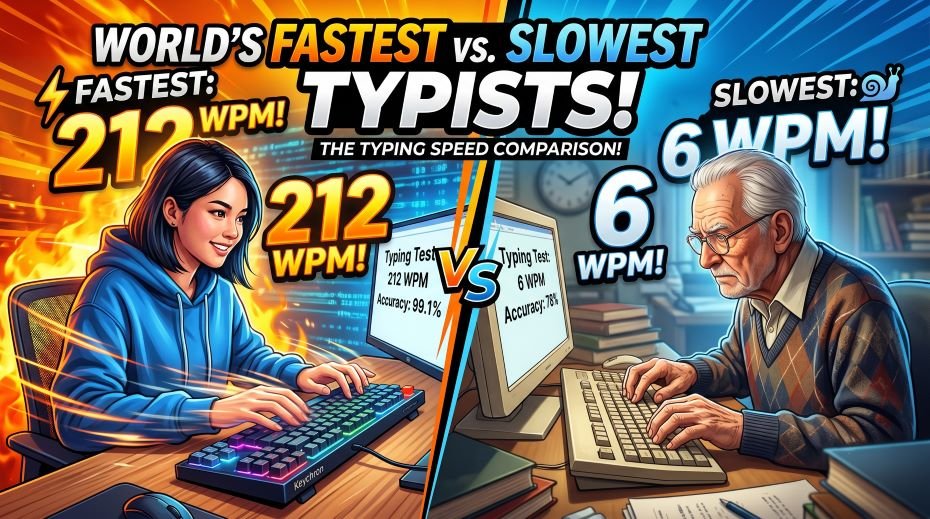
The stories of the world’s fastest – and slowest – typists carry practical lessons for every government exam aspirant, student, and professional trying to improve their typing speed:
| Lesson from Records | What It Means for You |
| Barbara Blackburn failed her typing test | Early failure predicts nothing. If you are currently slow, that is a starting point – not a destiny. |
| The best use all 10 fingers | Every world record holder uses all 10 fingers and never looks at the keyboard. Touch typing is non-negotiable for high speed. |
| Dvorak is faster – but irrelevant for govt. exams | Layout matters for raw speed records but not for your purpose. Master QWERTY (English) or Kruti Dev (Hindi) – what your exam uses. |
| India holds Guinness records in unusual categories | No Hindi typing speed Guinness record exists yet. The fastest Hindi typist in India could claim a genuine world first. |
| Speed plateaus are real but temporary | Every world record holder had periods of no improvement. The plateau is not a ceiling – it is a phase that targeted practice breaks through. |
| 35 WPM is achievable for everyone | The government qualifying standard of 35 WPM is in the ‘Average’ range globally. With 10–14 weeks of daily practice, any motivated person can reach it. |
| Hawking and Bauby typed with almost nothing | If they communicated at 1 word per minute and changed the world – there is no excuse for not practicing 30 minutes a day to reach 35 WPM. |
The distance between the world’s fastest typist (212 WPM) and the government qualifying standard (35 WPM) is enormous. But the distance between where you are and 35 WPM is not – and that is the only gap that matters for your goal.
Major Typing Competitions: Historical Results and Records
| Year | Competition | Winner | Speed / Notes |
| 2010 | Ultimate Typing Championship (UPC) | Sean Wrona | ~163 WPM – won inaugural championship |
| 2011 | Ultimate Typing Championship | Sean Wrona | Defended championship |
| 2017 | TypeRacer World Championship | Multiple elite competitors | Online championship format |
| 2019 | Typeracer Championship | Various international players | Global participation; India represented |
| 1923 | World Typewriting Championship | Albert Tangora | 147 WPM – mechanical typewriter |
| 1940–60s | Multiple World Championships | Cortez Peters | 8 championships – most decorated competitive typist |
| Ongoing | Monkeytype Competitions | Various elite users | Online tournaments with leaderboards – ongoing |
There is no single annual ‘World Typing Championship’ recognized by all bodies. TypeRacer, Monkeytype, and Ultimate Typing Championship each run their own competitions with different verification standards.
Official Links: World Records and Typing Speed Resources
| Resource | Link / Details |
| Guinness World Records – Typing | guinnessworldrecords.com |
| TypeRacer (Online Competition) | typeracer.com |
| Monkeytype (Speed Tests + Records) | monkeytype.com |
| 10FastFingers (Competitions) | 10fastfingers.com |
| Typewriter (Wikipedia) | en.wikipedia.org/wiki/Typewriter |
| Dvorak Keyboard Layout (Wikipedia) | en.wikipedia.org/wiki/Dvorak_keyboard_layout |
| Free Speed Test + Practice | typingmasterpro.com |
For submitting a Guinness typing speed record claim, visit guinnessworldrecords.com and search ‘apply for a record’. The process requires independent witnesses, standardized test conditions, and video evidence.
FAQ:
Who is the fastest typist in the world?
The most widely recognized Guinness World Record holder for fastest sustained keyboard typing is Barbara Blackburn of the United States, who achieved 212 WPM sustained over 50 minutes (216 WPM peak) on a Dvorak keyboard layout, certified in 2005. For electric typewriter speed, Stella Pajunas holds the 1946 record of 216 WPM. In modern online competitive typing, Sean Wrona has recorded peak speeds of 250+ WPM on standard QWERTY keyboards, though these are not Guinness-certified records.
What is the world record typing speed on a standard QWERTY keyboard?
On standard QWERTY keyboards in online competitive settings, the highest reliably documented speeds are in the 250–260 WPM range for elite competitors. Barbara Blackburn’s Guinness record used Dvorak layout. For Guinness-certified QWERTY records, the most documented sustained performances reach approximately 170–200 WPM among the world’s elite competitive typists, though Guinness has not separately categorized QWERTY vs. Dvorak for recent records.
Is there a world record for the slowest typing speed?
There is no Guinness World Record category for the slowest typing speed – because the theoretical minimum would simply be not typing at all. However, the most meaningful ‘slowest’ typing stories belong to individuals like Jean-Dominique Bauby (who dictated a memoir at approximately one letter per blink while having locked-in syndrome) and Stephen Hawking (who communicated at approximately 1 WPM via cheek sensor in his final years). Their stories represent the opposite end of the spectrum from speed records but are arguably more inspiring.
What is the fastest typing speed ever recorded in India?
India holds three unconventional Guinness World Records: Prabhakar Reddy for toes typing (103 WPM), Mohammed Khurshid Hussain for nose typing (103 WPM), and Abhijeet Kini for the longest typing marathon (124 hours). For conventional keyboard typing speed, India has strong representation on TypeRacer leaderboards with Indian typists reaching 130–160 WPM in regular competition. No official Guinness record exists for fastest Hindi typing speed – this record remains unclaimed.
What is the average typing speed in India?
The average typing speed among general adult computer users in India is estimated at 25–35 WPM – slightly below the global average of ~40 WPM. This is partly because India’s widespread computer adoption is more recent than in Western countries, and many users typed first on smartphones rather than keyboards. Among government job aspirants who have specifically trained for typing tests, 30–40 WPM is the typical range before preparation and 40–50 WPM after systematic practice.
Can a normal person reach 100 WPM typing speed?
Yes – with dedicated practice, 100 WPM is achievable by most people. It requires approximately 12–18 months of deliberate daily practice (30–45 minutes per day) starting from an average speed. Most people reach their ‘comfortable ceiling’ around 60–70 WPM without specific training beyond that point. Breaking through to 80, 90, and 100 WPM requires targeted practice on weak key pairs (bigrams), consistent typing game competition, and deliberate speed-push sessions. Reaching 100 WPM puts you in the top 5% of all typists globally.
Conclusion: Every Record Was Once Impossible – Including Yours
When Frank McGurrin typed approximately 95 words per minute on a Remington typewriter in 1888 to win the world’s first typing competition, the idea of someone typing 200+ WPM would have seemed physically impossible. When Barbara Blackburn failed her high school typing test, nobody predicted she would one day hold a Guinness World Record. When Stephen Hawking lost almost all voluntary movement to motor neurone disease, he continued to communicate – one word at a time – ideas that changed how humanity understands the universe.
The history of typing speed records is a history of humans consistently exceeding what was thought possible – through technique, technology, practice, and sheer determination. The lessons are universal whether you are chasing a Guinness record or a government job qualifying standard of 35 WPM.
Know your starting point. Use the right technique – all 10 fingers, eyes on the screen. Practice deliberately, not randomly. Build daily consistency above all else. Measure your progress weekly. And remember that every world record holder, every government typing test passer, and every person who ever typed quickly was once slower than they are now.
Find out your starting WPM right now at TypingMasterPro.com. Then begin the practice that will make your own personal record – whatever that number is – something to be proud of.