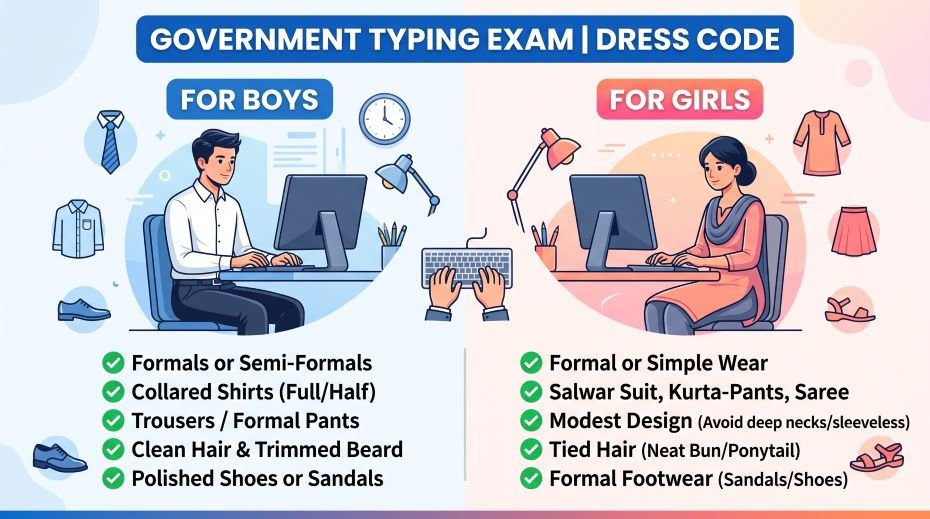
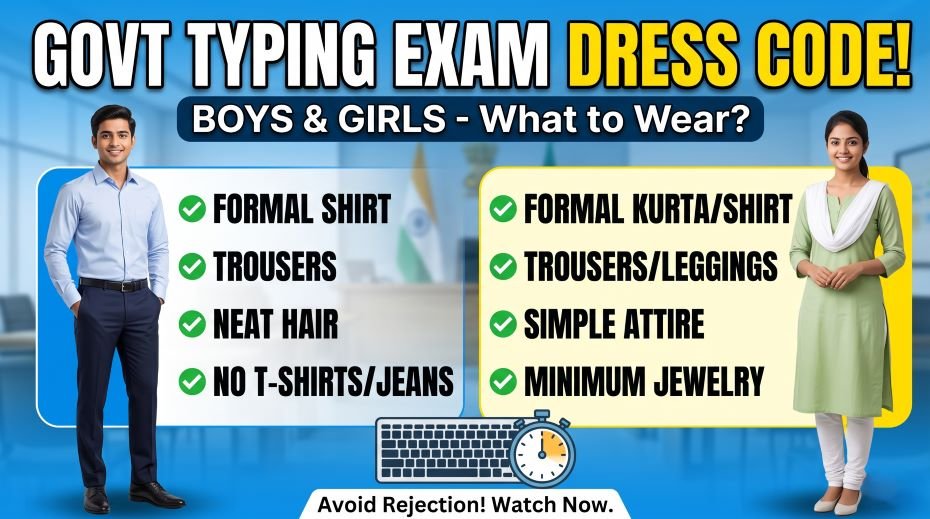
Dress Code for Government Typing Exam for Boys and Girls, what to wear for a government typing exam – dress code rules for boys and girls, jewelry restrictions, religious attire policy, and what happens during frisking. What you wear to a government typing exam can genuinely affect how smoothly your exam day goes – not because of any style rule, but because of security checking. A single metal button, a pair of earrings, or the wrong footwear can cost you precious minutes at the gate, minutes you cannot get back once your reporting time closes. This guide lays out exactly what to wear, what to avoid, and what actually happens during frisking, for both boys and girls.
Why the Dress Code Exists
SSC-type exams don’t publish a strict uniform, but they do enforce practical clothing guidelines built entirely around one goal: fast, thorough security checking with a metal detector and physical frisking, without giving anyone a way to conceal notes, devices, or other prohibited items. Every clothing recommendation below exists to make that checking process faster and less stressful for you.
General Rules That Apply to Everyone
- Wear light-coloured, simple clothing without heavy prints, multiple layers, or large pockets.
- Avoid full-sleeve tops where possible; if you do wear them, be ready to fold sleeves up to the elbow during frisking.
- Skip metal buttons, zippers, buckles, and any decorative metal on clothing, since each one can trigger the handheld metal detector and add delay.
- Choose open footwear like sandals or slippers over closed shoes, which are often checked more thoroughly and take longer.
- Leave all jewellery, watches (analog or digital), and metal hair accessories at home rather than removing them at the gate.
Dress Code for Boys
- A simple shirt or T-shirt with trousers or jeans (without metal chains, heavy studs, or ornamental hardware) works well.
- Avoid caps, hats, or any head covering not tied to religious requirement.
- Skip belts with large metal buckles; a simple fabric or minimal-metal belt is safer.
- Avoid wallets, chains, bracelets, or rings, since these routinely trigger extra scanning.
Dress Code for Girls
- A simple top or kurti with light, minimal-hardware clothing is generally the smoothest choice for quick frisking.
- Keep hair tied back neatly; loose hair is often subject to additional checking at some centres.
- Avoid earrings, nose pins, bangles, bracelets, anklets, and decorative hairpins – these are among the most common causes of delay at the gate.
- Some centres allow a simple mangalsutra where applicable, but other jewellery, however small, is best avoided entirely to prevent any ambiguity or delay.
- Choose simple rubber hair bands over metallic clips or decorative hair accessories.
also read: Forgot Admit Card or Aadhaar for Typing Exam? What To Do
Religious and Cultural Attire
Turbans, hijabs, burqas, and other religious attire are permitted at SSC-type exam centres – this isn’t restricted. What changes is the checking process, which understandably takes longer for these items.
- Candidates wearing religious attire, including items like a kara or kirpan, are specifically advised to report significantly earlier than the standard reporting time to allow for proper, respectful frisking.
- Frisking involving religious attire is conducted by same-gender security staff, and the process may include a physical inspection of the item itself.
- Plan your travel time with this extra buffer built in, rather than assuming standard reporting time will be enough.
What Actually Happens During Frisking
Understanding the actual process reduces a lot of first-time anxiety. Most centres combine a handheld metal detector scan with manual body-tapping, along with biometric verification such as fingerprint or facial scanning for identity confirmation.
- Frisking is conducted by staff of the same gender as the candidate.
- Every metal item on your body or clothing is likely to trigger the detector, so minimizing metal in advance directly reduces your time at this stage.
- Biometric checks (fingerprint and/or facial verification) are standard practice at most centres and are separate from the physical frisking.
- Bags, wallets, and pouches – even transparent ones – are generally not allowed inside the exam hall itself and must be left in outside storage, which centres are typically not responsible for if lost.
Fact Table: Allowed vs Prohibited Items
| Category | Generally Allowed | Generally Prohibited |
| Clothing | Simple, light-coloured, half-sleeve or foldable full-sleeve | Heavy, layered, or metal-heavy outfits |
| Footwear | Open sandals or slippers | Thick-soled shoes requiring extended checking |
| Jewellery | Minimal to none; a plain mangalsutra where applicable | Earrings, bangles, nose pins, chains, anklets |
| Watches | None – use the on-screen exam timer | Analog and digital watches, smartwatches |
| Religious items | Turban, hijab, kara, kirpan (with early reporting) | Non-religious head coverings like caps or scarves |
| Electronics | None | Mobile phones, Bluetooth devices, calculators, smartwatches |
Do’s and Don’ts
| Situation | Do | Don’t |
| Choosing an outfit | Pick simple, light clothing with minimal metal | Don’t wear heavy, layered, or metal-detailed outfits |
| Jewellery | Leave it at home entirely | Don’t plan to remove it at the gate, as it wastes time |
| Footwear | Wear open sandals or slippers | Don’t wear thick, closed shoes expecting a quick check |
| Religious attire | Report significantly earlier than standard time | Don’t assume standard reporting time is enough |
| Hair (for girls) | Tie it back neatly | Don’t leave hair open expecting no extra check |
Table 1: Dress Code Issues, Solutions & Where to Clarify
Government exam centers follow a strict “keep it simple” dress policy – not to judge your fashion sense, but to speed up security frisking and prevent unfair means. Wearing the wrong outfit can cause delays, extra checking, or in rare cases even denial of entry. Below is a breakdown of common dress code issues for boys and girls, practical guidance, and where to clarify rules if something’s unclear, along with real examples from aspirants.
| Issue / Cause | Problem Faced | Solution / Tip | Where to Clarify / Complain |
|---|---|---|---|
| Wearing full-sleeve shirts/kurtas | May be asked to fold sleeves up or face extra frisking time | Prefer half-sleeve shirts, T-shirts, or kurtas to avoid delays | Not applicable (self-preparation) |
| Cargo pants or trousers with many pockets | Extra scrutiny during security check, possible delay | Wear simple trousers or jeans without multiple/decorative pockets | Not applicable (self-preparation) |
| Metal buttons, buckles, or zippers on clothing | Sets off metal detectors, causes repeated frisking | Choose clothes with small, plain buttons; avoid belts with large metal buckles | Not applicable (self-preparation) |
| Jewelry worn out of habit (rings, earrings, chains, bangles) | Strictly prohibited, must be removed at entry, wastes time | Remove all jewelry before leaving home – earrings, nose pins, bangles, chains, anklets included | Not applicable (self-preparation) |
| Wearing shoes instead of open footwear | May be asked to remove shoes for inspection or face delays | Wear simple sandals or slippers with thin soles instead of shoes | Not applicable (self-preparation) |
| Smart watches, digital watches, or fitness bands worn as habit | Strictly banned, may be mistaken for prohibited electronic device | Leave all watches (analog or digital) at home; centers generally don’t allow any wristwatch | Not applicable (self-preparation) |
| Female candidates keeping hair open with metallic clips/pins | Extra checking time, some centers require hair tied | Tie hair with a simple rubber band; avoid metallic hair accessories | Not applicable (self-preparation) |
| Caps, hats, scarves, or sunglasses worn to the center | May be asked to remove or face denial of entry in some cases | Avoid headwear/sunglasses unless required for religious reasons | Center Invigilator (for religious attire clarification) |
| Religious attire (hijab, turban, etc.) causing confusion about rules | Uncertainty about whether it’s allowed | Religious attire is generally permitted, but candidates may be asked to cooperate during frisking | Center Invigilator / Exam Conducting Body’s Grievance Portal |
| Cold-weather clothing (sweaters, jackets) in winter exams | Conflict between staying warm and dress code restrictions | Wear a simple, thin sweater without metallic zips; layers are better than one heavy jacket, but be ready to remove it for frisking | Center Invigilator (for winter accommodation) |
| Heavy makeup, perfume, or cosmetics (especially female candidates) | Some centers flag this as against “keep it simple” policy | Keep makeup and perfume minimal on exam day | Not applicable (self-preparation) |
Table 2: Real-Life Examples
| Candidate Situation | What Happened | Outcome / Lesson |
|---|---|---|
| Male candidate wore a full-sleeve shirt with metal cufflinks | Asked to fold sleeves and remove cufflinks, lost a few minutes at frisking | Switched to plain half-sleeve shirts for future exams |
| Female candidate wore bangles and earrings out of habit | Had to remove all jewelry at the gate, causing delay and stress before the exam | Started removing all jewelry at home before leaving for future exams |
| Candidate wore sports shoes with thick soles | Was asked to remove shoes for inspection, felt rushed afterward | Switched to simple sandals for all future exam days |
| Aspirant wore a smartwatch, forgetting it was banned | Watch was confiscated for safekeeping at the gate, causing anxiety | Now leaves all watches at home before any exam |
| Female candidate kept hair open with a metallic clip | Faced extra frisking time due to the accessory | Started tying hair with a simple rubber band on exam days |
| Candidate wore a heavy jacket during a February exam | Had to remove it fully for frisking despite the cold | Switched to a thin, plain sweater without metal parts for winter exams |
| Candidate wearing religious attire was unsure if it would cause issues | Was allowed entry after cooperating with the frisking process | Learned that religious attire is permitted but should expect thorough checking |
Note: Dress code specifics can vary slightly by exam (SSC vs RRB) and year – always check the guidelines mentioned in your specific admit card or notification before exam day.
FAQ:
Can I wear a wristwatch to keep track of time?
No. All types of watches, analog or digital, are prohibited inside the exam hall – the on-screen timer during the computer-based test is what you’ll use instead.
Will I be denied entry for wearing jewellery?
Not necessarily denied, but you will likely be asked to remove it before entry, which costs time you may not have to spare. It’s simpler and safer to leave jewellery at home entirely.
What if I wear religious attire that needs inspection – will I lose exam time?
The inspection itself doesn’t reduce your exam duration, but it does take longer than standard frisking. Reporting well ahead of the standard time, as officially advised, ensures this doesn’t risk your entry before gates close.
None of this dress code is about fashion – it’s entirely about getting you through security quickly so you can sit down, breathe, and focus on typing. Choose simple, minimal-metal clothing, skip the jewellery entirely, and if you wear religious attire, build in the extra reporting time it deserves. A few minutes of planning the night before saves real stress at the gate.