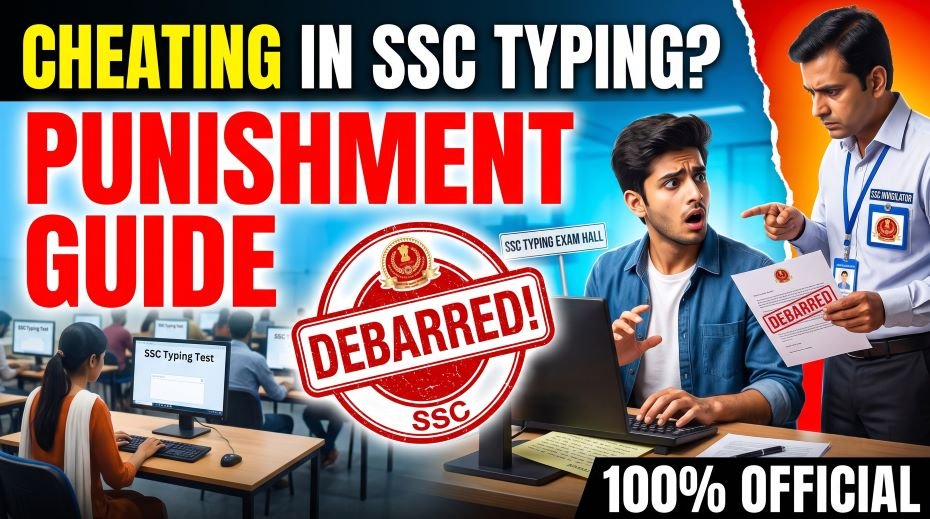
Debarment for Cheating in Typing Exam, what happens if you’re caught peeking at another screen or using tricks in a government typing exam? Real rules on debarment, legal action, and punishment. A quick glance at a neighbouring screen might feel harmless in the moment, but government exam bodies treat it as a serious offence with consequences that can follow a candidate for years. This isn’t an exaggeration for effect – recent advisories from SSC explicitly name “peeking into other candidates’ computers” as a specific form of malpractice they actively monitor and act against. This guide explains exactly what counts as unfair means, how it’s actually detected, and what punishment genuinely looks like, so there’s no ambiguity about how seriously this is taken.
What Counts as Unfair Means in a Typing Exam
The definition is broader than most candidates assume, and several official advisories have specifically called out behaviours that might otherwise seem minor.
- Speaking to or peeking into another candidate’s computer screen, explicitly named by SSC as a monitored and punishable act, even without any spoken communication.
- Writing answers or content on rough sheets with the intention of transferring it later – flagged by automated systems as a suspicious “fast answering” pattern.
- Any attempt to access unauthorised material, communicate with another candidate, or use a device during the exam.
- Deliberately locking or refusing to complete required biometric verification at any stage, which is treated as suspicious behaviour in itself.
- Impersonation, or facilitating impersonation, of another candidate – treated as one of the most serious categories of malpractice.
The Law Behind This: A Real Legal Framework
This is genuinely a matter of criminal law, not just exam-body discretion. The Public Examinations (Prevention of Unfair Means) Act, 2024 was introduced specifically to address malpractice in public examinations conducted by bodies including SSC, giving exam authorities and law enforcement clear legal grounds to prosecute offenders, not just cancel their result.
- Offences under this law are generally cognizable and non-bailable, meaning police can act without needing a separate warrant for serious cases.
- Even an attempt at unfair means, not just a completed or successful attempt, can be treated as a punishable act under this framework.
- Organised, large-scale malpractice (such as paper leaks or systemic cheating rings) can carry penalties as severe as ten years’ imprisonment and fines up to one crore rupees – individual, isolated acts by a single candidate are generally treated less severely, but are not exempt from serious administrative and potential legal consequences.
also read: Dress Code for Government Typing Exam for Boys and Girls
How SSC Actually Detects Malpractice
Modern computer-based typing tests are monitored far more closely than most candidates realise, using a mix of technology and human oversight.
- AI-based surveillance and pattern detection systems flag unusual behaviour such as suspiciously fast, uniform answering patterns.
- CCTV monitoring covers the exam hall throughout the test, reviewed both live and after the fact.
- Systems can detect if an exam node (workstation) is being remotely accessed or controlled, a serious red flag for organised malpractice.
- Biometric verification, done at multiple stages, is used to confirm candidate identity and flag any irregularity or refusal to comply.
- Importantly, invigilators may deliberately not interrupt a candidate suspected of malpractice during the live exam, specifically to avoid disturbing other candidates – action is instead taken afterward, based on the recorded evidence.
What Happens After You’re Caught: The Real Process
| Step | What Happens |
| During the exam | Suspicious activity is recorded; the candidate is often not interrupted immediately, to avoid disturbing others |
| After the exam | Electronic evidence is reviewed; the candidate’s score is withheld and not processed if malpractice is confirmed |
| Formal action | Candidature is cancelled through a defined administrative process, not an on-the-spot decision |
| Debarment | The candidate is barred from the current exam and, depending on severity, from future SSC exams for a set period |
| Public record | Details of debarred candidates are published on the official website in the interest of transparency |
| Possible legal action | Serious cases may additionally face prosecution under the Public Examinations (Prevention of Unfair Means) Act, 2024 |
Is a Brief Glance Really Treated as Seriously as Deliberate Cheating?
This is a fair question, and the honest answer is that intent and pattern matter, but even a single flagged glance carries real risk. Exam authorities generally cannot distinguish an innocent, momentary glance from a deliberate one purely from a recording – which is exactly why the advisory frames it as a behaviour to avoid entirely, not something to judge case by case in the moment. A candidate flagged for this, even if the intent was innocent, may still be included in a review process, and clearing your name after the fact is far harder than never being flagged at all.
Can You Appeal a Debarment Decision?
- Most recruiting bodies, including SSC, have a formal representation or appeal process, though it is not the same as an automatic right to reversal.
- If you believe you were wrongly flagged, submit a written representation promptly through the official grievance channel, including any relevant context or evidence.
- Legal recourse through a tribunal or court remains an option in genuinely disputed cases, particularly where a candidate has independent evidence contradicting the flagged behaviour.
- Prevention remains far more reliable than appeal – a debarment, once published, can affect your record even if a later appeal is partially successful.
How to Make Sure You’re Never Flagged
- Keep your eyes fixed on your own screen and passage for the entire duration, regardless of how harmless a glance might feel.
- Never write on rough sheets with the intention of transcribing answers later; if allowed rough sheets, use them only as genuinely instructed.
- Complete every stage of biometric verification promptly and fully – do not attempt to skip, delay, or lock this process.
- Do not speak to, gesture toward, or otherwise interact with neighbouring candidates at any point during the exam.
- If you notice a genuine technical issue or concern, raise your hand and wait for the invigilator rather than taking any independent action.
Do’s and Don’ts
| Situation | Do | Don’t |
| Your own screen | Keep your eyes on your own screen only | Don’t glance at a neighbouring screen, even briefly |
| Rough work | Use rough sheets only exactly as instructed | Don’t write answers intending to transfer them later |
| Biometric checks | Complete every verification step promptly | Don’t delay, avoid, or lock biometric verification |
| Suspected issues | Raise your hand and wait for the invigilator | Don’t take matters into your own hands mid-exam |
| If flagged after the exam | File a written representation through the official channel | Don’t ignore a notice or assume it will resolve on its own |
Quick Fact Table
This entire framework exists to protect the integrity of the recruitment process, and falls under the broader, globally recognised concern of academic dishonesty in high-stakes testing environments.
| Fact | Detail |
| Governing law | Public Examinations (Prevention of Unfair Means) Act, 2024 |
| Nature of offences | Generally cognizable and non-bailable for serious cases |
| Peeking at another screen | Explicitly named by SSC as monitored, punishable malpractice |
| Detection methods | AI surveillance, CCTV, remote-access detection, biometric checks |
| Maximum penalty (organised malpractice) | Up to 10 years imprisonment and a fine up to ₹1 crore |
| Public record | Debarred candidates’ details are published on the official website |
Table 1: Offenses, Consequences, Guidance & Where to Seek Help
Cheating in an SSC exam is no longer treated as just an academic offense – it now falls under the Public Examinations (Prevention of Unfair Means) Act, 2024, which brings criminal liability, not just debarment. Whether it’s carrying prohibited items, impersonation, or misusing technology, SSC has ramped up detection through AI-powered surveillance and biometric checks, and the consequences can follow a candidate for years. Below is a breakdown of common unfair-means scenarios, their consequences, and where to seek help if you’re wrongly implicated, along with real examples from past cases.
| Offense / Cause | Consequence Faced | Guidance / Tip | Where to Seek Help |
|---|---|---|---|
| Carrying prohibited items (phone, chits, smartwatch) even without using them | Can be treated as “attempt to use unfair means,” which is punishable on its own | Never carry banned items at all, even out of habit – possession alone is risky under current rules | Not applicable (avoid entirely) |
| Impersonation (someone else appearing on your behalf) | Cancellation of candidature, long-term/permanent debarment, and criminal prosecution for both parties | Never attempt or agree to impersonation under any circumstance – biometric and facial recognition checks make detection highly likely | Legal counsel if already implicated |
| Remote access/technical manipulation of exam system detected | Score not processed, candidature cancelled, debarment initiated through due process | Avoid any third-party “help” claiming to manipulate systems – SSC has deployed technology specifically to detect this | Not applicable (avoid entirely) |
| Sharing or discussing exam questions after the exam (online or otherwise) | Now a criminal offence under the 2024 Act; can lead to legal action | Do not post, discuss, or circulate exam content on social media or forums after the test | Not applicable (avoid entirely) |
| “Fast answering” pattern flagged by AI surveillance (writing all answers on rough sheet, then inputting quickly) | System flags this as suspected malpractice, even if unintentional | Answer directly on-screen at a natural pace; avoid patterns that resemble pre-prepared answer input | Not applicable (behavior awareness) |
| Speaking to or looking at another candidate’s screen | Can be treated as unfair means, leading to candidature cancellation | Stay focused only on your own screen; avoid any communication during the exam | Not applicable (self-discipline) |
| Wrongly flagged for malpractice despite no wrongdoing | Risk of unjust debarment or cancelled candidature | Request the process/evidence used for the decision; formally represent your case through appropriate channels | Exam Conducting Body’s Grievance Portal / Legal counsel if needed |
| Confusion about how long debarment lasts | Uncertainty about eligibility for future exams | Debarment periods vary by offense severity and are decided through SSC’s laid-down process – check the official debarred candidate’s list/notification for specifics | SSC official website / Regional SSC Office |
Table 2: Real-Life Examples (Based on Reported Patterns)
| Candidate Situation | What Happened | Outcome / Lesson |
|---|---|---|
| Candidate carried a phone into the exam hall “just in case,” never used it | Candidature was cancelled for possession alone | Learned that mere possession of banned items counts as an offense, regardless of use |
| Candidate agreed to let someone else take the exam for them | Both individuals faced debarment and legal action after biometric mismatch was detected | Learned impersonation carries severe, often permanent consequences for both parties |
| Aspirant discussed exam questions in a WhatsApp group right after the test | Faced scrutiny under the new law criminalizing question-sharing | Realized post-exam discussions of content are no longer a “harmless” activity under current rules |
| Candidate wrote all answers on rough sheet first, then typed them quickly at the end | Flagged by AI system as “fast answering” and suspected of malpractice | Learned to pace answers naturally on-screen instead of batch-inputting |
| Aspirant was flagged incorrectly due to a system glitch, not actual cheating | Initially faced candidature cancellation before the issue was investigated | Filed a formal representation with supporting evidence; case was reviewed through the grievance process |
Note: This is general awareness content, not legal advice. Rules under the Public Examinations (Prevention of Unfair Means) Act, 2024 and SSC’s debarment process can be complex – if you’re facing an actual case, consult a lawyer and refer to the official SSC advisory for exact provisions.
FAQ:
Will I be stopped immediately if I’m seen peeking at another screen?
Not necessarily. SSC has explicitly noted that invigilators may not interrupt the exam in the moment to avoid disturbing other candidates – action is typically taken afterward, based on recorded evidence, which means the risk doesn’t disappear just because nothing happened immediately.
Is debarment permanent?
It depends on the severity of the offence. Debarment periods vary, and while some cases result in a fixed-term ban, more serious or repeated offences can lead to longer or indefinite debarment, in addition to potential criminal proceedings.
Can a genuinely accidental glance be cleared through appeal?
It’s possible through a formal written representation, but success isn’t guaranteed, and the process can be lengthy. Avoiding the situation entirely remains far more reliable than relying on a later appeal.
The margin between a harmless-feeling glance and a serious punishable offence is far thinner than most candidates assume, and the systems watching for it are more sophisticated than they used to be. Treat every instruction about screen focus, rough sheets, and biometric checks as non-negotiable, not because the rule feels fair or unfair in the moment, but because the consequences of being flagged, even wrongly, are simply not worth the risk.