How to Make an Affidavit for Government Exam (Typing Docs Affidavit), Step-by-step guide to making an affidavit for a government exam – process, cost, notary vs Gazetted Officer attestation, which state to use, and what to write so, An affidavit sounds intimidating the first time you need one, but it’s genuinely one of the simplest legal documents to get done – usually completed within a day, for a modest cost, and accepted almost everywhere for exactly the kind of small document mismatches that come up during government exam verification. This guide walks through exactly why it’s needed, the full step-by-step process, what it costs, which state you can make it in, and what should actually be written on it.
Why an Affidavit Is Needed at All
An affidavit is a sworn, written statement of fact, signed under oath before an authorised official, and treated as legally admissible evidence of that statement. Government exam bodies accept it as an official bridge whenever two of your documents don’t perfectly match – for example, your Aadhaar spells your name slightly differently than your 10th certificate. Rather than requiring you to reissue an old certificate for a minor spelling variation, an affidavit lets you formally declare that both versions refer to the same person, backed by the legal weight of a sworn statement.
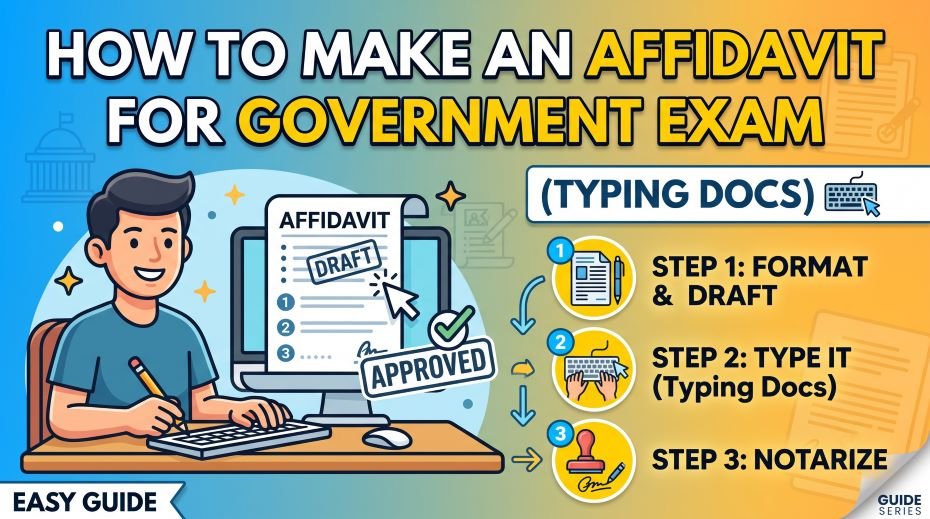
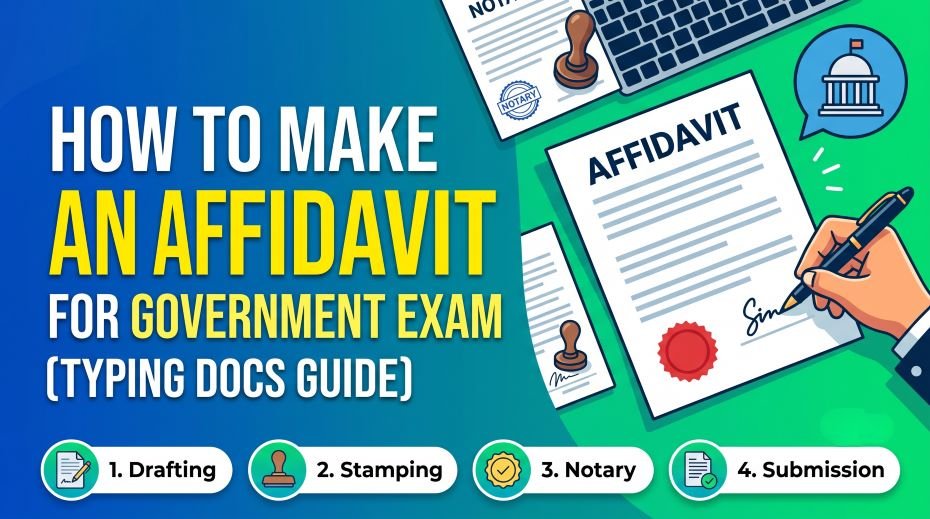
Step-by-Step Process to Make an Affidavit
1. Identify exactly what needs to be declared – a name spelling difference, a father’s name mismatch, a date of birth clarification, or another specific discrepancy.
2. Draft the affidavit content, either yourself, through a local typist near the court or notary office, or using a lawyer, clearly stating the facts in the first person.
3. Purchase non-judicial stamp paper of the required value (commonly between ₹10 and ₹100 depending on your state) from an authorised stamp vendor, or use an e-stamping portal where available.
4. Print or have the affidavit content typed directly onto the stamp paper.
5. Carry the printed affidavit along with a valid photo ID to a notary public, Executive Magistrate, or Oath Commissioner.
6. Sign the affidavit in their presence – this in-person signing step cannot currently be done remotely under Indian law, even though drafting can be done online.
7. The notary or magistrate verifies your identity, witnesses your signature, and applies their official seal and signature, along with an entry in their notarial register.
8. Collect the completed, notarised affidavit – the entire in-person process typically takes about 30 minutes once you’re at the notary’s office.
Levels of Attestation: Which One Do You Actually Need?
Not every document correction needs the same level of authentication, and understanding the difference prevents wasted time and money.
| Attestation Level | What It Involves | Typically Used For |
| Self-attestation | You sign a photocopy yourself, declaring it a true copy | Standard document copies submitted alongside originals at DV |
| Notarised affidavit | Signed under oath before a notary public or Oath Commissioner | Name mismatches, minor spelling errors, father’s/mother’s name corrections |
| Gazetted Officer attestation | Signed and certified by an officer holding a Gazetted rank in government service | Specific declarations some exams require, such as certain category or income declarations, as separately specified in the notification |
Always check your specific exam notification for which level is required for your exact situation – using notarisation when a Gazetted Officer attestation is specifically required (or vice versa) can lead to rejection at verification.
If You’re From One State But Study or Live in Another
This is a common and reasonable concern, and the good news is that jurisdiction is generally not a barrier. Under the stamp duty framework, if the correct stamp duty for your state has been paid, a stamp paper purchased in one state can generally be validly executed and used in another. This means you don’t need to travel back to your home state specifically to make an affidavit.
- You can generally make the affidavit in whichever state you currently reside in or are studying in, using that state’s applicable stamp duty value.
- If your document verification is happening in a different state again, carrying the affidavit made in your state of residence is typically accepted, since the sworn statement itself, not the specific state, is what matters.
- If in doubt for a specific, high-stakes situation, a quick check with a local lawyer or the recruiting body’s helpline can confirm any state-specific requirement for your particular case.
Complete Cost Breakdown
| Cost Component | Typical Range |
| Non-judicial stamp paper | ₹10 to ₹100, depending on state and affidavit type |
| Notary fee | ₹20 to ₹100 per document/page, regulated by state government |
| Typing or drafting charge (if you don’t type it yourself) | ₹100 to ₹200, varies by vendor |
| Total typical cost | Roughly ₹50 (bare minimum, self-typed) to ₹400 (full-service, vendor-assisted) |
Prices vary meaningfully by state and by whether you use a full-service vendor versus doing the stamp paper purchase and typing yourself. If a notary quotes an unusually high price, it’s reasonable to check with another notary nearby, since fees are meant to be nominal and regulated.
What Must Be Written on the Affidavit
While exact wording varies by situation, every affidavit for this purpose should include the following core elements.
- Your full name, parentage (son/daughter/wife of), age, and residential address, stated clearly at the start.
- A clear declaration of the specific fact being stated – for example, that two spellings of your name refer to the same person.
- Reference to the specific documents involved, including any relevant document numbers (Aadhaar number, certificate serial number, and so on).
- A statement that the contents are true to the best of your knowledge and belief, and an acknowledgment that a false affidavit is punishable under law.
- The place and date of signing, along with your signature and the notary or magistrate’s seal and signature.
Typing the Affidavit: Practical Tips
- Most notary offices or nearby typing shops can draft a standard affidavit for you if you explain the exact issue clearly.
- If typing it yourself, use clear, formal, first-person language and avoid vague or overly broad statements – precision matters more than length.
- Double-check every name, number, and date typed on the affidavit before printing, since an error here creates a new mismatch rather than resolving the original one.
- Keep both a digital copy and a couple of physical photocopies of the completed, notarised affidavit for your records and for submission alongside your other DV documents.
also read: Document Verification After Typing Exam (Full Guide)
Affidavits for Different Situations: Quick Reference
| Situation | What the Affidavit Should State |
| Name/spelling mismatch | Both spellings refer to the same individual, with supporting document numbers referenced |
| Father’s or mother’s name mismatch | The correct name and the mismatched name both refer to the same parent |
| Surname changed after marriage | Maiden name and married name refer to the same person, referencing the marriage certificate |
| Gap in education or employment | A truthful statement explaining the gap period, where specifically required by a notification |
| Address discrepancy | Current and previous address details, where the exam specifically requires an address declaration |
Common Mistakes to Avoid
- Waiting until the day of document verification to prepare the affidavit – many centres explicitly refuse last-minute attestation.
- Using a stamp paper of insufficient value for your state’s requirement, which can make the affidavit technically invalid.
- Vague or generic wording that doesn’t specifically reference the documents and details involved.
- Forgetting to carry a valid photo ID to the notary, which is required for them to verify your identity before witnessing your signature.
- Not keeping photocopies of the completed affidavit for your own records.
Do’s and Don’ts
| Situation | Do | Don’t |
| Timing | Prepare the affidavit at least a week before your DV date | Don’t leave it for the day of verification |
| Stamp paper | Buy the correct value for your state’s requirement | Don’t guess the value or use an undervalued stamp paper |
| Content | State the specific facts and document references clearly | Don’t use vague, generic wording |
| Attestation level | Confirm whether notary or Gazetted Officer attestation is required | Don’t assume one type of attestation works for every situation |
| Records | Keep photocopies of the finished, notarised affidavit | Don’t submit your only copy without retaining one for yourself |
Table 1: Issues, Solutions & Where to Seek Help
Affidavits come up more often than most aspirants expect during government exam documentation – for name mismatches, minority community declarations, widow/divorced-woman status, or married-name updates. They must follow specific legal formats to be accepted, and even small errors (wrong stamp value, missing notarization) can lead to rejection at document verification. Below is a breakdown of common affidavit-related issues, practical guidance, and where to seek help, along with real examples from candidates.
| Issue / Cause | Problem Faced | Solution / Tip | Where to Seek Help |
|---|---|---|---|
| Name/father’s name mismatch between application and original certificates | Risk of candidature rejection at document verification | Get a notarized affidavit stating the mismatch is due to spelling/variation, confirming it refers to the same person | Notary Public / Local Advocate |
| Affidavit not on the correct non-judicial stamp paper value | Affidavit may not be accepted as legally valid | Use the stamp paper value specified in the notification (commonly ₹10-₹100, varies by state and exam) | Notary Public (for correct format guidance) |
| Affidavit not properly notarized | Document treated as incomplete or invalid at DV | Get the affidavit executed and signed before a Notary Public, Oath Commissioner, or First-Class Magistrate | Local Notary / Sub-Registrar Office |
| Minority community declaration affidavit missing at DV | Candidature rejected for those claiming fee concession under this category | Prepare the affidavit in the exact Annexure format specified in the notification, submit at DV without fail | DV Officer / Grievance Portal |
| Widow/divorced/judicially separated status affidavit not prepared | Relevant relaxation benefit not granted | Prepare an affidavit stating the candidate has not remarried, along with supporting court documents (divorce decree/death certificate) | Notary Public / Legal Advocate |
| Confusion between affidavit and Gazette notification for name change | Affidavit alone rejected for permanent official name change purposes | Understand that an affidavit is often just the starting step – a Gazette notification may be separately required for full legal recognition of a name change | Local Gazette/Government Press Office (for formal name change) |
| Affidavit drafted in wrong language | Document not accepted if not in English/Hindi | Prepare the affidavit in English or Hindi, or attach a certified translation if originally in another language | Notary Public / Certified Translator |
| Using an old/incorrect affidavit format from a previous exam year | Affidavit rejected for not matching current requirements | Always use the specific Annexure format given in the current year’s notification, not a generic template | Exam Conducting Body’s official notification |
Table 2: Real-Life Examples
| Candidate Situation | What Happened | Outcome / Lesson |
|---|---|---|
| Candidate’s name was spelled slightly differently on Aadhaar vs 10th certificate | Faced questioning during document verification | Got a notarized affidavit confirming both names referred to the same person, resolving the issue |
| Aspirant claiming minority fee concession forgot to prepare the required affidavit | Candidature was at risk of rejection during DV | Prepared the affidavit in the exact Annexure format just before the DV date and got it notarized in time |
| Divorced candidate applied for related age relaxation | Was unsure what documentation was needed to support the claim | Prepared a notarized affidavit along with the divorce decree, which was accepted at document verification |
| Candidate used an affidavit template from a friend’s previous year’s exam | Format didn’t match the current year’s requirements, causing confusion | Learned to always refer to the current notification’s specific Annexure for affidavit format |
| Aspirant assumed a notarized affidavit alone was enough for a permanent name change | Later found some authorities required Gazette publication as well | Learned the distinction between an affidavit (starting step) and Gazette notification (formal completion) |
Note: This is general informational content, not legal advice. Affidavit formats, stamp paper values, and requirements can vary by state and exam – always consult a notary or legal professional and check your specific exam’s official notification/Annexure before preparing one.
FAQ:
Can I make the affidavit online without visiting a notary in person?
The drafting and stamp paper purchase can often be done online, but the actual signing and attestation currently still requires your in-person presence before a notary or magistrate under Indian law.
Is a notarised affidavit legally strong enough for SSC-type exam verification?
Yes, for common issues like spelling or name mismatches, a properly notarised affidavit is widely accepted. For specific declarations your notification separately requires Gazetted Officer attestation for, follow that specific requirement instead.
What happens if the facts in my affidavit turn out to be false?
A false affidavit is a punishable offence under Indian law, since it’s a sworn legal statement, not an informal declaration. Only state facts you can support with genuine documentation.
Making an affidavit is one of the most straightforward fixes available during document verification – inexpensive, quick, and widely accepted for the kind of small mismatches that trip up otherwise well-prepared candidates. The only real risk is timing: start the process at least a week before you need it, get the correct level of attestation for your specific situation, and keep your own copies. Handled this way, an affidavit turns a potential DV problem into a five-minute non-issue.