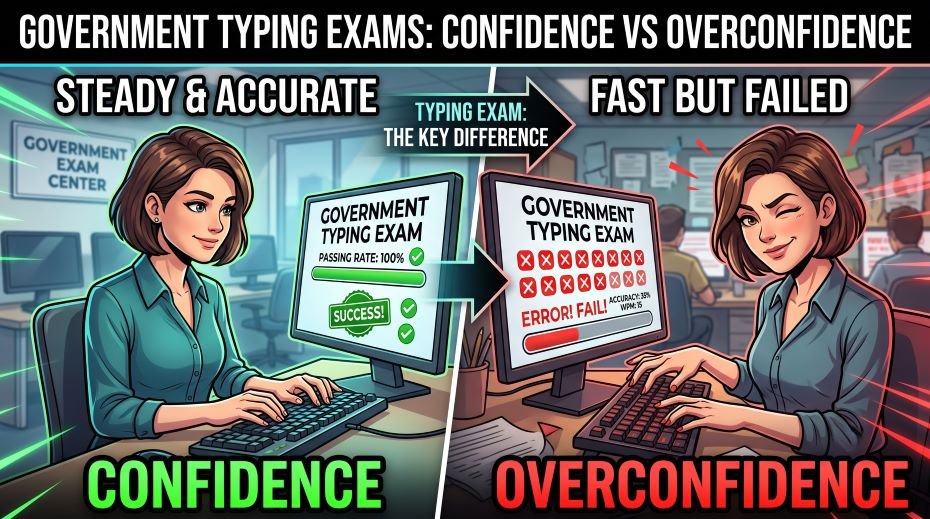
Confidence vs Overconfidence in Typing Exams, ask any experienced typing instructor which candidates worry them most, and many won’t say the nervous ones – they’ll say the overconfident ones. Confidence genuinely helps you type steadily and think clearly under pressure. Overconfidence, on the other hand, quietly skips the exact preparation steps that confidence is supposed to be built on. The two can feel identical from the inside, which is exactly what makes this distinction worth understanding before exam day, not after a disappointing result.
Why Confidence Genuinely Matters in a Typing Exam
A calm, self-assured candidate types more steadily than an anxious one – this isn’t just motivational language, it reflects how stress physically affects fine motor control and decision-making speed under time pressure. Genuine confidence reduces hesitation, keeps error-recovery calm rather than panicked, and helps a candidate follow instructions precisely instead of second-guessing every step.
What Real Exam Confidence Looks Like
- It’s built on a track record – dozens of timed mock tests with consistent, verified results, not a single good practice session.
- It coexists with careful preparation – a confident candidate still reads every instruction fully and double-checks exam-day logistics.
- It stays calm rather than dismissive when facing a harder-than-expected passage, adjusting pace instead of assuming the difficulty doesn’t apply to them.
- It’s specific – “I consistently hit 38 WPM with under 15% errors in my last ten mocks” is confidence; “I’ll obviously clear this easily” without that data behind it usually isn’t.
What Overconfidence Looks Like – And Why It’s Risky
Overconfidence often shows up as a kind of shortcut thinking: skipping steps that feel unnecessary because past success (or past assumptions) suggests they’re not needed. This pattern closely resembles what psychologists describe as the Dunning–Kruger effect, where limited self-assessment leads someone to overestimate their actual ability, particularly in a skill they haven’t rigorously tested against real conditions.
- Skipping full-length timed mock tests because “I already know I’m fast enough,” without recent, verified data to back that assumption.
- Not reading exam instructions fully, assuming the format will match what was expected or what a previous exam used.
- Dismissing nervousness or hand tremors as something that “won’t happen to me,” and therefore never practicing recovery techniques for it.
- Assuming a passage will be easy based on subject familiarity, then rushing early and making avoidable errors.
- Treating category-wise error allowances as a safety cushion to lean on, rather than a buffer to stay well within.
also read: Health Problems Aspirants Face Before Typing Exams
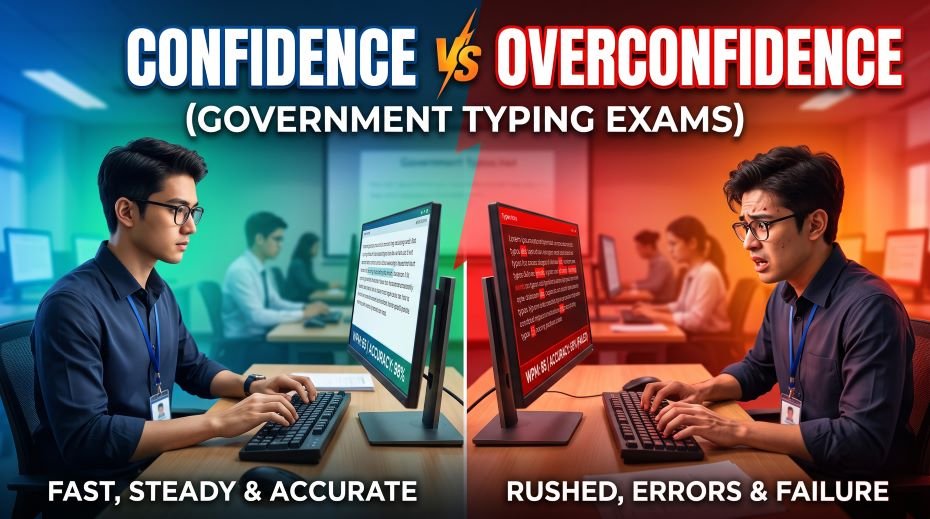
The Fine Line: A Side-by-Side Comparison
| Situation | Confidence | Overconfidence |
| Before the exam | Reviews instructions carefully despite feeling well-prepared | Skims or skips instructions, assuming they already know them |
| Mock test habit | Takes regular timed mocks to verify current speed and accuracy | Stopped taking mocks weeks ago, relying on an old result |
| Facing a hard passage | Adjusts pace calmly, stays accurate | Rushes to prove the difficulty “doesn’t matter,” increasing errors |
| Handling a mistake | Uses a practiced recovery technique and moves on | Gets flustered because they “never expected” to make one |
| Self-assessment | Backed by recent, specific data (WPM, error rate) | Backed by a general feeling or an old, unverified achievement |
How Overconfidence Quietly Costs Real Marks
The damage from overconfidence rarely comes from one dramatic mistake – it comes from a series of small, avoidable ones that a well-prepared candidate would have caught.
- Missing a stated rule (such as a restricted key or a specific formatting instruction) because the instructions weren’t read carefully, assuming familiarity from past exams.
- Arriving later than planned because “I’ve done this before, I know the routine,” skipping the buffer time a first-time candidate might build in.
- Losing composure at the first real mistake because no recovery technique was ever practiced, having assumed errors “wouldn’t be an issue.”
- Underestimating a passage’s actual difficulty and rushing early, only to lose accuracy in the back half of the test.
Building Genuine, Durable Confidence
Real confidence is closer to what psychologist Albert Bandura described as self-efficacy – a grounded belief in your ability to perform a specific task, built through repeated, verified success rather than general optimism.
- Take full-length, timed mock tests regularly right up until close to the exam, not just early in preparation.
- Track your actual WPM and error percentage over time, so your confidence is based on current numbers, not memory of an old personal best.
- Deliberately practice under slightly harder conditions than expected (a tougher passage, a stricter error margin) so the real exam feels familiar rather than surprising.
- Rehearse your mistake-recovery routine regularly, so calm handling of an error becomes automatic rather than something you assume you won’t need.
- Read the full instructions in every mock test exactly as you would on exam day, building the habit rather than skipping it once you feel experienced.
A Quick Self-Check: Confident or Overconfident?
- Can you state your current WPM and error rate from a mock test taken in the last week? If not, your confidence may be running on outdated information.
- Do you still read exam instructions in full during mock tests? If you’ve started skipping this step, that’s a sign of overconfidence creeping in.
- Have you rehearsed what you’ll do after a mid-test mistake? If your plan is “it won’t happen,” that’s a gap worth closing.
- Would you be comfortable if an examiner checked your last ten mock results right now? If the honest answer is no, it may be time to rebuild your practice consistency before the exam.
Do’s and Don’ts
| Situation | Do | Don’t |
| Self-assessment | Base confidence on recent, verified mock results | Don’t rely on an old personal best or a general feeling |
| Instructions | Read every word, every single time | Don’t assume this exam matches a previous one exactly |
| Mock tests | Continue taking them regularly until close to the exam | Don’t stop practicing because you feel “ready enough” |
| Handling mistakes | Practice a calm recovery routine in advance | Don’t assume errors won’t happen to you |
| Exam-day mindset | Stay alert and attentive despite feeling prepared | Don’t let familiarity turn into carelessness |
Here’s the intro and both tables for this topic.
Table 1: Issues, Causes, Solutions & Where to Seek Help
Confidence gets you into the exam hall with a steady mind, but overconfidence can just as easily cost you the exam. The line between the two is thin – one keeps your hands calm and focused, the other makes you careless about accuracy and time management. Below is a breakdown of how confidence tips into overconfidence, practical ways to stay balanced, and where to seek help if underlying anxiety is the real issue, along with real examples from aspirants.
| Issue / Cause | Problem Faced | Solution / Tip | Where to Seek Help |
|---|---|---|---|
| Skipping final mock tests, assuming preparation is “enough” | Rustiness or unexpected errors on exam day | Continue regular mock practice right up to exam day, regardless of confidence level | Not applicable (self-practice) |
| Typing too fast without checking accuracy, assuming speed will carry the score | Higher error rate despite good speed | Balance speed with periodic accuracy checks during practice, not just on exam day | Not applicable (self-practice) |
| Underestimating the passage difficulty or exam-day nerves | Caught off guard mid-exam, confidence turns into panic | Prepare for varying passage difficulty and unexpected nerves, not just best-case scenarios | Not applicable (self-practice) |
| Not reading on-screen instructions carefully due to overfamiliarity | Wrong test attempt or format-related errors | Read instructions fully every single time, even if you’ve taken the exam format before | Not applicable (self-practice) |
| Comparing self to weaker peers and assuming automatic success | Complacency in the final days of preparation | Benchmark against your own best mock scores, not against others | Not applicable (self-practice) |
| Low confidence despite adequate practice (opposite problem) | Hesitant typing, second-guessing every keystroke | Track objective mock scores over time to build evidence-based confidence rather than relying on feelings | Not applicable (self-practice) |
| Persistent self-doubt despite consistent good scores | Mismatch between actual skill and self-perception, affecting exam performance | If this pattern feels difficult to manage alone, talking to a counselor about performance anxiety can help | Consult a mental health professional / counselor |
| Overconfidence leading to arriving late or under-preparing logistics | Last-minute rush affects composure before the exam even starts | Treat exam-day logistics (documents, timing, center location) with the same seriousness regardless of skill confidence | Not applicable (self-preparation) |
Table 2: Real-Life Examples
| Candidate Situation | What Happened | Outcome / Lesson |
|---|---|---|
| Aspirant stopped practicing a week before the exam, confident in their speed | Felt slightly rusty and made avoidable errors on exam day | Learned to maintain practice consistency right up to the exam, regardless of confidence |
| Candidate focused only on typing speed in the final weeks | Accuracy dropped due to neglecting error-checking during fast typing | Reintroduced accuracy-focused mock tests alongside speed drills |
| Aspirant assumed the exam passage would be similar to usual practice sets | Struggled with an unfamiliar, harder passage on exam day | Started practicing with varied and unpredictable passage difficulty levels |
| Candidate skimmed exam instructions, assuming the format hadn’t changed | Lost time realizing the format was slightly different from expected | Made it a habit to read every instruction screen fully, regardless of past exam experience |
| Aspirant compared their scores to less-prepared friends and relaxed prep | Complacency led to reduced practice hours in the final stretch | Switched to tracking personal best scores instead of comparing to peers |
| Candidate had strong mock scores but constant self-doubt going into the exam | Hesitant, overly cautious typing slowed them down significantly | Began reviewing objective score history before each mock to build calibrated confidence |
FAQ:
Is it possible to be too nervous and too overconfident at the same time?
Yes – some candidates swing between dismissive overconfidence in preparation and sudden panic on exam day, precisely because their confidence was never grounded in consistent practice data to fall back on when nerves hit.
How do I stay confident without becoming careless?
Keep tying your confidence to specific, current evidence – recent mock scores, a rehearsed recovery routine, a habit of reading instructions fully – rather than to a general sense of being “good at this.” Confidence grounded in verified practice rarely tips into carelessness.
Does overconfidence affect experienced repeat candidates more?
It can, since familiarity with the exam format sometimes replaces active preparation. Candidates attempting a typing exam for a second or third time benefit from treating each attempt with the same fresh discipline as their first, rather than assuming past experience alone is enough.
The candidates who walk out of a typing exam satisfied with their performance are rarely the ones who felt certain going in – they’re the ones whose certainty was earned through consistent, verified practice. Keep checking your confidence against real numbers, keep reading every instruction like it’s the first time, and let steady preparation, not assumption, be what carries you through the exam.