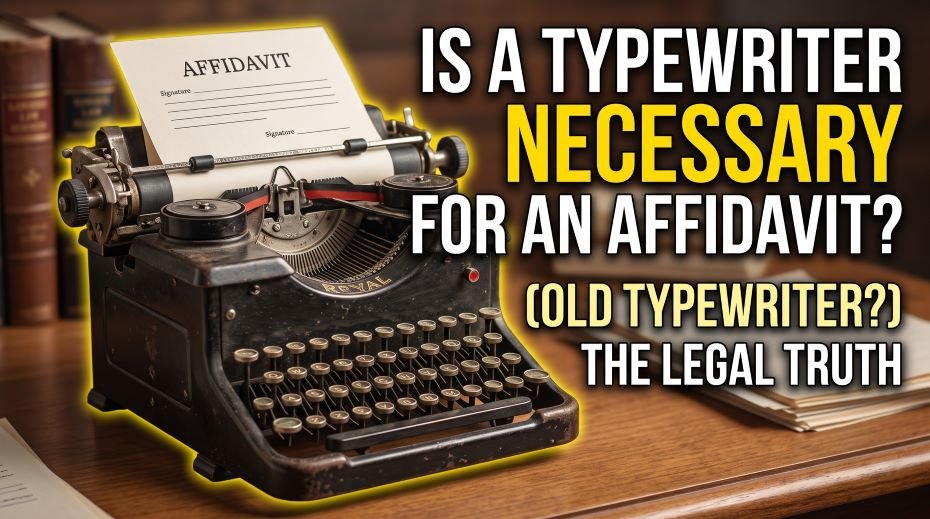
Is a Typewriter Necessary for an Affidavit? (Old Crinkling Typewriter in court) so, do you really need an old typewriter to prepare an affidavit for your government exam, or is computer printing accepted? Here’s what the law actually says so, if you’ve ever walked past a court complex in India, you’ve probably seen them – rows of typists sitting under a tree or a tin shed, clacking away at old mechanical typewriters, drafting affidavits for a steady stream of people. It’s a genuinely common sight, and it leads a lot of first-time affidavit-makers to assume a typewriter is somehow legally required. It isn’t. Here’s the real, straightforward answer, along with why typewriters are still so visibly common outside courts even though they’re not mandatory.
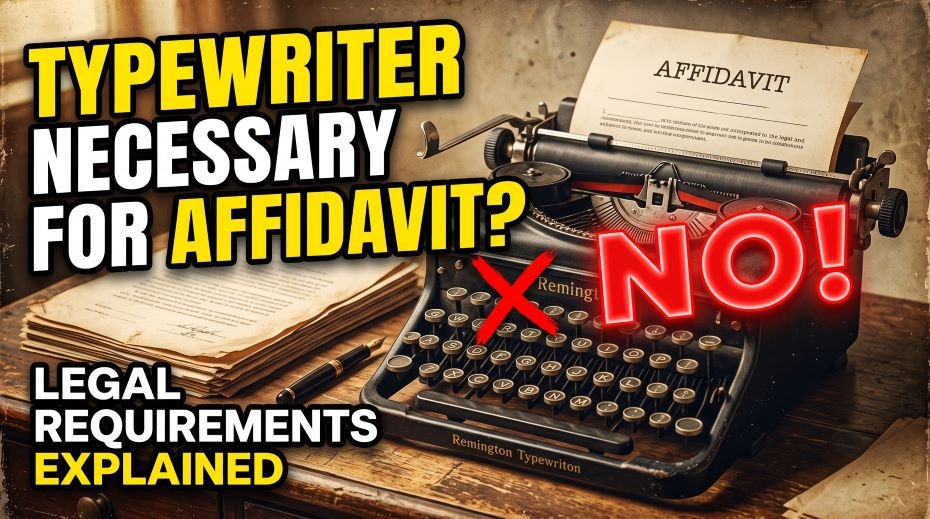
The Short Answer: No, a Typewriter Is Not Legally Required
There is no law, rule, or notification that requires an affidavit to be typed specifically on a mechanical typewriter rather than printed from a computer. Indian courts have directly addressed this question in various rulings, treating typewriter-typed and computer-printed documents as equally valid, provided the content, stamp paper, and attestation requirements are properly met. What matters legally is the content, the correct stamp paper value, and proper signing and attestation – not the specific machine used to put the words on paper.
Why You Still See Typewriters Outside Every Court
The persistence of the typewriter near Indian courts is a matter of tradition, convenience, and local infrastructure, not legal necessity. Several practical factors explain why they’ve stuck around.
- Court typists are often highly experienced at converting informal handwritten notes or vague instructions into the exact formal legal phrasing that gets accepted without objection.
- Typewriters don’t require electricity, making them reliable in areas with inconsistent power supply.
- Maintenance is cheap and the machines can last decades, making them a low-cost, dependable tool for typists who work purely on a per-document fee basis.
- For many people visiting court premises without easy computer or printer access nearby, a typewriter stall is simply the fastest, most familiar option available on the spot.
- Old habits and local court culture matter – many notaries and typists near smaller court complexes have used typewriters for decades and continue to, purely out of established practice.
What the Law Actually Requires
Rather than focusing on the machine, focus on what genuinely determines whether your affidavit is valid.
| Requirement | Why It Matters |
| Correct stamp paper value for your state | Determines whether stamp duty has been properly paid |
| Accurate, clearly stated content | The substance of the sworn declaration is what has legal weight |
| Your signature, made in person | Confirms you are the one making the sworn statement |
| Notary or magistrate’s seal, signature, and register entry | Confirms the affidavit was properly witnessed and attested |
| Legible, unaltered text | Prevents disputes about what was actually declared |
None of these requirements reference typewriters specifically. A neatly formatted, computer-printed affidavit satisfies every one of them just as well as a typewritten one, as long as it’s printed on the correct stamp paper and properly signed and attested.
Typewriter vs Computer-Printed: A Quick Comparison
| Factor | Typewriter | Computer-Printed |
| Legal validity | Valid | Equally valid |
| Availability | Common near court complexes specifically | Available anywhere with a printer, including most stationery/Xerox shops |
| Editing before finalising | Difficult; mistakes often mean starting over | Easy to edit and correct before printing |
| Typical cost | Roughly ₹10 to ₹50 per page from a court-area typist | Similar or slightly less at a standard print shop, depending on location |
| Speed | Fast for an experienced typist working from familiar formats | Fast if you already have the content typed and ready to print |
Can a Notary Refuse a Computer-Printed Affidavit?
- In practice, this is rare, since there’s no legal basis for such a refusal – but individual notaries or local offices occasionally have their own informal preferences or habits.
- If a specific notary insists on typewriter formatting for no clearly stated legal reason, it’s reasonable to ask for the specific rule they’re citing, or simply try a different notary nearby.
- Carrying a clean, correctly formatted, computer-printed draft on the correct stamp paper is normally accepted without any issue at the vast majority of notary offices.
also read: How to Make an Affidavit for Government Exam (Typing Docs)
When Handwriting Might Still Be Relevant
- In genuinely remote areas without easy access to a typist or printer, a neatly handwritten affidavit is sometimes accepted, provided it is fully legible and otherwise meets all content and attestation requirements.
- This is uncommon for government exam-related affidavits specifically, since most candidates have reasonable access to printing facilities, but it’s not automatically invalid purely because it’s handwritten rather than typed.
- If in doubt for your specific situation, a quick check with the notary or the recruiting body’s helpline resolves any uncertainty faster than guessing.
Do’s and Don’ts
| Situation | Do | Don’t |
| Choosing how to prepare it | Use whichever method (computer print or typewriter) is convenient and accessible to you | Don’t assume a typewriter is mandatory or search one out unnecessarily |
| Content accuracy | Proofread carefully before printing or having it typed | Don’t leave errors uncorrected assuming they don’t matter |
| If a notary objects | Politely ask for the specific rule being cited | Don’t assume the objection is automatically valid without checking |
| Stamp paper | Ensure the correct value regardless of typing method | Don’t focus on the typing method while overlooking the stamp paper requirement |
| Final document | Ensure it’s clean, legible, and properly signed | Don’t submit a messy or hard-to-read affidavit, typed or handwritten |
Quick Fact Table
| Question | Answer |
| Is a typewriter legally required for an affidavit? | No |
| Is a computer-printed affidavit valid? | Yes, equally valid |
| What actually makes an affidavit valid? | Correct stamp paper, accurate content, signature, and proper attestation |
| Why are typewriters still common near courts? | Tradition, reliability without electricity, and experienced local typists |
| Is handwriting ever accepted? | Sometimes, if legible and all other requirements are met, though uncommon for this purpose |
Table 1: Issues, Solutions & Where to Seek Help
Many aspirants worry that an affidavit must be typed on an old-fashioned mechanical typewriter to be “official,” picturing the classic typewritten legal documents from decades past. The reality is more flexible: what actually matters for legal validity is proper stamp paper, correct content, and notarization – not the machine used to produce the text. Below is a breakdown of common misconceptions and issues, practical guidance, and where to seek help, along with real examples from candidates.
| Issue / Misconception | Problem Faced | Solution / Tip | Where to Seek Help |
|---|---|---|---|
| Assuming a typewriter is mandatory for affidavits | Wastes time and money searching for a typewriter/typing shop unnecessarily | An affidavit can be handwritten, typed on a computer, or printed – a typewriter is not legally required | Not applicable (misconception clarified) |
| Handwritten affidavit submitted with illegible handwriting | Risk of rejection due to unclear text | If handwriting the affidavit, ensure it is fully legible; otherwise prefer computer-typed and printed format | Local typing/DTP shop near court/notary office |
| Believing computer-printed affidavits are “less official” than typewritten ones | Unnecessary anxiety about document acceptance | Courts and authorities focus on proper content, stamp paper, and notarization – not the printing method | Not applicable (misconception clarified) |
| Affidavit signature typed instead of handwritten | Document may be deemed invalid | The deponent’s signature must always be in their own handwriting, regardless of how the text itself was produced | Notary Public (for correct execution guidance) |
| Confusion about whether old-style typewriter shops near courts are still necessary | Unnecessary trips to specific typewriter vendors | Any standard printout on the correct stamp paper is generally accepted – typewriter shops persist mainly out of local habit, not legal requirement | Not applicable (self-clarification) |
| Affidavit content/format incorrect regardless of typing method | Rejected at document verification despite being neatly printed | Use the exact Annexure/format specified in your exam notification – content matters more than the typing method | Notary Public / Exam Conducting Body’s Grievance Portal |
| Uncertainty about digital/e-affidavits for exam purposes | Confusion about whether digital signing works for physical DV submission | For SSC/RRB DV, a physical notarized affidavit on stamp paper is generally expected – check your specific notification before relying on any digital alternative | Exam Conducting Body’s official notification |
Table 2: Real-Life Examples
| Candidate Situation | What Happened | Outcome / Lesson |
|---|---|---|
| Aspirant searched for hours for a “typewriter shop” near the court believing it was mandatory | Wasted a full day before realizing it wasn’t a legal requirement | Got the affidavit computer-typed and printed instead, notarized without any issue |
| Candidate handwrote their affidavit in a rush before DV | Notary flagged illegible portions, requiring a redo | Retyped it on a computer for clarity and got it re-notarized in time |
| Aspirant assumed a printed affidavit would be “less valid” than a typewritten one at DV | Delayed getting the affidavit prepared out of unnecessary worry | Learned that both handwritten and typed affidavits are legally valid as long as properly notarized |
| Candidate got the affidavit content wrong despite it being neatly typewritten | Rejected at document verification due to incorrect format, not typing style | Learned that following the exact notification format matters far more than the typing method |
| Aspirant typed their own signature digitally on the affidavit before printing | Notary rejected the document for missing an original handwritten signature | Signed the printed affidavit by hand in front of the notary as required |
Note: This is general informational content, not legal advice. Requirements can vary slightly by state and exam body – always confirm the exact stamp paper value, format, and submission method with a notary or your specific exam’s official notification.
Frequently Asked Questions
Will my affidavit be rejected during document verification if it’s computer-printed?
No. Recruiting bodies and verifying officers care about the affidavit’s content, correct stamp paper, and proper attestation – not whether it was typed on a typewriter or printed from a computer.
Why do lawyers near courts still use typewriters if it’s not required?
It’s largely about established practice, reliability without electricity dependence, and the speed of experienced typists working from familiar formats – not a legal requirement they’re following.
Is it cheaper to use a court typewriter typist or a computer print shop?
Costs are broadly similar and vary by location; neither option is meaningfully cheaper as a rule. Convenience and accessibility usually matter more than the small cost difference.
The typewriters outside Indian courts are a genuinely charming piece of living tradition, not a legal checkpoint you need to pass through. Whether your affidavit is typed on a decades-old machine or printed cleanly from a home computer, what actually matters is getting the content right, using the correct stamp paper, and having it properly signed and attested. Use whichever option is more convenient for you, and don’t let the sight of a typewriter stall convince you it’s the only accepted route.