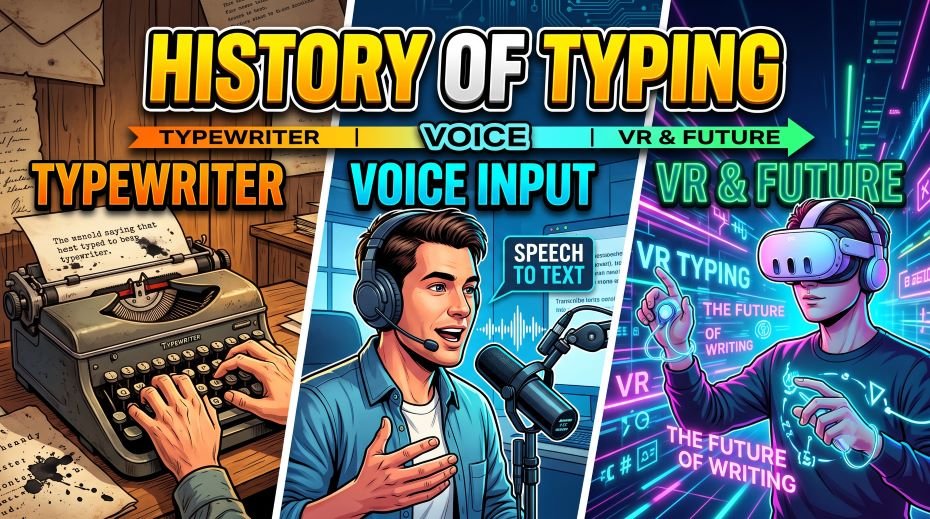
History of Typing from Typewriter to Voice and VR, The complete timeline of typing – from the first mechanical typewriter and QWERTY keyboard to touch typing, computers, and the future of voice and VR input so, Every time you place your fingers on a keyboard, you’re using a layout and a skill with a genuinely fascinating 150-year history – one that runs from a clunky mechanical writing machine to the touchscreen in your pocket, and is now heading toward voice commands and virtual reality. This is the complete timeline of how typing became what it is today, and where it’s headed next.
The Mechanical Beginning: 1860s–1870s
The story of modern typing begins with Christopher Latham Sholes, a Milwaukee newspaperman and part-time inventor, who patented an early typewriter design in 1868 alongside collaborators Carlos Glidden and Samuel Soule. Commercial production began in 1873, and the resulting Sholes & Glidden typewriter became the first commercially successful machine to use what would become the world’s most enduring keyboard layout.
Where QWERTY Actually Came From
The popular story is that Sholes deliberately arranged the QWERTY layout to slow typists down and prevent the mechanical typebars from jamming. This version of events is widely repeated, but historians studying the actual development process have raised doubts about it, pointing instead to influence from telegraph operators who needed certain letter combinations positioned for faster Morse code transcription. Whatever the exact reasoning, the layout stuck, and by 1874 the Remington Typewriter Company had licensed and mass-produced it, cementing QWERTY as the default for generations to come.
Early Competition: A Crowded Field of Machines
QWERTY didn’t dominate immediately or without competition. Several other typewriter designs and keyboard layouts fought for a place in the market during the late 1800s.
- The Hammond typewriter (1884) used its own two-row “Ideal” keyboard layout, offering a genuinely different typing experience from QWERTY machines.
- The Caligraph (1880) featured a “full” keyboard with entirely separate keys for uppercase and lowercase letters, unlike the shift-based QWERTY approach.
- The Smith Premier (1890) was another popular full-keyboard alternative of the era.
- Despite this competition, QWERTY’s early momentum and Remington’s manufacturing scale meant alternative layouts steadily lost ground, eventually becoming known simply as the “Universal” keyboard.
The Rise of Touch Typing
For years after the typewriter’s invention, typists still looked at the keys while typing. That changed with the popularisation of touch typing – typing without looking at the keyboard, using muscle memory tied to fixed finger positions. A widely cited public typing contest in 1888 demonstrated the dramatic speed and accuracy advantage of this method, helping popularise touch typing as the standard technique taught to professional typists from that point forward – the same fundamental skill still taught today.
Standardisation and the Electric Era
- Through the early-to-mid 1900s, mechanical typewriters became a fixture in offices, government departments, and homes worldwide, with QWERTY firmly established as the standard.
- Electric typewriters began appearing by the mid-20th century, reducing the physical effort needed to type and increasing achievable speed.
- IBM’s Selectric typewriter, introduced in 1961, replaced individual typebars with a single rotating “golf ball” type element, a major mechanical innovation that dominated office typing for decades.
- By the late 1970s and into the 1980s, electronic typewriters with impulse-based keys became the new standard, bridging the gap between pure mechanical machines and the coming computer era.
The Alternative That Almost Won: Dvorak
In 1936, August Dvorak and William Dealey patented the Dvorak keyboard layout, specifically designed to reduce finger travel and improve typing efficiency compared to QWERTY. Despite genuine ergonomic advantages demonstrated in various studies over the decades, Dvorak never displaced QWERTY, largely because the cost and effort of retraining an entire typing world outweighed the individual benefits for most users and institutions – a pattern that has repeated with nearly every alternative layout proposed since.
The Computer Keyboard Era
- Personal computers in the 1970s and 1980s carried the QWERTY layout forward largely unchanged, simply replacing mechanical typebars with electronic key switches sending signals to a screen instead of paper.
- Word processing software transformed how people thought about typing, introducing easy editing, formatting, and correction – capabilities entirely impossible on a mechanical typewriter.
- Keyboards gained new function keys, number pads, and eventually cursor and navigation keys, expanding well beyond the original typewriter key set while keeping the core alphabetic layout untouched.
also read: Is a Typewriter Necessary for an Affidavit? (Old Typewriter)
Mobile and Touchscreen Typing
- Early mobile devices in the 1990s, including some of the first handheld personal digital assistants, carried miniature QWERTY keypads, adapting the century-old layout to entirely new hardware.
- The 2000s brought smartphone keyboards, first physical and then increasingly touchscreen-based, along with predictive text and autocorrect systems that fundamentally changed how casual typing works.
- Swipe and gesture-based typing on touchscreens introduced an entirely new input method, letting users trace a path across letters instead of tapping each key individually.
The Mechanical Keyboard Revival
- Even as most computing moved to flat, low-travel keyboards, a dedicated community of enthusiasts and gamers drove a genuine resurgence of mechanical keyboards, valuing their tactile feedback and durability.
- This revival has coexisted with, rather than replaced, the flat membrane and laptop-style keyboards most people use daily, creating a genuinely diverse keyboard landscape today.
Where Typing Skill Stands Today
Despite over a century of technological change, the core skill of accurate, fast QWERTY typing remains directly relevant – it’s still the primary method for government exams, professional data entry roles, and the vast majority of everyday computer use worldwide. The layout that began as a solution to mechanical typebar jams in the 1870s remains, remarkably, the dominant way humans communicate with computers a century and a half later.
The Future: Voice, Gesture, and VR Typing
- Voice-to-text technology has matured significantly, with modern speech recognition systems achieving high accuracy for dictation, though physical typing remains faster and more precise for many structured or technical tasks.
- Virtual and augmented reality headsets are actively experimenting with new text input methods, including pressure-sensitive virtual keyboards and touch-typing-like experiences designed specifically for headset use, since a physical keyboard isn’t always practical in an immersive environment.
- Gesture and motion-based typing, using hand-tracking technology instead of physical keys, is an active area of research aimed at making text input more natural within VR and AR spaces.
- Early-stage brain-computer interface research is exploring direct neural input as a long-term future possibility, though this remains experimental and far from replacing keyboard typing in any practical, everyday sense.
- For the foreseeable future, physical keyboard typing remains the fastest and most reliable input method for structured, high-accuracy tasks – exactly the kind of skill tested in typing exams today.
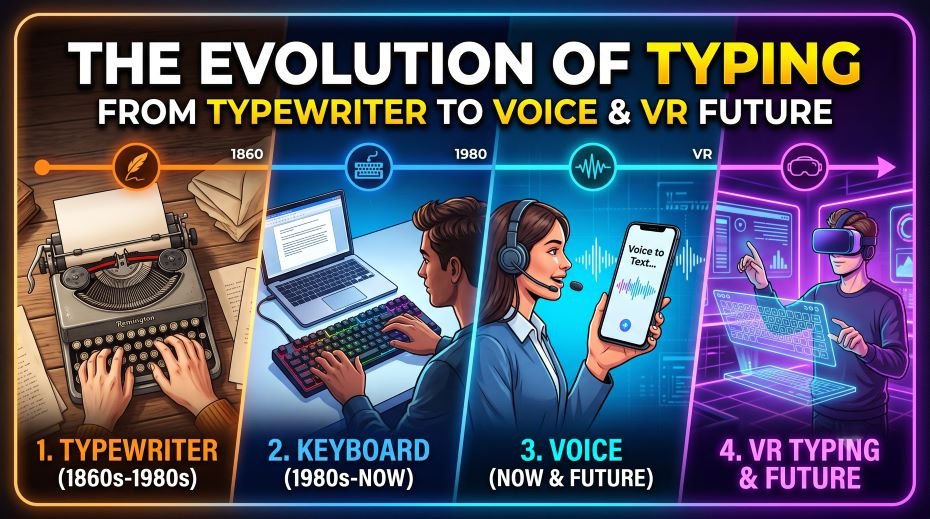
Complete Timeline at a Glance
| Period | Milestone |
| 1868 | Christopher Latham Sholes patents an early typewriter design |
| 1873 | Commercial production of the Sholes & Glidden typewriter begins, introducing QWERTY |
| 1874 | Remington licenses and mass-produces the QWERTY typewriter |
| 1888 | A public contest popularises touch typing as the standard technique |
| 1936 | The Dvorak keyboard layout is patented as an alternative to QWERTY |
| 1961 | IBM Selectric introduces the rotating “golf ball” typing element |
| 1970s–80s | Personal computers and word processors carry QWERTY into the digital era |
| 1990s | Handheld PDAs bring miniature QWERTY keypads to mobile devices |
| 2000s | Smartphone touchscreen keyboards, predictive text, and swipe typing emerge |
| 2010s–Present | Mechanical keyboard revival alongside continued dominance of flat digital keyboards |
| Emerging | Voice dictation, VR/AR gesture typing, and early brain-computer interface research |
Table 1: Era-by-Era Evolution of Typing
Typing has evolved dramatically over the past 150 years – from clunky mechanical typewriters that jammed if you typed too fast, to touchscreens, to voice assistants that skip the keyboard entirely, and now early experiments with typing in virtual reality. For today’s typing exam aspirants, it’s worth understanding this arc – not just as trivia, but as a reminder that keyboard-based typing skills, while still essential for government exams today, sit within a much longer and still-evolving story. Below is a timeline of key eras, followed by real-world examples from each stage of this evolution.
| Era / Technology | Key Development | Impact on Typing | What Changed Next |
|---|---|---|---|
| Mechanical Typewriters (1870s-1950s) | QWERTY keyboard layout introduced to reduce jamming of mechanical arms | Typing became a standardized, teachable skill; speed limited by mechanical key travel and manual carriage returns | Electric typewriters removed the need for manual force and carriage returns |
| Electric Typewriters (1950s-1980s) | Motorized key strikes, correction ribbons, and eventually memory (e.g., IBM Selectric) | Typing became faster and less physically tiring; minor corrections became easier | Word processors and early computers replaced mechanical typing entirely |
| Computer Keyboards & Word Processors (1980s-2000s) | Digital text entry, backspace/delete, spell-check, unlimited editing | Typing tests began measuring speed and accuracy digitally rather than on paper output | Rise of personal computers made typing a near-universal white-collar skill |
| Government Exam Digitization (2000s-2020s) | Shift from typewriter-based DEST to computer-based typing tests (SSC, RRB, etc.) | Typing exams became standardized nationally, scored digitally with precise accuracy tracking | AI-based monitoring and CBT (Computer-Based Test) formats became the norm |
| Touchscreens & Mobile Typing (2010s-present) | On-screen keyboards, autocorrect, swipe typing, predictive text | Typing became more casual and multi-modal, but formal exams still require physical keyboard proficiency | Voice input began challenging keyboard-first typing habits |
| Voice-to-Text / Speech Recognition (2010s-present, rapidly improving) | AI-driven transcription (e.g., voice assistants, dictation software) | Reduced need for manual typing in many everyday contexts | Growing discussion on whether typing tests should eventually incorporate or account for voice-based input |
| VR/AR Typing Interfaces (Experimental, 2020s-ongoing) | Virtual keyboards, gesture-based and eye-tracking text entry in VR/AR environments | Early-stage, mostly experimental – not yet practical for high-speed formal typing | Long-term potential to reshape how “typing skill” itself is defined and tested |
Table 2: Real-World Examples Across Eras
| Example | Era | Significance |
|---|---|---|
| Sholes and Glidden Typewriter (1873) | Mechanical Typewriter Era | First commercially successful typewriter; introduced the QWERTY layout still used today |
| IBM Selectric Typewriter (1961) | Electric Typewriter Era | Introduced the “golf ball” typing element, allowing faster, quieter, and more flexible typing |
| WordStar and early word processors (1980s) | Computer Keyboard Era | Among the first software tools to let users edit digital text before printing, transforming office typing |
| SSC/RRB shift to Computer-Based Typing Tests | Government Exam Digitization | Moved government typing exams from mechanical/electric typewriters to standardized digital tests with AI-based monitoring |
| Smartphone predictive text and swipe typing | Touchscreen Era | Changed everyday typing habits for younger generations, though formal exams still test traditional keyboard skills |
| Voice assistants like dictation-based transcription tools | Voice-to-Text Era | Demonstrated that spoken words can now be converted to accurate text in real time, raising questions about future typing test formats |
| Experimental VR typing interfaces (e.g., virtual keyboards in headsets) | VR/AR Era | Still largely experimental; shows the direction technology may take typing skills in future decades |
Note: Despite these advances, keyboard-based typing speed and accuracy remain the standard for Indian government exams today – so current aspirants should focus on mastering traditional typing skills for now, even as the broader technology landscape continues to evolve.
Frequently Asked Questions
Why hasn’t a better keyboard layout replaced QWERTY after 150 years?
The cost and effort of retraining users, manufacturers, and institutions worldwide has consistently outweighed the incremental efficiency gains of alternative layouts like Dvorak, even when those gains are genuinely measurable.
Will voice typing eventually replace keyboard typing?
For casual dictation, voice input has become genuinely capable, but structured, precise, and high-speed text entry – the kind needed in professional and exam settings – still favours physical keyboard typing, and is likely to for the foreseeable future.
Is touch typing still relevant with predictive text and autocorrect?
Yes, especially for structured, high-accuracy tasks like government typing exams and professional data entry, where predictive text isn’t available or reliable enough to depend on.
From a mechanical writing machine designed to avoid jammed typebars to a skill now being reimagined for voice assistants and virtual reality headsets, typing has proven remarkably durable as a core human-computer skill. The tools around it keep changing, but the fundamental ability to translate thought into accurate, fast text remains as valuable today as it was when Christopher Sholes patented his first typewriter design over 150 years ago.