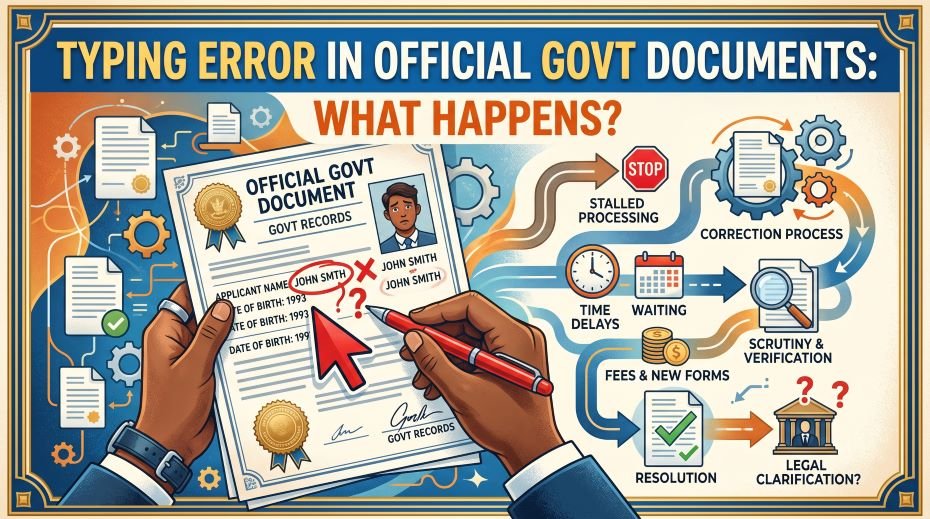
Typing Error in Official Govt Documents or What actually happens if a government employee makes a typing error in an official Hindi, English, or regional-language document? Real consequences and correction process so, Every government employee who types official documents for a living carries a quiet worry: what if I make a typing mistake in something official? The honest answer is reassuring in most cases and genuinely serious in a few – it depends heavily on what the document is, how the error is discovered, and whether it reflects a one-off slip or a pattern of carelessness. This guide walks through what actually happens, in Hindi, English, or any regional language document, and how the correction and disciplinary process genuinely works.
Not Every Typo Is Treated the Same Way
The single most important thing to understand is that Indian service law explicitly distinguishes between an honest mistake and genuine misconduct. Courts and tribunals reviewing disciplinary cases have repeatedly held that mere inefficiency or an isolated error does not by itself amount to misconduct – it has to involve negligence, culpable indifference, or a recurring pattern before it becomes a disciplinary issue rather than simply a mistake to be corrected.
- A single typo in an internal memo, easily caught and corrected, is treated very differently from a repeated pattern of careless errors.
- The nature of the document matters enormously – a typo in a routine internal note carries far less weight than an error in a legal order, a financial instrument, or a public notification.
- Whether the error was caught internally before causing harm, or only discovered after real consequences occurred, significantly affects how seriously it’s treated.
How the Correction Process Actually Works
Most official errors, once identified, are fixed through a formal, public correction process rather than quietly edited. Government notifications, gazette entries, and official orders are typically corrected through a published erratum or corrigendum – an official notice stating the specific correction, referencing the original document.
- A corrigendum is issued through the same official channel as the original document, clearly stating what was wrong and what the correct information is.
- For internal administrative documents, correction is often handled through a formal note or amendment attached to the file, rather than a public notice.
- For documents affecting an individual’s rights or records (like a certificate or an official order naming a specific person), the correction process usually requires a written request and, in some cases, supporting documentation before the correction is made.
also read: Top 10 Keyboards for Typing Exam Practice in 2026
When It’s a Minor, Honest Mistake
- If you catch your own error and report it immediately, this is generally viewed favourably and treated as routine correction, not misconduct.
- Being proactive and transparent about an error, rather than hoping it goes unnoticed, is one of the strongest protective factors when it comes to how seriously a mistake is treated.
- A first-time, low-impact error – especially one that’s quickly caught and corrected – typically results in nothing more than a verbal reminder or, at most, a written note for the file.
When It Becomes a Disciplinary Matter
Under the Central Civil Services (Conduct) Rules, 1964, government employees are expected to maintain devotion to duty and act with due diligence – meaning reasonable, systematic care in performing official work. A pattern of careless errors, or a single error causing significant harm, can be treated as a breach of these standards under the associated Central Civil Services (Classification, Control and Appeal) Rules, 1965, which govern how disciplinary action is actually conducted.
- Repeated errors despite prior warnings can be treated as a pattern of negligence rather than isolated mistakes.
- An error causing considerable financial loss, legal complication, or reputational harm to the department is treated far more seriously than a routine correction.
- Disciplinary consequences range from a minor penalty (such as a censure or withholding of an increment) to, in genuinely serious and repeated cases, more significant action – the severity is always proportionate to the actual harm and the presence (or absence) of genuine negligence.
Consequences by Severity: A Realistic Picture
| Type of Error | Typical Consequence |
| Minor typo, quickly self-corrected | No formal action; may not even be recorded |
| Minor typo caught by a supervisor, first occurrence | Verbal reminder or informal note |
| Recurring careless errors despite feedback | Written warning, formal note in service record |
| Error causing financial loss or legal complication | Formal inquiry, possible minor or major penalty under CCS (CCA) Rules |
| Deliberate falsification disguised as a “typo” | Treated as misconduct, not negligence – far more serious consequences |
Special Case: Bilingual Hindi–English Document Errors
India’s central government functions under the framework of the Official Languages Act, 1963, which requires many official documents to be issued in both Hindi and English. This creates a specific risk area: a translation mismatch between the two versions of the same document, where the Hindi and English texts say slightly different things due to a typing or translation error.
- Mismatches between the Hindi and English versions of the same official document are taken seriously, since either version can be treated as authoritative depending on the context and region.
- Departments handling bilingual documents typically have a dedicated translation and proofreading step precisely because this type of error is common and consequential.
- If you’re responsible for typing bilingual content, cross-checking both versions against each other, not just against the source material, is an extra but essential step.
- The same logic extends to regional-language documents in state government offices, where a translation or transliteration error between the regional language and Hindi or English can create similar ambiguity.
Real-World High-Stakes Examples
- A wrong date of birth or name spelling on an official certificate can create downstream problems for the citizen or employee it concerns, often requiring the affidavit-based correction process used during document verification.
- A wrong figure in a financial order or payment instruction can cause real monetary loss, which shifts the matter from a typing error to a negligence and accountability issue.
- An error in a legal order or notification can have consequences well beyond the department itself, sometimes requiring court-level correction rather than a simple administrative fix.
- Errors in land records or property-related documents are notoriously difficult to correct after the fact, which is why these departments often have the strictest internal verification processes.
How Departments Prevent This
- Dual-verification systems, where a second person checks critical documents before they’re issued, are standard practice for high-stakes paperwork.
- Draft-and-approve workflows, where a senior officer reviews and signs off before a document becomes official, catch most errors before they cause harm.
- Software-based spell-check and template systems reduce typing errors in routine, repetitive documents.
- Departments handling bilingual content often have dedicated translation review staff specifically to catch Hindi-English mismatches before publication.
What to Do If You Made the Error
- Report it to your supervisor as soon as you notice it, rather than waiting to see if it’s caught by someone else.
- Note the specific document, date, and nature of the error in writing, since a clear paper trail protects you if questions arise later.
- Follow your department’s specific correction process (corrigendum, amendment note, or formal request) rather than trying to informally fix it yourself.
- If the error already caused some impact, be transparent about that too – how you handle disclosure generally matters more to how the situation is judged than the original mistake itself.
Do’s and Don’ts
| Situation | Do | Don’t |
| Noticing your own error | Report it immediately to your supervisor | Don’t hope it goes unnoticed |
| High-stakes documents | Use dual-verification or draft-approval steps where available | Don’t finalise critical documents without a second check |
| Bilingual documents | Cross-check Hindi and English versions against each other | Don’t assume a correct source draft guarantees a correct translation |
| Recurring mistakes | Seek feedback and adjust your workflow proactively | Don’t dismiss repeated feedback as unimportant |
| After an error causes impact | Be transparent and cooperate with the correction process | Don’t attempt to informally hide or downplay a consequential error |
Quick Fact Table
| Fact | Detail |
| Governing conduct framework | Central Civil Services (Conduct) Rules, 1964 |
| Disciplinary process framework | Central Civil Services (Classification, Control and Appeal) Rules, 1965 |
| Legal standard for misconduct | Mere inefficiency isn’t misconduct unless due to negligence or culpable indifference |
| Standard correction method | Corrigendum/erratum issued through the same official channel as the original document |
| Bilingual document requirement | Governed by the Official Languages Act, 1963 for central government documents |
Table 1: Scenarios, Consequences & Where to Fix Them
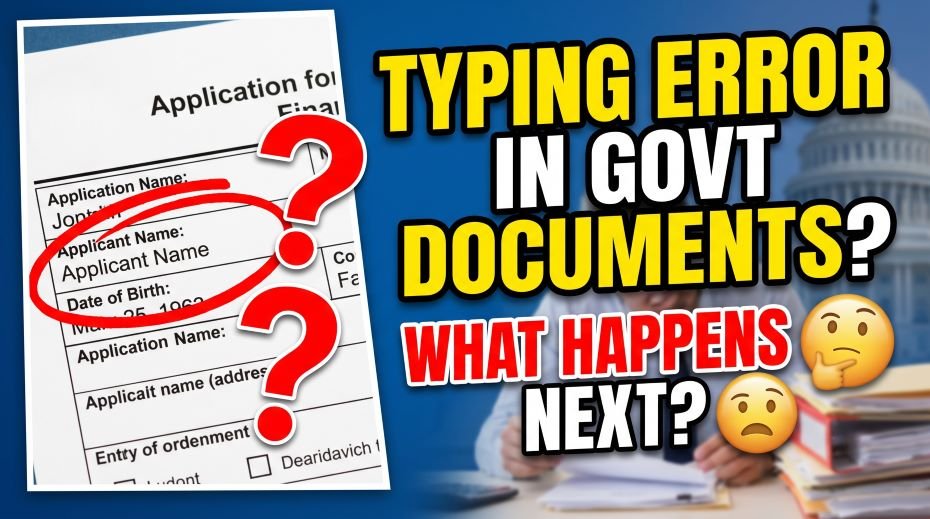
A typing error in an official government document – whether it’s your own certificate, an application form, or a document typed by a government clerk – can range from a minor inconvenience to a serious headache depending on where it appears and how it’s discovered. The good news is that Indian law provides clear correction pathways for most of these situations, from simple correction windows to formal Gazette notifications. Below is a breakdown of common typing-error scenarios, what happens next, and where to get them fixed, along with real examples.
| Error Scenario | What Happens | Solution / Correction Process | Where to Get It Fixed |
|---|---|---|---|
| Typo in your own exam application form (name, DOB, category) | Risk of mismatch flagged at document verification if uncorrected | Most exams offer a correction window shortly after form submission – use it before the deadline | Exam Conducting Body’s official correction portal |
| Spelling error in name across certificates (school, Aadhaar, PAN) | Identity verification failures, rejected job offers, delayed passport/visa processing | Prepare a notarized affidavit stating the correct spelling, then apply for Gazette notification for permanent legal correction | Notary Public → Gazette Department (Ministry of Housing and Urban Affairs) |
| Typing mistake in marksheet/certificate issued by a board | Can block government job verification, higher education admission, or passport processing if unaddressed | Apply directly to the issuing board/university with supporting documents and an affidavit for correction | Concerned Education Board/University |
| Wrong date entered in an official notification or government order | Confusion about applicability or effective dates | Minor corrections are typically issued via an official “errata” or corrigendum notice | Issuing Government Department |
| Significant/substantive error in a government contract or agreement | Can lead to real disputes about obligations, terms, or figures | May require a rectification deed (with mutual agreement) or, if disputed, court intervention under the Specific Relief Act | Legal counsel / concerned Sub-Registrar or court |
| Government employee (typist/clerk) makes a factual/data entry error in an official record | Can affect the citizen relying on that record (e.g., wrong figures, misspelled names in certificates) | The affected citizen typically must apply for correction through the issuing department with proof of the correct information | Issuing Government Department / Grievance Portal |
| Handwritten corrections made informally on an official document | Not considered legally valid, can create further complications | Never cross out and re-sign; always follow the formal correction procedure (affidavit/rectification deed) for the specific document type | Relevant issuing authority (varies by document) |
| Uncorrected error discovered years later, just before a major process (e.g., passport renewal, job verification) | Sudden delays or rejections during a time-sensitive process | Address name/spelling mismatches proactively rather than waiting – correction processes can take weeks to months | Notary Public / Gazette Department / Issuing Authority |
Table 2: Real-Life Examples
| Situation | What Happened | Outcome / Lesson |
|---|---|---|
| Aspirant’s father’s name was typed as “Rajender” on the school certificate but “Rajendra” on Aadhaar | Faced issues during passport verification due to the mismatch | Filed an affidavit and published a Gazette notification; all documents were updated smoothly afterward |
| Graduate’s name appeared as “Rahul Kumar S” on his Class 10 certificate but just “Rahul Kumar” on Aadhaar and PAN | Lost a job offer when background verification failed due to the discrepancy | Learned that even minor initial-related mismatches can derail employment verification if left uncorrected |
| Candidate noticed a typo in their SSC/RRB application form after submission | Initially worried the error couldn’t be fixed | Used the official correction window provided after the application closing date to fix it in time |
| GDS aspirant made a typing mistake while filling their application form | Risked negative impact on candidature if left unaddressed | Used the correction portal opened by the department post-application to rectify the error |
| Citizen’s birth certificate had a spelling mistake in their name from decades ago | Delayed a property transaction requiring consistent identity documents | Applied to the local municipal/registrar office with supporting documents to get it corrected |
| Businessman’s PAN card showed his full name with initials while his bank account showed a different format | Loan application was rejected due to the mismatch | Went through the name correction and Gazette process to align all financial documents |
Note: This is general informational content, not legal advice. Correction processes vary by document type and issuing authority – always confirm the exact procedure and required documents with the concerned department, board, or a legal professional.
Frequently Asked Questions
Can a single typo get a government employee fired?
Almost never on its own. A single, honestly disclosed, low-impact error is treated as a routine correction matter. Serious consequences generally require either a pattern of negligence or a single error causing substantial, demonstrable harm.
Who is responsible for catching bilingual translation errors?
Typically both the drafting official and a dedicated review or translation step, depending on the department’s internal process. Ultimate responsibility can still fall on whoever finalised and issued the document, which is why cross-checking both language versions matters.
What if a citizen is affected by an error in their certificate or document?
The department is generally expected to issue a correction through the appropriate formal process (often involving an affidavit from the affected person, similar to standard document correction procedures) rather than leaving the error unaddressed.
A typing error in an official document is rarely the career-ending event it can feel like in the moment – what actually matters is the document’s stakes, whether it reflects a pattern or a one-off slip, and how honestly and quickly it’s addressed. Build the habit of double-checking high-stakes and bilingual documents specifically, report errors the moment you notice them, and trust that the system is generally designed to distinguish an honest mistake from genuine negligence.